



The clutch consists of a pressure plate, a driven clutch plate and a clutch release bearing.
The pressure plate is rigidly connected to the flywheel, which is flanged to the engine crankshaft. Between the pressure plate and the flywheel is the driven clutch disc, which is pressed by the pressure plate to the flywheel. The driven disc is centered on the splines of the drive shaft of the gearbox.
When pressing the clutch pedal (disengaging the clutch) due to the hydraulic drive and the clutch release lever, the clutch release bearing is pressed against the diaphragm spring of the pressure plate and moves it slightly away from the flywheel. Due to this, the driven clutch plate moves away from the flywheel, and the power engagement between the engine and the gearbox is broken.
All models of cars have a hydraulic clutch drive. The hydraulic system uses brake fluid supplied from a common brake fluid expansion tank.
Each time the clutch is engaged and disengaged, minor wear of the friction linings of the driven disk occurs. Thus, the driven disk is a wearing part: nevertheless, its average service life exceeds 100,000 kilometers. Wear depends mainly on the load (for example, operating a vehicle with a trailer) and driving style. The clutch does not require maintenance, as it is adjusted automatically.
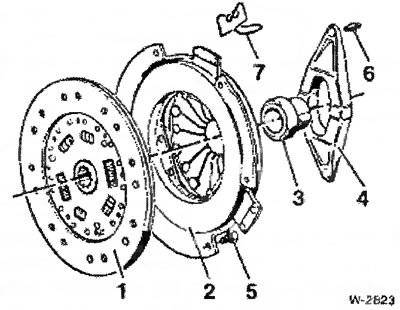
1 - driven clutch disc
2 - pressure plate
3 - clutch release bearing
4 - clutch release lever
5 - Hexagon head bolt
6 - ball head pin
7 - spring clip