
The generator is driven by the crankshaft using a poly-V belt. The rotor with the excitation winding rotates inside the stationary stator windings.
The excitation current flows through the excitation winding via carbon brushes and slip rings, creating a magnetic field.
The position of the magnetic field relative to the stator windings constantly changes as the rotor rotates. This causes alternating current to arise in the stator windings.
Since the battery can only be charged with direct current, the alternating current is converted to direct current using a rectifier consisting of diodes. The voltage regulator changes the charging current by switching the excitation current on and off in accordance with the battery's state of charge. At the same time, the regulator maintains the operating voltage constant at about 14 V, regardless of the engine speed.
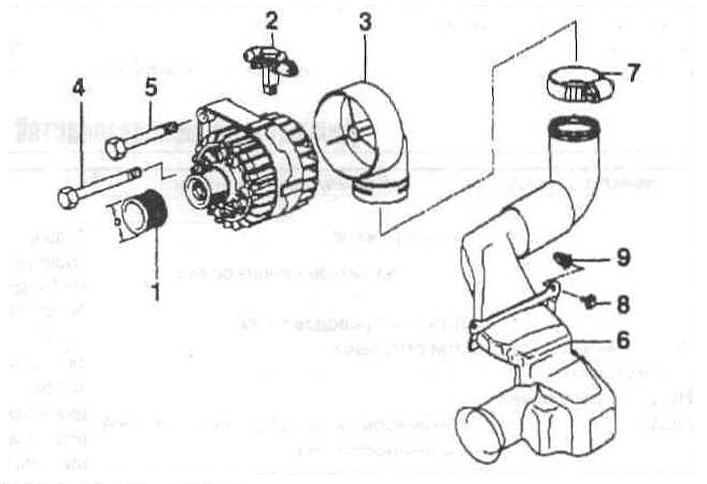
Generator mounting elements
1 - pulley;
2 - voltage regulator;
3 — air supply nipple;
4 - Hexagon head bolt;
5 - Hexagon head bolt with washer;
6 - air duct;
7 — clamp;
8 - self-tapping screw;
9 - tin nut.
Precautions when working with an alternator
Do not confuse the voltage regulator and alternator wires. Mark the wires with tape before disconnecting.
Do not disconnect the wires from the battery or voltage regulator while the engine is running.
Do not remove the generator while the battery is connected.
When carrying out welding work, be sure to disconnect the battery.