
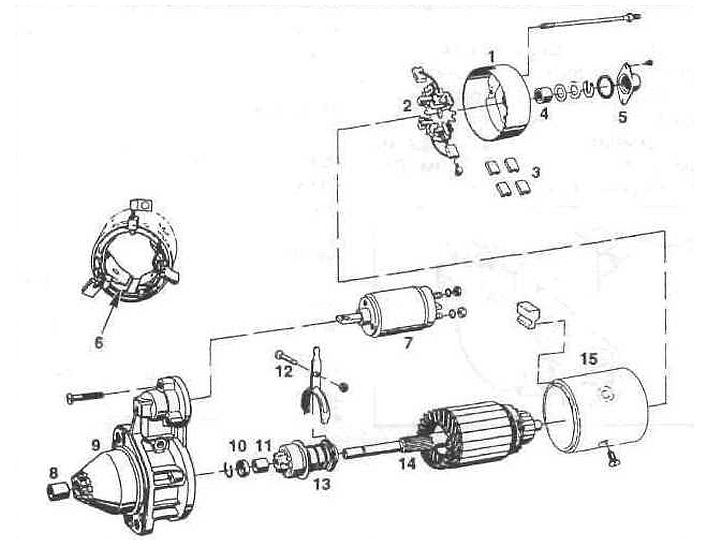
Bosch starter components
1 — collector body;
2 - brush holder;
3 - set of carbon brushes;
4 - metal-ceramic bushing;
5 - cap;
6 - excitation winding;
7 - traction relay;
8 - metal-ceramic bushing;
9 — drive housing;
10 — thrust ring;
11 - metal-ceramic bushing;
12 — drive fork;
13 — gear;
14 - anchor;
15 — pole housing.
To start an internal combustion engine, a small electric motor is needed - a starter. In order for the engine to start, the starter must spin it up to at least 300 rpm. This only happens when the starter works normally and the battery is sufficiently charged.
The starter consists of a drive housing, a pole housing, and a collector housing. The pole and collector housings contain the anchor and collector, as well as the brush holder. The brush holder contains carbon brushes, which wear out slowly but constantly. If the brushes are heavily worn, the starter will not be able to work well.
The drive pinion is located in the front housing of the drive. When the ignition switch voltage is applied to the starter, the drive pinion moves along the grooves of the axle with the help of the traction relay, which is located on the starter housing, and is pressed against the toothed ring of the engine flywheel. As soon as the pinion reaches the stop along the axle, it is rigidly connected to the flywheel. Now the starter can turn the engine at the required number of revolutions. When the engine starts, the pinion is accelerated by the engine, i.e. it moves faster than the starter for a short time and disengages, breaking the connection of the starter with the engine.
Since a large current is required for starting, the quality of the wire connections must be checked as part of the maintenance. Clean corroded connections and lubricate with protective grease.
Note: For replacement, you can use not only a new starter, but also one reconditioned in a workshop.
The website served as the basis for the text: BMWMan