
Table of contents: Petrol engines ↓ Diesel engine ↓
- Home
- BMW 7 Series
- E32
- Power unit
- Exhaust system
- Catalyst operation
Catalyst operation (BMW 7 Series E32)
All engines are equipped with a catalytic converter to clean exhaust gases.
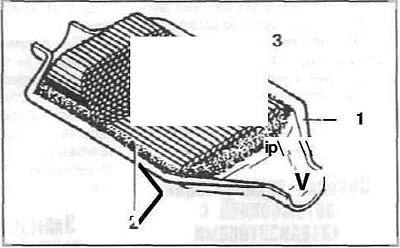
The catalyst consists of a ceramic body with cells that are covered with a layer. On the active (working) layer are salts of noble metals that facilitate the conversion process. In the body (1), the catalyst is fixed with insulating protective mats (2), which, among other things, compensate for thermal expansion.
Thanks to the electronic fuel injection system and the lambda probe, the amount of fuel for combustion in the cylinders is precisely dosed so that the catalytic converter can effectively reduce the concentration of harmful substances. The lambda probe is located in the exhaust pipe in front of the catalytic converter and is flowed around by the exhaust gas flow. The lambda probe is an electrical sensor that measures the concentration of oxygen in the exhaust gases and provides this information in the form of voltage fluctuations, providing feedback on the correction of the fuel-air mixture. In a fraction of a second, the lambda probe transmits a corresponding signal to the fuel injection system control unit, and thanks to this, the air-fuel ratio is constantly changing. On the one hand, this is necessary, since the operating conditions of the engine are constantly changing (idle, full load), on the other hand, optimal afterburning in the catalytic converter only occurs when there is still a sufficient amount of gasoline in the exhaust gases.
In order for afterburning to occur at all in the catalytic converter at temperatures from 300 to 800°C, there must be more fuel in the fuel-air mixture than is needed for "clean" combustion.
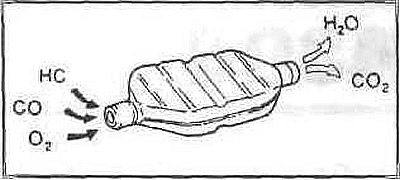
The catalyst used is a so-called three-stage catalyst. This means that with such a catalyst, thanks to lambda regulation, the oxidation of carbon monoxide (CO) and hydrocarbons (HC or CH) occurs simultaneously, as well as a reduction in the concentration of nitrogen oxides (NOx).
The diesel engine also has a catalytic converter as standard. In the case of diesel, it is not possible to adjust the composition. However, the catalytic converter reduces the concentration of toxic carbon monoxide and hydrocarbons to a level that is much lower than in petrol engines with a regulated catalytic converter. In addition, the characteristic noise from diesel operation is reduced. The higher concentration of nitrogen oxides in the exhaust gases of the diesel is maintained at a low level by an additional exhaust gas recirculation system.
The catalyst consists of a ceramic body with cells that are covered with a layer. On the active (working) layer are salts of noble metals that facilitate the conversion process. In the body (1), the catalyst is fixed with insulating protective mats (2), which, among other things, compensate for thermal expansion.
Petrol engines
Thanks to the electronic fuel injection system and the lambda probe, the amount of fuel for combustion in the cylinders is precisely dosed so that the catalytic converter can effectively reduce the concentration of harmful substances. The lambda probe is located in the exhaust pipe in front of the catalytic converter and is flowed around by the exhaust gas flow. The lambda probe is an electrical sensor that measures the concentration of oxygen in the exhaust gases and provides this information in the form of voltage fluctuations, providing feedback on the correction of the fuel-air mixture. In a fraction of a second, the lambda probe transmits a corresponding signal to the fuel injection system control unit, and thanks to this, the air-fuel ratio is constantly changing. On the one hand, this is necessary, since the operating conditions of the engine are constantly changing (idle, full load), on the other hand, optimal afterburning in the catalytic converter only occurs when there is still a sufficient amount of gasoline in the exhaust gases.
In order for afterburning to occur at all in the catalytic converter at temperatures from 300 to 800°C, there must be more fuel in the fuel-air mixture than is needed for "clean" combustion.
The catalyst used is a so-called three-stage catalyst. This means that with such a catalyst, thanks to lambda regulation, the oxidation of carbon monoxide (CO) and hydrocarbons (HC or CH) occurs simultaneously, as well as a reduction in the concentration of nitrogen oxides (NOx).
Diesel engine
The diesel engine also has a catalytic converter as standard. In the case of diesel, it is not possible to adjust the composition. However, the catalytic converter reduces the concentration of toxic carbon monoxide and hydrocarbons to a level that is much lower than in petrol engines with a regulated catalytic converter. In addition, the characteristic noise from diesel operation is reduced. The higher concentration of nitrogen oxides in the exhaust gases of the diesel is maintained at a low level by an additional exhaust gas recirculation system.
This article is available at russian, bulgarian, belarusian, ukrainian, serbian, croatian, romanian, polish, slovak, hungarian
Article verified: Sevastyanov Nikolay
Share information:
Previous articles
БМВ E32: Exhaust system
Next articles
Similar articles on other types of BMW cars:
The principle of operation of the fuel injection system BMW 3 Series E21 (1975-1983)
Safe Operation Precautions for Alternating Current Generators BMW 3 Series E36 (1990-2000)
Description of the controller operation BMW 5 Series E12 (1972-1981)
Checking the lambda probe operation BMW 5 Series E34 (1988-1996)
Table of causes of malfunctions in vehicle operation BMW X3 E83 (2003-2010)
Features of winter operation of a diesel engine BMW X5 E53 (1999-2006)
The principle of operation of the fuel injection system BMW 3 Series E21 (1975-1983)
Safe Operation Precautions for Alternating Current Generators BMW 3 Series E36 (1990-2000)
Description of the controller operation BMW 5 Series E12 (1972-1981)
Checking the lambda probe operation BMW 5 Series E34 (1988-1996)
Table of causes of malfunctions in vehicle operation BMW X3 E83 (2003-2010)
Features of winter operation of a diesel engine BMW X5 E53 (1999-2006)
Link in different formats to this page
Visitor comments
No comments yet
- General information
- Introduction to guide
- Manual
- Maintenance
- Power unit
- Engine M60/1, M60/2 (petrol)
- M62 engine (petrol)
- M57 engine (diesel)
- M67 engine (diesel)
- Cooling system
- Fuel system (petrol)
- Fuel system (diesel)
- Exhaust system
- Ignition and control systems
- Charge and launch systems
- Transmission
- Clutch
- Mechanical gearbox
- Automatic gearbox
- Cardan and drive shafts
- Chassis
- Brake system
- Front suspension
- Rear suspension
- Steering
- Body
- Exterior
- Interior
- Electrical equipment
- Equipment and devices
- Lighting
- Heating and air conditioning
- Electrical circuits
- General information
- Care and maintenance
- Power unit
- Minor engine repair
- Engine overhaul
- Lubrication system
- Cooling system
- Ignition system
- Supply system
- Injection system (petrol)
- Injection system (diesel)
- Exhaust system
- Transmission
- Clutch
- Manual gearbox
- Automatic gearbox
- Cardan gear
- Rear axle and shafts
- Chassis
- Front suspension
- Rear suspension
- Steering
- Wheels and tires
- Brake system
- Body
- Body elements
- Electrical equipment
- Equipment and devices
- Electrical circuits