
The following signs indicate a faulty shock absorber:
- Additional vibrations of the body when driving on uneven roads.
- Increase in the amplitude of body vibrations with successive road irregularities.
- Wheels bounce when driving on a normal road.
- Unintentional skidding of a car when braking may be a consequence of other reasons.
- Instability when turning due to poor track holding and vehicle skidding.
- Increased tire wear with tread cutting (washing out) protector.
- A rumbling noise is also a sign of faulty shock absorbers. This noise can also be caused by other reasons, such as loosening of mounting bolts and nuts, failure of wheel bearings and constant velocity joints. Therefore, always check the condition of the shock absorbers before replacing them.
The shock absorber can be checked manually. However, an accurate check of the shock absorber operation is only possible with a shock tester or a special testing machine.
Manual check
1. Remove the shock absorber.
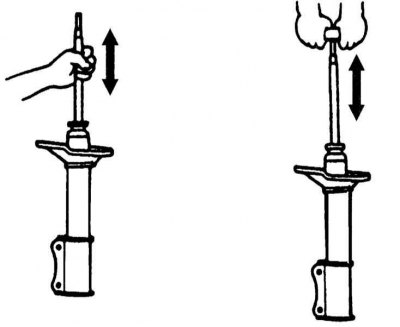
2. Set the shock absorber to the working position, extend and compress it. Throughout the entire stroke, the shock absorber should move smoothly and evenly.
3. In gas-filled shock absorbers, the piston rod returns to its original position automatically when there is sufficient gas pressure. If the piston rod does not return, this does not mean that the shock absorber must be replaced. Its operating principle corresponds to that of a conventional shock absorber as long as there is no significant oil leakage. The damping effect of the shock absorber is also maintained in the absence of gas pressure. However, its noise characteristics deteriorate.
4. If the shock absorber is functioning normally, minor traces of leaked oil are not grounds for replacing it. The basic rule here is the following: if the oil coming out of the rod seal is visible, but it does not extend beyond the lower spring plate, then the shock absorber is in good condition. Minor oil leaks even have some advantage, since they lubricate the seal, which helps to increase its service life.
5. If there are significant oil leaks, the shock absorber must be replaced.
You can read the original on the website «bmwman.ru»