
Table of contents: Manual check ↓ Shock absorber disposal ↓
- Home
- BMW 5 Series
- E39
- Transmission
- Front axle
- Checking/disposal of shock absorber
Checking/disposal of shock absorber (BMW 5 Series E39)
A defective shock absorber is indicated by the presence of the following violations of the dynamic properties of the vehicle.
The shock absorber can be checked manually. However, an accurate check of the ability of the shock absorber installed on the car to withstand the load is possible only with the help of a diagnostic device, and of the shock absorber removed from the car - on a stand for checking shock absorbers.
Remove the shock absorber.
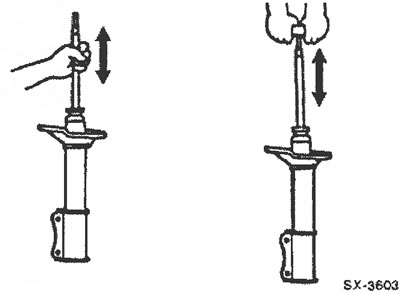
Holding the shock absorber in the mounting position, stretch it at least three times, and then compress it. During the entire stroke, the piston rod of the shock absorber should move evenly, heavily and without jolts. In addition, any unusual noises should be absent.
Retract the piston rod completely and then release it. The rod should extend again at a uniform speed.
Minor traces of oil on the shock absorber, if it is working perfectly, are not grounds for replacing the shock absorber.
If there is significant oil loss, the shock absorber should be replaced.
Install the shock absorber.
In order to recycle a defective shock absorber, it is necessary to drain the oil from it and hand it over to a special waste collection point. The empty shock absorber can then be handed over as regular scrap metal.
Before disposing of the shock absorber, the oil is removed from it as follows.
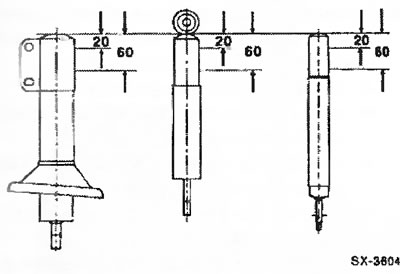
Clamp the removed shock absorber in a vice vertically with the piston rod facing down.
At a distance of approximately 20 mm from the base of the pipe, drill a hole of 3 mm diameter in the outer wall to release the gas. The gas released is colorless, odorless and non-toxic.
At a distance of approximately 80 mm from the base of the pipe, drill a second hole with a diameter of 5 mm to drain the oil.
Hold the shock absorber over the container and by repeatedly moving the piston rod in both directions at full stroke, squeeze the oil out of the shock absorber.
- Long-term vibration of the body due to uneven road surfaces.
- The body sways when the road unevenness follows one after another.
- Wheels bounce even on a flat road.
- Car jerking when braking (may also have other reasons).
- Danger when turning due to insufficient longitudinal stability, skidding of the vehicle.
- Rattling noises while driving.
- Uneven wear of the tire tread.
The shock absorber can be checked manually. However, an accurate check of the ability of the shock absorber installed on the car to withstand the load is possible only with the help of a diagnostic device, and of the shock absorber removed from the car - on a stand for checking shock absorbers.
Manual check
Remove the shock absorber.
Holding the shock absorber in the mounting position, stretch it at least three times, and then compress it. During the entire stroke, the piston rod of the shock absorber should move evenly, heavily and without jolts. In addition, any unusual noises should be absent.
Retract the piston rod completely and then release it. The rod should extend again at a uniform speed.
Minor traces of oil on the shock absorber, if it is working perfectly, are not grounds for replacing the shock absorber.
If there is significant oil loss, the shock absorber should be replaced.
Install the shock absorber.
Shock absorber disposal
In order to recycle a defective shock absorber, it is necessary to drain the oil from it and hand it over to a special waste collection point. The empty shock absorber can then be handed over as regular scrap metal.
Before disposing of the shock absorber, the oil is removed from it as follows.
Clamp the removed shock absorber in a vice vertically with the piston rod facing down.
At a distance of approximately 20 mm from the base of the pipe, drill a hole of 3 mm diameter in the outer wall to release the gas. The gas released is colorless, odorless and non-toxic.
At a distance of approximately 80 mm from the base of the pipe, drill a second hole with a diameter of 5 mm to drain the oil.
Hold the shock absorber over the container and by repeatedly moving the piston rod in both directions at full stroke, squeeze the oil out of the shock absorber.
Caution: The oil in the shock absorber must never be simply drained onto the ground or thrown away with ordinary household waste. The oil from the shock absorber is mineral and must be taken to a collection point for used motor oils.
This article is available at russian, bulgarian, belarusian, ukrainian, serbian, croatian, romanian, polish, slovak, hungarian
Article verified: Ilyinsky Matvey
Share information:
Previous articles
БМВ E39: Front axle
Next articles
Similar articles on other types of BMW cars:
Checking the shock absorber BMW 3 Series E30 (1982-1994)
Checking the shock absorber BMW 3 Series E36 (1990-2000)
Shock absorber — inspection/disposal BMW 7 Series E32 (1986-1994)
Gas-filled hood shock absorber BMW X3 E83 (2003-2010)
Replacing the rear shock absorber BMW X5 E53 (1999-2006)
Checking the shock absorber BMW 3 Series E30 (1982-1994)
Checking the shock absorber BMW 3 Series E36 (1990-2000)
Shock absorber — inspection/disposal BMW 7 Series E32 (1986-1994)
Gas-filled hood shock absorber BMW X3 E83 (2003-2010)
Replacing the rear shock absorber BMW X5 E53 (1999-2006)
Link in different formats to this page
Visitor comments
No comments yet
- General information
- Governing bodies
- Manual
- Maintenance
- Power unit
- Engine repair
- Lubrication system
- Cooling system
- Ignition system
- Supply system
- Injection system (gasoline)
- Injection system (diesel)
- Exhaust system
- Transmission
- Clutch
- Car gearbox
- Front axle
- Rear axle
- Chassis
- Steering
- Brake system
- Wheels and tires
- Body
- Interior
- Exterior
- Heating system
- Electrical equipment
- Equipment and devices
- Power devices
- Windscreen wipers
- Electrical circuits
- General information
- Manual
- Maintenance
- Power unit
- Engine repair
- Ignition system
- Engine lubrication system
- Cooling system
- Fuel system (gasoline)
- Fuel system (diesel)
- Exhaust system
- Transmission
- Clutch
- Car gearbox
- Chassis
- Front and rear suspension
- Steering
- Brake system
- Body
- Exterior
- Interior
- Electrical equipment
- Heating system
- Equipment and devices
- Power devices
- Electrical circuits
- General information
- Manual
- Maintenance
- Power unit
- Engine in a car
- Engine overhaul
- Cooling system
- Supply system
- Ignition system
- Control system
- Transmission
- Clutch
- Manual gearbox
- Automatic gearbox
- Transmission line
- Chassis
- Steering
- Front suspension
- Rear suspension
- Brake system
- Body
- Body elements
- Car care and painting
- Electrical equipment
- Heater and air conditioner
- Equipment and devices
- Starter and generator
- Electrical circuits
- General information
- Operation and maintenance
- Specifications
- Power unit
- Engine repair
- Cooling and lubrication system
- Supply system
- Ecotronic power supply system
- Fuel injection system
- Ignition system
- Transmission
- Clutch
- Gearbox BMW 242/4
- Gearbox Getrag 262/8
- Gearbox Getrag 265/6
- Automatic gearbox
- Cardan gear
- Rear axle
- Chassis
- Steering
- Front suspension
- Rear suspension
- Brake system
- Electrical equipment
- Equipment and devices
- Electrical circuits