
- Long-term rocking of the body when driving over uneven surfaces.
- The body sways when driving over uneven surfaces one after another.
- Wheels bouncing on a flat road.
- "Yawing" of the car when braking (may have other reasons).
- Uncertain cornering due to insufficient stability, vehicle skidding.
- Rumbling sounds in motion.
- Uneven wear of tires with worn areas on the tread.
The shock absorber can be checked manually. However, an accurate check of the shock absorber is only possible on a test stand or using special diagnostic equipment.
Manual check
While holding the shock absorber in the installation position, stretch and compress it at least three times. In this case, the shock absorber should move along the entire path with uniform force and smoothly, in addition, there should be no unusual noise.
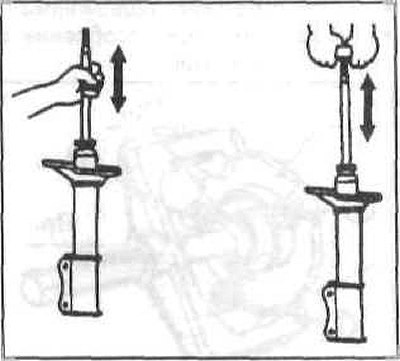
Push the piston rod all the way in and then release it. It should come back out again at a steady speed.
During normal operation, small traces of shock absorber oil are not a reason to replace it.
If there is a large loss of oil, replace the shock absorber. Install the shock absorber.