
The beam is screwed to the load-bearing body and connected via silent blocks to the transverse levers. The shock absorber struts rest on the transverse levers via ball joints, which allows them to move in the transverse direction.
The longitudinal movement of the shock absorber struts is limited by thrust rods, which are attached to the shock absorber struts via ball joints.
The shock absorbers rest against the wheel well dome through the bearing.
The right and left suspensions are elastically connected to each other via a stabilizer. The stabilizer is fixed to the body via rubber bushings.
The shock absorber strut consists of a tube with a steering knuckle and a spring system, a shock absorber cartridge, a spring with an upper cup and a bearing.
The steering knuckle carries a hub with a bearing. "Floating" brake calipers are mounted on shock absorber struts. The steering gear is screwed to the beam. The steering rod consists of three parts and is attached to the beam on two supports.
The described suspension can be removed either entirely or in parts.
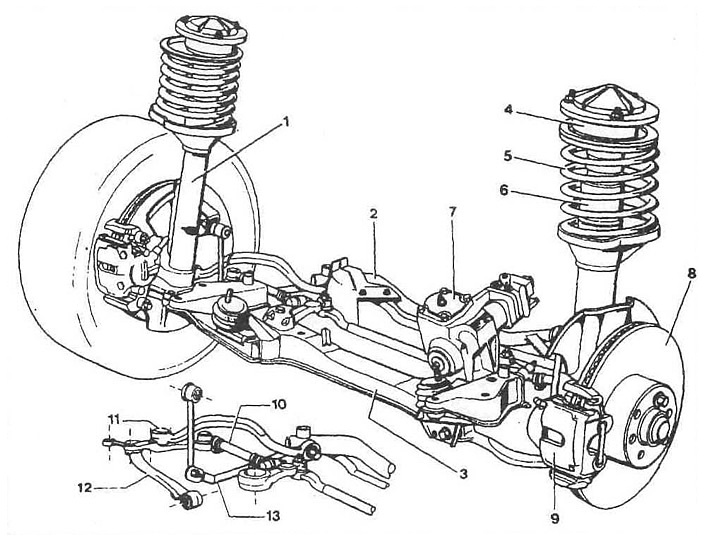
Front suspension elements
1 - shock absorber strut;
2 - cross beam;
3 — front axle beam;
4 - thrust bearing;
5 - coil spring;
6 — shock absorber;
7 — steering gear reducer;
8 — brake disc;
9 — brake caliper;
10 — steering rod;
11 - stretching;
12 — transverse lever;
13 — stabilizer.
Electronic Suspension Control (EDC)
The optional Electronic Suspension Control (EDC) system adjusts damper stiffness virtually without delay to changing road surfaces and driving style.
The sensors constantly monitor the vehicle speed, vertical acceleration of the body, pressure in the brake system, load, steering angle and position of the gas pedal. Based on their data, the computer determines the appropriate control commands to the shock absorbers, the force of which can be adjusted by electromagnetic valves as "hard", "medium" and "soft".
[The website served as the basis for the text bmwman.ru]