
Signs of damage to shock absorbers are:
- large amplitude of body vibrations;
- increase in the amplitude of body vibrations when driving on an uneven road;
- car body bounces when driving on a flat road;
- car turning when braking as one of the reasons;
- poor track holding and car skidding when turning;
- extraneous noise, knocking when moving;
- increased tire wear.
The design of the shock absorber strut and its support is shown in Fig. 13.28, Fig. 13.39 and Fig. 13.40. The shock absorber strut must be removed in the following order.
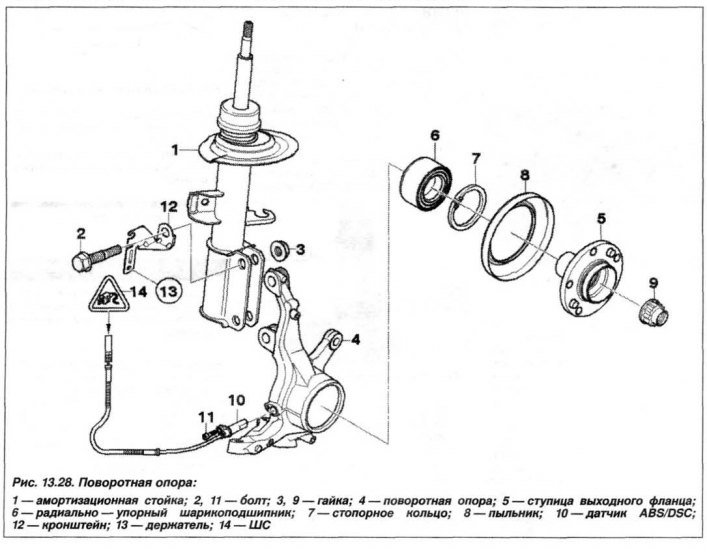
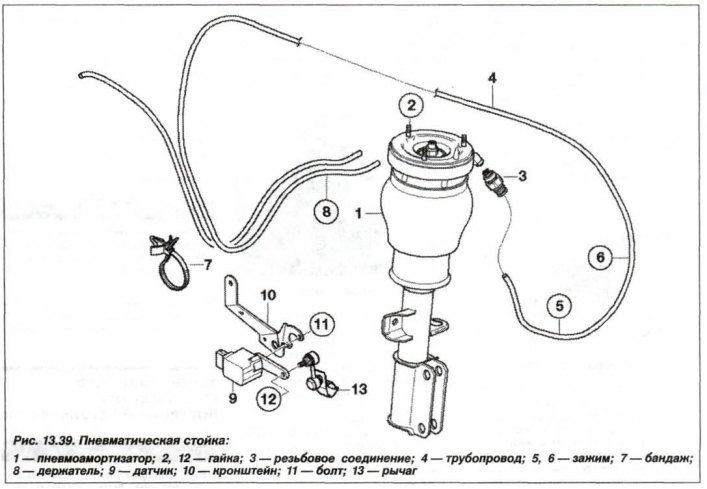
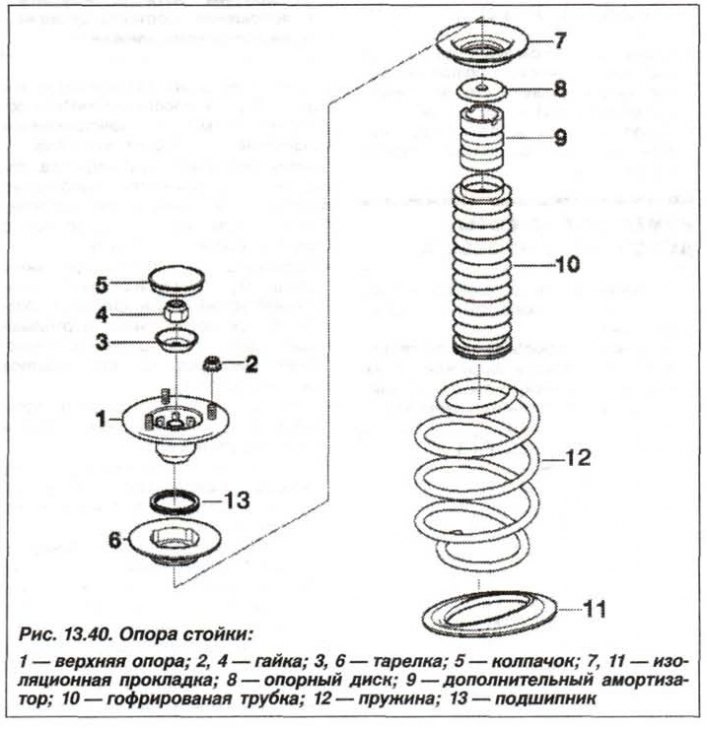
Prepare the equipment "31.3.341", "31.3.352" and "312.210", cover the wing with a thick canvas-type fabric to avoid damaging the paintwork. Remove the wheel, remove the stiffening plate and engine compartment protection panels
Remove the brake caliper and secure it with a wire clamp to the car body, the pipes remain connected. In case of disconnection, it is necessary to bleed the brake system.
Unscrew the nut (8, see Fig. 13.46) fastenings of the anti-roll bar (7), when installing the shock absorber strut, tighten it to a torque of 100 N·m (10.0 kgf·m).
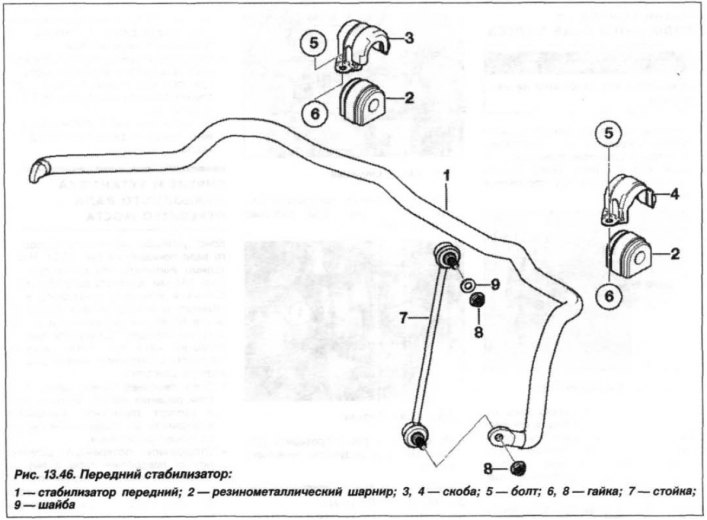
Remove the cable harness of the brake pad wear sensor and wheel speed sensor of the ABS system from the holder and disconnect the SS (2) of the above-mentioned systems.
Mark the position of the studs in relation to the wheel well. In this case, when installing the shock absorber, you can be sure that the wheel alignment will remain the same.
Attention! If the centering pin is missing, first unscrew only one nut on the upper support of the shock absorber strut.
Two nuts are unscrewed (2, see Fig. 13.40) connections between the upper support of the shock absorber strut and the mudguard in the engine compartment.
Unscrew the nuts (3, see Fig. 13.28) connection of the shock absorber strut with the pivot support. Separate the pivot support and secure it with a wire clamp to the car body. Unscrew the remaining nut (or two nuts) connections of the upper support of the front shock absorber strut and the mudguard. Remove the shock absorber strut (1) by moving it downwards.
Attention! It is necessary to check the technical condition and operability of the devices "31.3.341" and "31.3.352" before each use.
To avoid injury, do not use damaged equipment.
Do not make any changes to the design of the devices.
Use the devices only for their intended purpose.
Compress and release the device only with a hand wrench.
It is forbidden to compress the spring until the coils touch each other.
Clamp the device "31.3.341" to the bar (1, Fig. 13.41), in a vice.
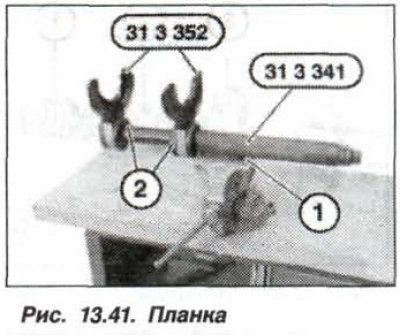
Install (the horns) of the device "31.3.352" (2) on the bar (1), inserting them from the side of the bar chamfer. The locking pins of the horns should lock with an audible click and a feeling of the moment of fixation. Install the front strut in the compression device, the spring coils should fully enter the recesses of the horns. Compress the spring with a hand wrench until the force is removed from the upper support of the shock absorber strut.
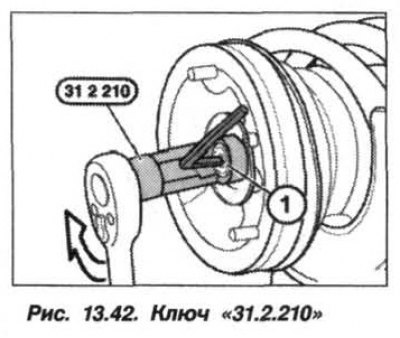
Removing the cap (5, see Fig. 13.40) and unscrewing the nut (4) of the upper shock absorber support should be done only when the spring is correctly compressed and its coils are completely in the recesses of the horns. If necessary, repeat the operation of compressing the spring. Holding the unit (shock absorber rod) from turning with a key, unscrew the nut with the key "31.2.210" (arrow, Fig. 13.42) and remove the shock absorber strut.
If a new spring is to be installed, the old spring must be completely released (unclamped) by unscrewing the device "31.3.341" and removing it from the horns.
Install the new spring into the horns so that there are four turns between them. Check that the spring turns are completely located in the recess of the horns.
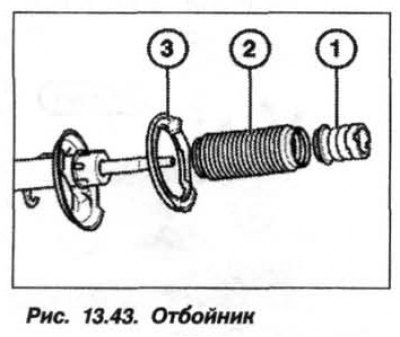
Replace the bump stop if necessary (1, Fig. 13.43). Check the plate (2), the insulating pad (3) of the spring and the condition of the corrugated cover. Make sure that the insulating pad and the spring plate are installed correctly.
Caution! Never open the device so much that its horns (clamps) rest against the upper and lower spring plates or the outermost coil of the spring. Otherwise, the spring or device may be damaged.
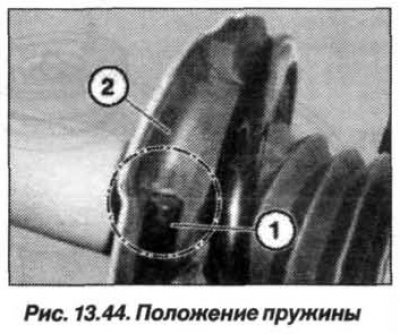
The installation of the shock absorber strut should be carried out in the reverse order, while it is necessary to insert the shock absorber strut into the coil spring and the upper spring plate (fig. 13.44). The end of the spring must coincide with the ledge of the lower plate or insulating gasket.
Screw on a new self-locking nut (4, see Fig. 13.40) flush with the piston rod of the shock absorber working cylinder. Using the key "31.2.210", tighten the nut (M14) to a torque of 64 N·m (6.4 kgf·m). Smoothly release the compression force from the spring so that it is completely adjacent to the lower plate of the strut.
Tighten the nuts securing the upper support to the engine compartment mudguard cup to the following torque:
- with a rod diameter of 18 mm – 24 N·m (2.4 kgf·m);
- with a rod diameter of 21 mm – 34 N·m (3.4 kgf·m).
New self-locking nuts (3, see Fig. 13.28) tighten the shock absorber strut mounting clamp bolts to a torque of 250 N·m (25.0 kgf·m).
Check the front wheel alignment angles and adjust them if necessary.
(The original article is posted on the resource: «BMWMAN.ru»)