
- Home
- BMW 5 Series
- E12
- Power unit
- Supply system
- Maintenance of the Stromberg 175 CDET carburetor
Maintenance of the Stromberg 175 CDET carburetor (BMW 5 Series E12)
See the picture "Main parts of the Stromberg 175 CDET carburetor".
Adjustment of the starting device should be carried out only with fully synchronized carburetors and a warm engine.
Remove the air filter.
Disconnect the rod 1 (see photo) connecting the carburetors and move the throttle control lever 2 down by approximately 15 mm.
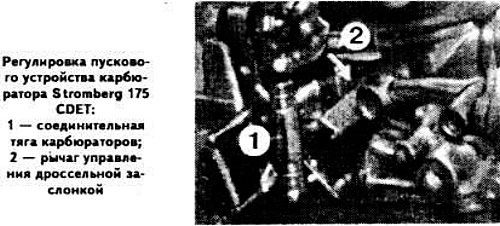
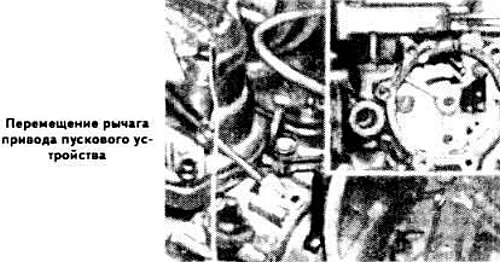
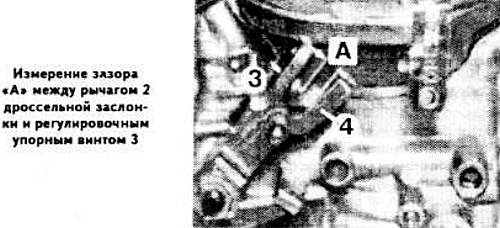
Insert a screwdriver into the hole in the trigger housing and move the trigger drive lever clockwise. Release the throttle control lever and release the trigger drive lever. As a result, the throttle control lever, which has two profiles, should take the 1st or 2nd fixed position. Measure the gap "A" (see photo) between the throttle control lever and the stop adjusting screw. It should be equal to:
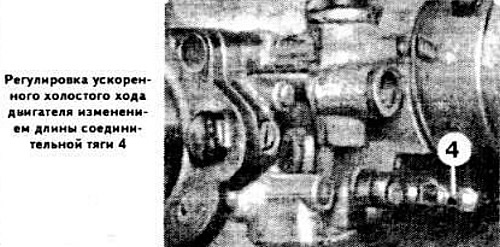
By changing the length of connecting rod 4 (see photo), set the crankshaft speed at fast idle speed (in this case the throttle control lever should be in the 2nd fixed position) with each carburetor operating at 1700±100 rpm. After adjustment, the engine's fast idle speed with both carburetors operating should be within 2000-2200 rpm.
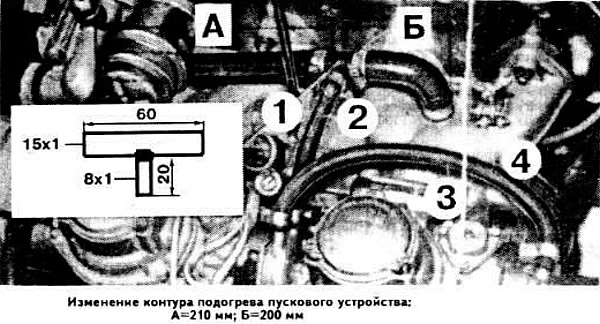
If after stopping a warmed-up engine the automatic starting device starts again, change the circuit of its starting device heating as shown in the photo. To do this:
Remove the air filter. Connect the BMW test device and gas analyzer.
Disconnect the throttle control rod and connect the 6083/1 process rod (6083 on cars with automatic transmission).
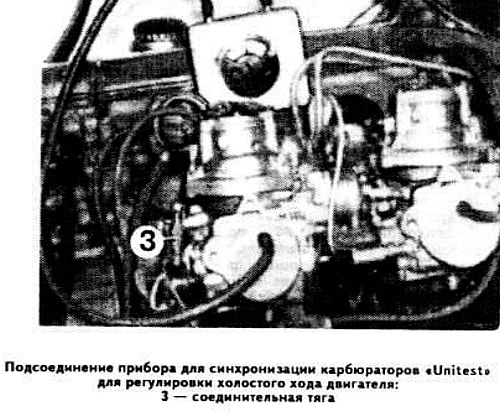
Remove the intake chamber and connect the Unitest carburetor synchronization device as shown in the photo.
Start the engine and increase the crankshaft speed to approximately 2000 rpm, adjusting the length of the 6083/1 rod.
After this, adjust the length of the connecting rod 3 (see photo) so as to achieve a stable position of the control device pointer at zero on the scale. Remove the technological rod 6083/1.
Connect the throttle control rod. The crankshaft speed should not change. If it does, adjust the length of the throttle control rod so that the lower stop of the intermediate lever rests on the engine mount support and the throttle control levers rest on the stop screws (it is prohibited to change the position of the stop screws secured with paint).
Install the air filter and start the engine.
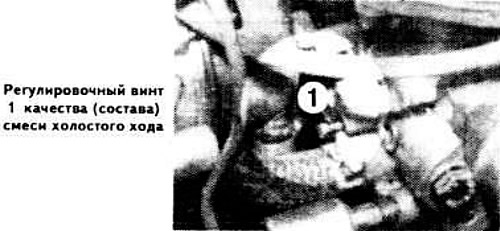
Using the rear carburetor mixture quality (composition) adjusting screw 1, adjust the carbon monoxide (CO) content in the exhaust gases so that it is equal to 2.5-3.5% at a crankshaft speed of 900-1000 rpm.
Using the mixture quantity adjusting screw 2, set the idle speed within 900-1000 rpm. By alternately turning adjusting screws 1 and 2, achieve the specified values of the engine idle speed and CO content.
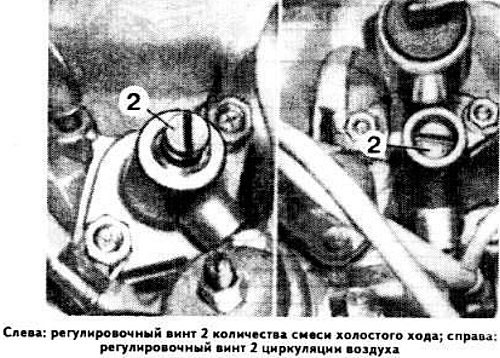
If it is not possible to set the idle speed of the crankshaft at 900-1000 rpm, then only in this case remove the intake chamber and disconnect the drive rod. Connect the "Unitest" carburetor synchronization device and turn out the adjusting screw 2 of the air circulation until the engine idle speed stabilizes. Synchronize the operation of the carburetors with the stop screws at a crankshaft speed of 1000 rpm. Connect the drive rod and adjust the engine idle speed and CO content as described above.
Remove the carburetor from the engine.
Remove the float chamber 44 (see picture), the float axis and the floats. Check their condition, then put the floats and the float axis back in place.
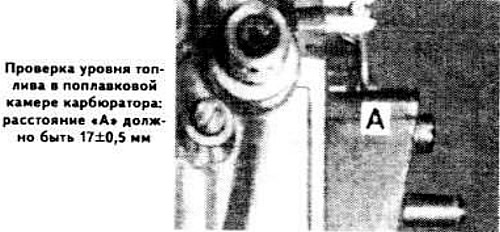
Place the carburetor body in a vertical position and measure the distance "A" (see photo) between the point on the top of the float and the plane of contact of the float chamber, which should be equal to 17±0.5 mm. In this case, the lever should rest on the needle without sinking the ball.
If necessary, achieve the proper size by bending the float lever.
Replace the float chamber and install the carburetor.
Remove the air filter and intake chamber by unscrewing the three screws.
Install a new intake chamber and air filter.
Remove the protective cover 67 (see picture) and check the condition of the sealing gasket. The oil level should reach the bottom of the piston cover edge. Do not reuse oil drained from the carburetor.
Remove the piston shock absorber (see below).
Fill with 20 cm³ of automatic transmission oil type "Automatic Transmission Fluid" into the piston cover, of which 6 cm is in the sleeve, which corresponds to an oil level of approximately 40 mm.
When installing the removed parts, make sure that the ventilation holes of the piston shock absorber tube are not clogged.
Remove the protective cover 67 (see picture), lift the capillary tube mounting bracket and remove the tube, marking its position.
Unscrew and remove the piston shock absorber.
When installing the shock absorber, orient the capillary tube in accordance with the previously made mark, the end of which should be at the lowest point of the piston cover 59 (see picture).
Fill the shock absorber with oil.
Perform the above operations, then remove the piston cover 59, holding it as it is lifted by spring 58. Let the oil drain (do not use drained oil).
Remove the piston with the diaphragm by gradually lifting the outer edge of the diaphragm.
Remove washer 54 securing the diaphragm to the piston and remove the diaphragm.
When assembling, make sure that the diaphragm protrusion fits into the groove of the carburetor body.
Fill the piston cap with oil (see above).
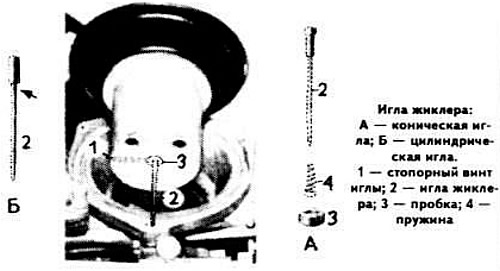
Perform the above operations, then unscrew the lock screw 57 and the needle 56. The jet needle can be conical or cylindrical.
When installing the conical needle, direct spring 4 as shown in the photo and insert plug 3 so that it is in line with the piston.
When installing a cylindrical needle, insert the needle so that the upper edge of the opening shown by the arrow in the photo is level with the bottom of the piston.
Adjusting the automatic starting device and fast idle speed
Adjustment of the starting device should be carried out only with fully synchronized carburetors and a warm engine.
Remove the air filter.
Disconnect the rod 1 (see photo) connecting the carburetors and move the throttle control lever 2 down by approximately 15 mm.
Insert a screwdriver into the hole in the trigger housing and move the trigger drive lever clockwise. Release the throttle control lever and release the trigger drive lever. As a result, the throttle control lever, which has two profiles, should take the 1st or 2nd fixed position. Measure the gap "A" (see photo) between the throttle control lever and the stop adjusting screw. It should be equal to:
- 4.5-5 mm when using a distributor without a vacuum regulator;
- 3.9±0.1 mm with vacuum hose disconnected;
- 2.4±0.1 mm with vacuum hose connected.
By changing the length of connecting rod 4 (see photo), set the crankshaft speed at fast idle speed (in this case the throttle control lever should be in the 2nd fixed position) with each carburetor operating at 1700±100 rpm. After adjustment, the engine's fast idle speed with both carburetors operating should be within 2000-2200 rpm.
Note: On a carburetor removed from a vehicle, the throttle valve starting clearance should be 0.4 mm (when connecting carburetors with a rod with right and left threads) or 7 mm (when connecting carburetors via a rod and a linkage).
If after stopping a warmed-up engine the automatic starting device starts again, change the circuit of its starting device heating as shown in the photo. To do this:
- drain the fluid from the cooling system.
- disconnect the starting device heating hose from the intake manifold. Unscrew the threaded fitting and plug the hole with a screw M 10x12 mm, placing an aluminum washer under its head;
- loosen both starter housing covers and turn them so that the coolant inlet and outlet hoses are directed as shown in the photo;
- cut the upper hose so that the distance "A" is 210 mm, and "B" is 200 mm, and connect its sections with a tee 1, made from scrap materials;
- connect hose 2 to the free end of the tee and attach hoses 3 and 4.
Adjusting engine idle speed
Remove the air filter. Connect the BMW test device and gas analyzer.
Disconnect the throttle control rod and connect the 6083/1 process rod (6083 on cars with automatic transmission).
Remove the intake chamber and connect the Unitest carburetor synchronization device as shown in the photo.
Start the engine and increase the crankshaft speed to approximately 2000 rpm, adjusting the length of the 6083/1 rod.
After this, adjust the length of the connecting rod 3 (see photo) so as to achieve a stable position of the control device pointer at zero on the scale. Remove the technological rod 6083/1.
Connect the throttle control rod. The crankshaft speed should not change. If it does, adjust the length of the throttle control rod so that the lower stop of the intermediate lever rests on the engine mount support and the throttle control levers rest on the stop screws (it is prohibited to change the position of the stop screws secured with paint).
Install the air filter and start the engine.
Using the rear carburetor mixture quality (composition) adjusting screw 1, adjust the carbon monoxide (CO) content in the exhaust gases so that it is equal to 2.5-3.5% at a crankshaft speed of 900-1000 rpm.
Using the mixture quantity adjusting screw 2, set the idle speed within 900-1000 rpm. By alternately turning adjusting screws 1 and 2, achieve the specified values of the engine idle speed and CO content.
If it is not possible to set the idle speed of the crankshaft at 900-1000 rpm, then only in this case remove the intake chamber and disconnect the drive rod. Connect the "Unitest" carburetor synchronization device and turn out the adjusting screw 2 of the air circulation until the engine idle speed stabilizes. Synchronize the operation of the carburetors with the stop screws at a crankshaft speed of 1000 rpm. Connect the drive rod and adjust the engine idle speed and CO content as described above.
Setting the fuel level in the float chamber
Remove the carburetor from the engine.
Warning: Place the carburetor with the flange on the throttle side facing down. Do not move the throttle valve or piston, as this will cause oil to leak from the piston damper. If the throttle valve or piston is accidentally moved, proceed as described in the subsection "Checking the oil level".
Remove the float chamber 44 (see picture), the float axis and the floats. Check their condition, then put the floats and the float axis back in place.
Place the carburetor body in a vertical position and measure the distance "A" (see photo) between the point on the top of the float and the plane of contact of the float chamber, which should be equal to 17±0.5 mm. In this case, the lever should rest on the needle without sinking the ball.
If necessary, achieve the proper size by bending the float lever.
Replace the float chamber and install the carburetor.
Replacing the suction chamber
Remove the air filter and intake chamber by unscrewing the three screws.
Install a new intake chamber and air filter.
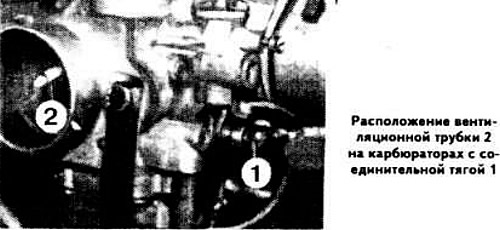
Note: After installing the connecting rod 1 (see photo), a ventilation tube 2 is installed on the suction chamber, the absence of which leads to a significant loss of engine power.
Checking the oil level
Remove the protective cover 67 (see picture) and check the condition of the sealing gasket. The oil level should reach the bottom of the piston cover edge. Do not reuse oil drained from the carburetor.
Remove the piston shock absorber (see below).
Fill with 20 cm³ of automatic transmission oil type "Automatic Transmission Fluid" into the piston cover, of which 6 cm is in the sleeve, which corresponds to an oil level of approximately 40 mm.
When installing the removed parts, make sure that the ventilation holes of the piston shock absorber tube are not clogged.
Removal the piston shock absorber
Remove the protective cover 67 (see picture), lift the capillary tube mounting bracket and remove the tube, marking its position.
Unscrew and remove the piston shock absorber.
When installing the shock absorber, orient the capillary tube in accordance with the previously made mark, the end of which should be at the lowest point of the piston cover 59 (see picture).
Fill the shock absorber with oil.
Replacing the piston diaphragm
Perform the above operations, then remove the piston cover 59, holding it as it is lifted by spring 58. Let the oil drain (do not use drained oil).
Remove the piston with the diaphragm by gradually lifting the outer edge of the diaphragm.
Remove washer 54 securing the diaphragm to the piston and remove the diaphragm.
When assembling, make sure that the diaphragm protrusion fits into the groove of the carburetor body.
Fill the piston cap with oil (see above).
Replacing the jet needle
Perform the above operations, then unscrew the lock screw 57 and the needle 56. The jet needle can be conical or cylindrical.
When installing the conical needle, direct spring 4 as shown in the photo and insert plug 3 so that it is in line with the piston.
When installing a cylindrical needle, insert the needle so that the upper edge of the opening shown by the arrow in the photo is level with the bottom of the piston.
This article is available at russian, bulgarian, belarusian, ukrainian, serbian, croatian, romanian, polish, slovak, hungarian
Article verified: Polikarpov Saveliy
Share information:
Previous articles
БМВ E12: Supply system
Next articles
Similar articles on other types of BMW cars:
Carburetor maintenance work BMW 3 Series E30 (1982-1994)
Removal and installation of the Solex DIDTA 32/32 carburetor BMW 3 Series E21 (1975-1983)
Vehicle maintenance plan BMW 7 Series E32 (1986-1994)
Schedule of current maintenance BMW 7 Series E38 (1994-2001)
Maintenance upcoming indicator (MOT) BMW X3 E83 (2003-2010)
Carrying out maintenance work BMW X5 E53 (1999-2006)
Carburetor maintenance work BMW 3 Series E30 (1982-1994)
Removal and installation of the Solex DIDTA 32/32 carburetor BMW 3 Series E21 (1975-1983)
Vehicle maintenance plan BMW 7 Series E32 (1986-1994)
Schedule of current maintenance BMW 7 Series E38 (1994-2001)
Maintenance upcoming indicator (MOT) BMW X3 E83 (2003-2010)
Carrying out maintenance work BMW X5 E53 (1999-2006)
Link in different formats to this page
Visitor comments
No comments yet
- General information
- Governing bodies
- Manual
- Maintenance
- Power unit
- Engine repair
- Lubrication system
- Cooling system
- Ignition system
- Supply system
- Injection system (gasoline)
- Injection system (diesel)
- Exhaust system
- Transmission
- Clutch
- Car gearbox
- Front axle
- Rear axle
- Chassis
- Steering
- Brake system
- Wheels and tires
- Body
- Interior
- Exterior
- Heating system
- Electrical equipment
- Equipment and devices
- Power devices
- Windscreen wipers
- Electrical circuits
- General information
- Manual
- Maintenance
- Power unit
- Engine repair
- Ignition system
- Engine lubrication system
- Cooling system
- Fuel system (gasoline)
- Fuel system (diesel)
- Exhaust system
- Transmission
- Clutch
- Car gearbox
- Chassis
- Front and rear suspension
- Steering
- Brake system
- Body
- Exterior
- Interior
- Electrical equipment
- Heating system
- Equipment and devices
- Power devices
- Electrical circuits
- General information
- Manual
- Maintenance
- Power unit
- Engine in a car
- Engine overhaul
- Cooling system
- Supply system
- Ignition system
- Control system
- Transmission
- Clutch
- Manual gearbox
- Automatic gearbox
- Transmission line
- Chassis
- Steering
- Front suspension
- Rear suspension
- Brake system
- Body
- Body elements
- Car care and painting
- Electrical equipment
- Heater and air conditioner
- Equipment and devices
- Starter and generator
- Electrical circuits
- General information
- Operation and maintenance
- Specifications
- Power unit
- Engine repair
- Cooling and lubrication system
- Supply system
- Ecotronic power supply system
- Fuel injection system
- Ignition system
- Transmission
- Clutch
- Gearbox BMW 242/4
- Gearbox Getrag 262/8
- Gearbox Getrag 265/6
- Automatic gearbox
- Cardan gear
- Rear axle
- Chassis
- Steering
- Front suspension
- Rear suspension
- Brake system
- Electrical equipment
- Equipment and devices
- Electrical circuits