
Use a charged battery for testing.
Turn off all electrical consumers, available clocks (and other regular consumers) disconnect, close the doors and the hood of the engine compartment. Turn off the rear door switch.
Disconnect the ground (-) cable from the battery.
Caution: This will erase the contents of electronic memory devices, such as engine fault codes. Before disconnecting the battery, you should also read the instructions in the chapter "Removal and installation the battery".
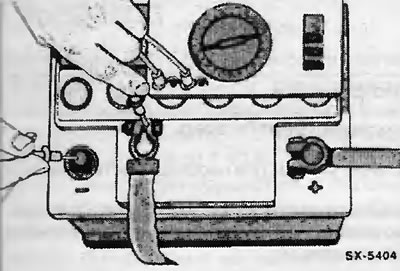
Set the ammeter with a measurement range from 0-5 mA to 5 A to the highest measurement limit. Connect the ammeter between the negative pole of the battery and the ground wire.
Note: The test can also be performed using a test lamp. If the lamp connected between the ground wire and the negative pole of the battery does not light, then an ammeter must be used.
Reduce the ammeter measurement range until the reading can be read from the instrument scale (permissible value 1-3 mA).
By removing fuses in sequence, open various electrical circuits. If the ammeter needle moves to zero when the circuit is open, the fault should be looked for in this circuit. The fault may be caused by corrosion and contamination of contacts, chafing of wires, or an internal short circuit in the unit.
If no fault is detected in the fuse-protected electrical circuit, then it is necessary to disconnect the wires from the unit or system not protected by the fuse. Such a unit or system may be a generator, starter, ignition system.
If, when disconnecting a unit or system that does not have a fuse, the ammeter needle deviates to zero, the corresponding unit must be repaired or replaced. If there is a loss of current in the starter or ignition system, always check the ignition switch in accordance with the electrical diagram.
Connect the negative (-) battery cable. Set the clock. Tune the radio to transmitting stations.