
- Home
- BMW 5 Series
- E39
- Electrical equipment
- Power devices
- Checking the battery
Checking the battery (BMW 5 Series E39)
Checking the electrolyte level
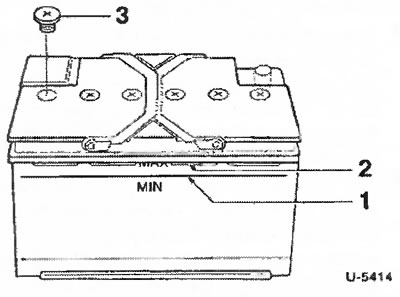
The electrolyte level in each element should be between the MIN mark "1" and the MAX mark "2". Otherwise, unscrew the plugs "3" of the battery and top up the level with distilled water.
Checking voltage
The condition of the battery can be checked by measuring the voltage by connecting a voltmeter to its terminals.
Disconnect the battery.
Before checking, the battery must be disconnected for at least two hours.
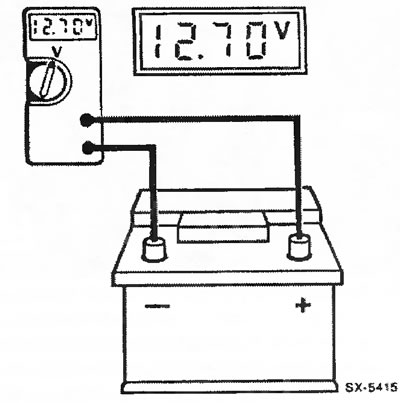
Connect a voltmeter to the battery terminals and measure the voltage.
Conclusions based on the measurement results:
- 12.7 volts or higher - battery is in good condition;
- 12.5 volts - normal condition;
- 12.3 volts or below - the battery is in poor condition and needs to be charged or replaced.
Connect the battery.
Checking the battery under load
Connect a voltmeter to the battery terminals, start the engine and read the voltmeter reading.
During engine starting, the voltage of a fully charged battery should not fall below 10 volts (at an electrolyte temperature of approximately +20°C).
If the voltage immediately drops, and in addition, different densities of electrolyte in the battery cells were detected, then it is necessary to conclude that it is defective.
Checking the density of the electrolyte (does not apply to maintenance-free batteries)
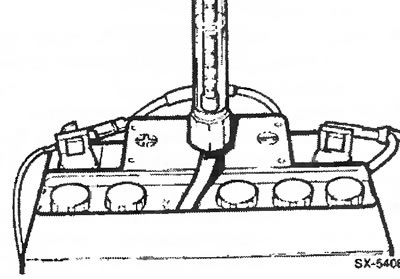
The density of the electrolyte, along with the voltage measurement, allows you to make an accurate conclusion about the state of charge of the battery. A battery densimeter with a pipette is used for testing, which is offered at an affordable price by specialized stores. The higher the density of the electrolyte sucked by the densimeter from the battery, the more the float of the densimeter rises. The densimeter scale can be used to determine the density of the electrolyte in g / ml or in degrees Baume (+ "Be"). The state of charge of the battery corresponding to the measured density of the electrolyte is indicated below:
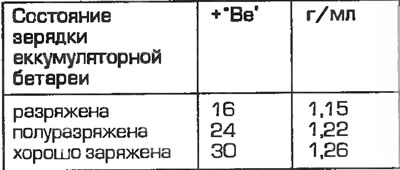
Check each battery element in sequence; all elements must have the same electrolyte density. The maximum permissible difference in electrolyte density in individual elements is 0.04 g/ml. Otherwise, a conclusion is made about the battery defect.
The original text is available on the website «BMWMAN»
This article is available at russian, bulgarian, belarusian, ukrainian, serbian, croatian, romanian, polish, slovak, hungarian
Article verified: Ilyinsky Matvey
Share information:
Previous articles
БМВ E39: Power devices
Next articles
Similar articles on other types of BMW cars:
Battery — Checking and Charging BMW 3 Series E46 (1998-2006, petrol)
Checking battery condition, care and charging BMW 3 Series E46 (1998-2006)
Checking and caring for your battery BMW 7 Series E38 (1994-2001)
Starting the engine from an auxiliary battery BMW 7 Series E32 (1986-1994)
Bleeding the cooling system and checking it for leaks (M54, N46, N47,… BMW X3 E83 (2003-2010)
Checking the battery status BMW X5 E53 (1999-2006)
Battery — Checking and Charging BMW 3 Series E46 (1998-2006, petrol)
Checking battery condition, care and charging BMW 3 Series E46 (1998-2006)
Checking and caring for your battery BMW 7 Series E38 (1994-2001)
Starting the engine from an auxiliary battery BMW 7 Series E32 (1986-1994)
Bleeding the cooling system and checking it for leaks (M54, N46, N47,… BMW X3 E83 (2003-2010)
Checking the battery status BMW X5 E53 (1999-2006)
Link in different formats to this page
Visitor comments
No comments yet
- General information
- Governing bodies
- Manual
- Maintenance
- Power unit
- Engine repair
- Lubrication system
- Cooling system
- Ignition system
- Supply system
- Injection system (gasoline)
- Injection system (diesel)
- Exhaust system
- Transmission
- Clutch
- Car gearbox
- Front axle
- Rear axle
- Chassis
- Steering
- Brake system
- Wheels and tires
- Body
- Interior
- Exterior
- Heating system
- Electrical equipment
- Equipment and devices
- Power devices
- Windscreen wipers
- Electrical circuits
- General information
- Manual
- Maintenance
- Power unit
- Engine repair
- Ignition system
- Engine lubrication system
- Cooling system
- Fuel system (gasoline)
- Fuel system (diesel)
- Exhaust system
- Transmission
- Clutch
- Car gearbox
- Chassis
- Front and rear suspension
- Steering
- Brake system
- Body
- Exterior
- Interior
- Electrical equipment
- Heating system
- Equipment and devices
- Power devices
- Electrical circuits
- General information
- Manual
- Maintenance
- Power unit
- Engine in a car
- Engine overhaul
- Cooling system
- Supply system
- Ignition system
- Control system
- Transmission
- Clutch
- Manual gearbox
- Automatic gearbox
- Transmission line
- Chassis
- Steering
- Front suspension
- Rear suspension
- Brake system
- Body
- Body elements
- Car care and painting
- Electrical equipment
- Heater and air conditioner
- Equipment and devices
- Starter and generator
- Electrical circuits
- General information
- Operation and maintenance
- Specifications
- Power unit
- Engine repair
- Cooling and lubrication system
- Supply system
- Ecotronic power supply system
- Fuel injection system
- Ignition system
- Transmission
- Clutch
- Gearbox BMW 242/4
- Gearbox Getrag 262/8
- Gearbox Getrag 265/6
- Automatic gearbox
- Cardan gear
- Rear axle
- Chassis
- Steering
- Front suspension
- Rear suspension
- Brake system
- Electrical equipment
- Equipment and devices
- Electrical circuits