
Note: The following information should be considered as a guide only. When using the battery, follow the manufacturer's instructions.
1. All models are equipped with maintenance-free batteries when leaving the factory. Under normal operating conditions, such batteries do not require any attention throughout their entire service life.
2. If the battery condition is suspect, remove the battery as described in paragraph 4 and check the electrolyte level in the cans, which is visible through the transparent battery case. The level should be the same in all cans, approximately 5 mm above the upper edge of the plates. If necessary, the electrolyte level can be increased by adding distilled water to the cans (not acid!).
3. The condition of the battery can be assessed as a first approximation by measuring the density of the electrolyte.
4. Measure the specific gravity of the electrolyte in each can and compare the results with the values in the following table. Please note that the specific gravity of the electrolyte given below is for a temperature of +15°C. If the temperature differs from the specified one during measurement, add 0.007 to the measured value for every 10°C above 15°C, and subtract 0.007 for every 10°C below 15°C.
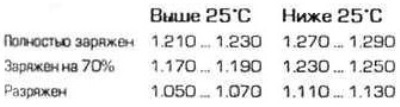
5. The density of the electrolyte in all cans should be approximately the same. If the density of the electrolyte in any can differs from the others by 0.04 or more, this means either an electrolyte leak or a malfunction of the battery working plates. In both cases, the battery is faulty and requires replacement.
6. If the difference in electrolyte density between the cans is within acceptable limits, but the battery is discharged, it should simply be charged in accordance with the manufacturer's instructions
7. You can also check the battery condition using a voltmeter. Connect the voltmeter to the battery terminals. A fully charged battery should have a voltage of at least 12.5 V. This test will give the correct result if the battery has not been charged in the last six hours. If this is not the case, turn on the high beam headlights for 30 seconds, then turn off the headlights and wait a few more minutes. After that, you can start checking. All electrical consumers on the car must be turned off. Therefore, first check that all doors and the trunk lid are securely closed.
8. If the voltage at the battery terminals is between 12.2 and 12.4 V, the battery is partially discharged. Voltage below 12.2 V indicates a complete discharge.
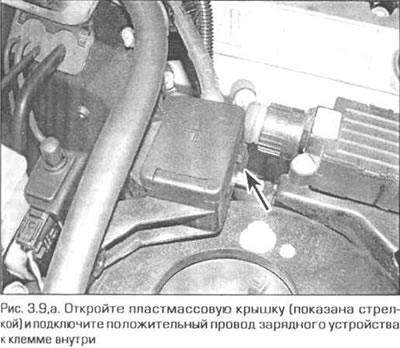
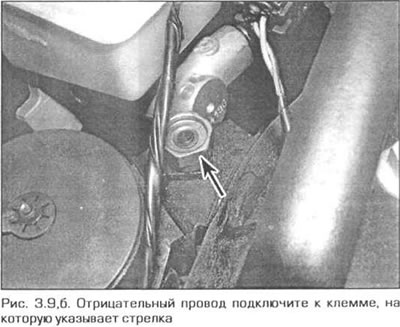
9. If the battery needs to be charged with an external charger, locate the terminals for connecting this device in the rear right corner of the engine compartment and connect the charger wires to these terminals (fig. 3.9,a,b). If using an external fast charger or if you are unsure of the charger type, remove the battery from the vehicle and charge it according to the manufacturer's instructions.
(The text is based on materials from the website: www.bmwman.ru)