
To ensure easy control when parking the car, the car is equipped with a hydraulic power steering as standard. The efficiency of the power steering depends on the engine speed. At high speeds, the force decreases, at low speeds, it weakens.
Depending on the model and its equipment, the steering operation is facilitated by a power steering system, the operation of which depends on the vehicle speed (SERVOTRONIC). Thanks to this, the effort required to turn the steering wheel on a stationary vehicle will be even less, and at high speeds, on the contrary, due to the reduced efficiency of the power steering, better contact with the road and high steering precision are achieved.
The power steering consists of an oil pump, a fluid reservoir, and delivery lines. The pump sucks fluid (oil) from the reservoir and delivers it under high pressure to the steering gear. The pump is driven by a V-belt.
In the steering mechanism, the adjusting device ensures that the fluid acts in the desired direction.
The steering wheel contains an inflatable airbag for the driver. In the event of a severe frontal collision, the control unit commands the ignition of the charge in the airbag unit. The combustion products (gases) inflate the airbag in a fraction of a second. This time is enough to protect the instrument panel and the driver's upper body from impact with the steering wheel. Then, in a few seconds, the airbag deflates again, as the gases escape through special openings.
For personal safety reasons, work on the airbag should be carried out in a specialized workshop.
Caution: Always replace the self-locking nuts. Welding and straightening work on steering components is not permitted. Work on the airbag system should only be performed in a workshop.

Steering elements with worm-gear sector steering mechanism
1 — steering gear housing;
2 - bipod;
3 - medium thrust;
4 - lateral pull;
5 - ball joints;
6 - pendulum lever.
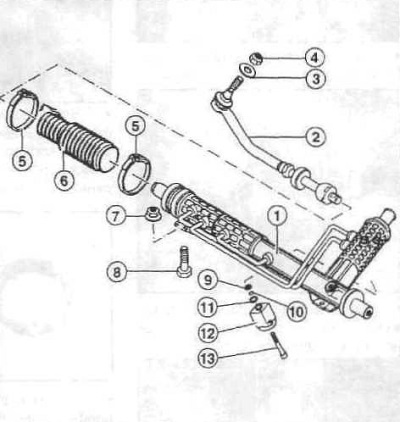
Rack and pinion steering components
1 — "rack-and-pinion" steering gear;
2 - steering rod;
3 - washer;
4 - nut;
5 — clamp;
6 — case;
7 - nut;
8 — bolt;
9 — mesh;
10 - sealing ring;
11 - gasket;
12 — SERVOTRONIC system unit;
13 — bolt.
Precautions when working with an airbag
Inspection and repair work on the airbag system must be carried out only in a workshop. Under no circumstances should any changes be made to the design.
The steering wheel with airbag should only be replaced with exactly the same part from BMW.
The steering wheel trim plate must not be glued, pulled or otherwise affected. It can be wiped with a dry or slightly damp cloth or a cloth soaked in a special cleaner.
The airbag does not replace seat belts. Passengers must use seat belts, only then they are optimally protected.
The driver's seat must always be precisely adjusted to the driver's height. Do not use a special child seat in the front passenger seat. Children under 12 years of age must be transported in the rear seat only.
There should be no objects between the airbag and the person.
Do not use the front passenger airbag cover as a shelf.
If the airbag has deployed during an accident, the control unit, airbag unit and contact unit must be replaced with new parts in a workshop.
Before performing work on the airbag system or on electrical equipment parts, disconnect the negative wire from the battery (AB). Then disconnect the plug of the airbag system from the steering column.
The airbag assembly should always be stored with the trim facing up.
If the vehicle is undergoing long-term repairs, the non-deployed airbag must be stored in a closed box.
The airbag assembly must not be exposed to grease, cleaning agents or similar products.
The airbag assembly and control unit are sensitive to impacts.
If they fell from a height of more than 50 cm, they cannot be reinstalled. If the height was less than 50 cm, the airbag must be checked in a workshop.
When performing welding work, the welding machine contacts should be located as close as possible to the welding site. In each case, the negative wire should be disconnected from the battery. Then, the negative contact should be insulated from the battery to avoid accidental contact. Disconnect the airbag unit plugs from the gas generator.
The airbag unit and control unit must not be heated above +75°C, even for a short time. Damaged or faulty parts must not be repaired under any circumstances. Airbag system parts must not be opened under any circumstances. Before installation, check again that the negative cable is disconnected from the battery.