
Warm up the engine to operating temperature until the temperature gauge on the instrument panel shows normal coolant temperature.
Check the coolant level and top up if necessary.
Remove the expansion tank cap.
Caution: When the engine is hot, cover the cap with a thick cloth before removing it to avoid being burned by hot liquid or steam. Remove the cap only when the coolant temperature is below +90°.
Install a control device with an adapter on the neck of the expansion tank. Use the device's hand pump to create a pressure of about 1.0 bar. If the pressure drops by more than 0.1 bar within 2 minutes, you need to find leaks and eliminate them. Leaks can be determined by the outgoing coolant.
If the pressure drops but there are no signs of coolant leaks, this indicates internal coolant leaks in the engine, for example through a damaged cylinder head gasket or through a crack in the block.
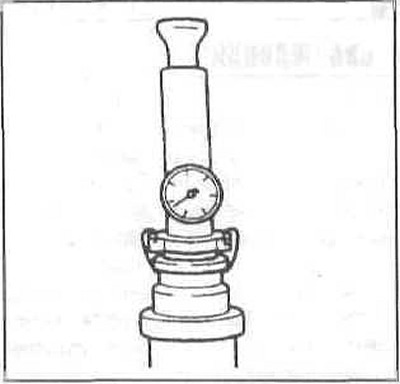
To check the safety valve in the radiator cap, install a test device on the cap. Create pressure using a hand pump. At a pressure of about 2.0 bar, the safety valve should open. If this is not the case, the cap must be replaced.
Check the radiator cap with a vacuum. At a vacuum of 0.1 bar, the vacuum valve in the radiator cap should open.