
- Home
- BMW 7 Series
- E38
- Power unit
- Engine M60/1, M60/2 (petrol)
- General information and preparatory operations
General information and preparatory operations (BMW 7 Series E38)
This chapter describes the most typical and important engine maintenance and repair procedures, with the exception of those requiring special skills and tools, such as engine overhaul procedures – these jobs should be left to service technicians. The following covers the M60/1, M60/2 and M73 petrol engines, as well as the M57 and M67 diesel engines. Work on the M51, M52 and M62 engines is similar.
The cars in question are equipped with six types of engines: 6-cylinder turbodiesel M51 (SOHC), 6-cylinder diesel M57 (DOHC), 6-cylinder petrol engine M52 (DOHC), 8-cylinder V-shaped petrol (M60, M62) and diesel (M67) engines (DOHC), as well as 12-cylinder V-shaped petrol engine M73 (SOHC). The abbreviations SOHC and DOHC indicate the presence of one or two camshafts per cylinder bank, respectively (and therefore 2 or 4 valves per cylinder), located at the top of the engine. The power unit is installed along the vehicle and is removed from the engine compartment upwards using a crane.
Its M52 engine cylinder head and block are cast from aluminum alloy. Unlike traditionally used cast iron, aluminum alloy has higher thermal conductivity and is lighter. This contributes to better cooling and lower fuel consumption.
The cylinder block of the M51 turbodiesel engine is cast from cast iron, the cylinder head is made of light alloy. In case of increased wear and the presence of scoring on the cylinder walls, they can be honed with subsequent replacement of old pistons with pistons of repair sizes.
Engine M51
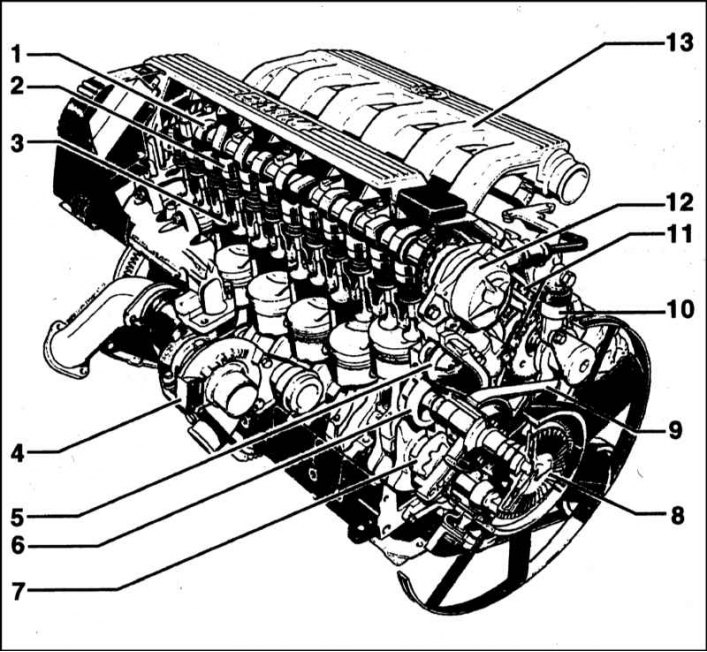
1 — Camshaft
2 - Hydraulic pusher
3 — Valve
4 - Turbocharger
5 - Thermostat
6 - Water pump
7 - Oil pump
8 — Viscous coupling
9 — Drive belt
10 — Drive belt tensioner
11 — Timing chain
12 - Vacuum pump
13 — Inlet manifold
The cylinder head of all engines has so-called cross-flow scavenging. This means that the fuel mixture enters the cylinders from one side, and the exhaust gases (EG) exit from the other. This scheme facilitates faster gas exchange.
The timing drive is carried out from the crankshaft via a chain; multi-ribbed belts are used to drive auxiliary units. M52 engines are equipped with a timing control system (VANOS)by shifting the intake camshaft relative to its sprocket. Timing phase adjustment is controlled by the engine control unit (ECM, DME) depending on the speed of the crankshaft by opening and closing a special oil valve.
Engine M52
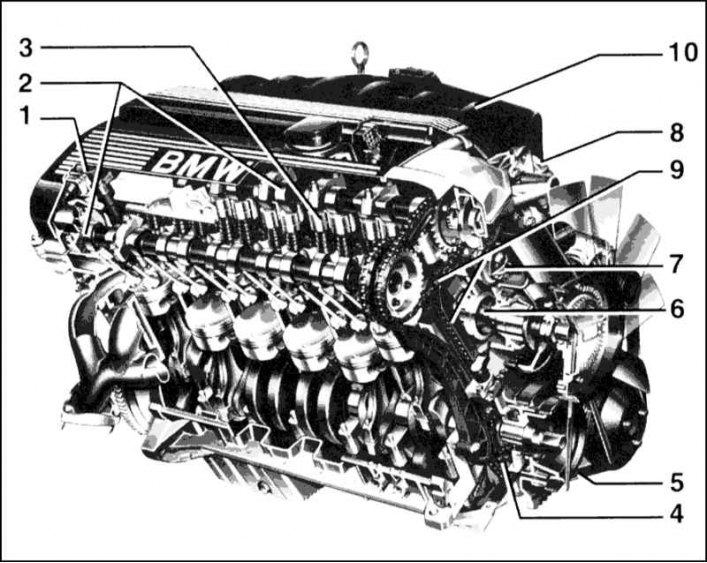
1 - Ignition coils
2 — Camshafts
3 - Hydraulic pusher
4 - Oil pump
5 - Drive belt
6 - Water pump
7 — Thermostat
8 — Oil filter
9 — Timing chain
10 — Inlet manifold
The valves are driven by camshafts via hydraulic tappets. There is no need to adjust valve clearances during maintenance. On SOHC engines, the intake and exhaust valves are driven by a single shaft, while on DOHC engines, a separate camshaft is used to drive the intake and exhaust valves.
But the piston contains 2 compression rings and one oil scraper ring. The crankshaft is located in the main bearings.
Oil is supplied to the lubrication system by an oil pump, which in the 6-cylinder petrol engine is located in the front of the oil pan and is driven by the crankshaft. In the diesel engine M51, the oil pump is located in the timing chain cover and is driven by a gear transmission. Oil is sucked from the oil pan and fed through holes and pipes to the bearings of the crankshaft and camshaft, as well as to the working surfaces of the cylinders.
The coolant pump is located at the front of the cylinder block. The pump shaft drives the cooling fan via a viscous coupling when the appropriate temperature is reached. The water pump is driven via a multi-ribbed belt, which also drives the generator. The cooling system is filled with a mixture of antifreeze, corrosion protection and water with a low lime content.
The preparation of the air-fuel mixture is controlled by the injection system, which, together with the ignition system and some other systems, is part of the engine management system. This ensures a stable low content of harmful substances in the exhaust gases. The ignition system has no moving parts, which eliminates their wear. In a diesel engine, the distribution of fuel among the cylinders is regulated by an electronic control unit (ECM, DDE).
Gasoline engines are designed to operate on AI-95 gasoline, but other grades of fuel can be used due to the presence of detonation control. If AI-98 gasoline is used, then under normal operating conditions, fuel consumption decreases and engine power increases. When using AI-91 gasoline, engine power decreases and fuel consumption increases.
Preparatory operations
Before performing any engine maintenance procedures, clean the engine compartment and the outer surfaces of the power unit using a special solvent. This treatment will prevent dirt from getting inside the engine.
If necessary, depending on the nature of the work to be done, the bonnet can be removed to provide free access to the components to be serviced (see chapter Body). To avoid accidental damage to the paintwork, cover the car fenders with special covers or old blankets.
Excessive engine oil consumption can be considered a signal that it is necessary to check the condition of the piston rings, valve stem seals and/or valve guides. Naturally, first of all, you should make sure that the oil loss is not associated with the development of external leaks. Check the compression in the cylinders (see section Checking the compression pressure) to determine the general condition of the engine.
Loss of power, loss of RPM stability, excessive valve noise and increased fuel consumption are usually fairly common signs that an engine overhaul is needed, especially when all of these factors occur simultaneously. If performing a full range of adjustments does not help to eliminate the problems, the only way out is to perform general mechanical work to restore the engine.
Major repairs of the power unit involve restoring all its operating parameters to the level typical of a new engine. During a major repair, piston rings are replaced and cylinder mirrors are restored (turning and/or honing). Usually, the main and connecting rod bearings of the crankshaft are replaced; if necessary, its journals can be turned and restored. Valve maintenance is mandatory; their condition at the time of the need for a major overhaul of the engine almost certainly leaves much to be desired. In parallel with the general overhaul of the power unit, a restorative overhaul of the starter and generator is usually also carried out.
Critical components of the cooling system such as hoses, drive belts and thermostat must be replaced with new ones during a major engine overhaul. In addition, the condition of the radiator should be carefully checked (see Chapters Vehicle settings and routine maintenance and Engine cooling, heating, ventilation and air conditioning systems). If signs of leaks or obstruction are detected, the radiator should be replaced. Don't forget to check the condition of the oil pump as well.
Major engine repairs do not require high professional training from the performer, but they take quite a lot of time. You should plan to stop using the car for at least two weeks, especially if you need to seek help from a mechanical workshop to perform certain repairs.
Most of the work can be done using a standard set of metalworking tools, but some of the tests to determine the suitability of individual components for further use require the use of precision measuring equipment. In doubtful situations, seek help from service station specialists.
Do not forget that the decisive factor in the question of the advisability of performing a major overhaul of the engine is the condition of its cylinder block. It is often cheaper and more reliable to replace a worn-out engine with a reconditioned one.
In conclusion, it can be noted that all efforts to perform restoration repairs of worn components will be wasted if the requirement of maintaining cleanliness during assembly of the unit is neglected.
(The original article is available on the website «BMWMAN.RU»)
This article is available at russian, bulgarian, belarusian, ukrainian, serbian, croatian, romanian, polish, slovak, hungarian
Article verified: Polikarpov Saveliy
Share information:
Previous articles
БМВ E38: Engine M60/1, M60/2 (petrol)
Next articles
Similar articles on other types of BMW cars:
General information about engines BMW 3 Series E30 (1982-1994)
Gearbox. General information BMW 3 Series E36 (1990-2000)
General information about the engine BMW 5 Series E12 (1972-1981)
Engine Repair Manual. General Information BMW 5 Series E34 (1988-1996)
Tachometer — general information BMW X3 E83 (2003-2010)
General information about M54 engines BMW X5 E53 (1999-2006)
General information about engines BMW 3 Series E30 (1982-1994)
Gearbox. General information BMW 3 Series E36 (1990-2000)
General information about the engine BMW 5 Series E12 (1972-1981)
Engine Repair Manual. General Information BMW 5 Series E34 (1988-1996)
Tachometer — general information BMW X3 E83 (2003-2010)
General information about M54 engines BMW X5 E53 (1999-2006)
Link in different formats to this page
Visitor comments
No comments yet
- General information
- Introduction to guide
- Manual
- Maintenance
- Power unit
- Engine M60/1, M60/2 (petrol)
- M62 engine (petrol)
- M57 engine (diesel)
- M67 engine (diesel)
- Cooling system
- Fuel system (petrol)
- Fuel system (diesel)
- Exhaust system
- Ignition and control systems
- Charge and launch systems
- Transmission
- Clutch
- Mechanical gearbox
- Automatic gearbox
- Cardan and drive shafts
- Chassis
- Brake system
- Front suspension
- Rear suspension
- Steering
- Body
- Exterior
- Interior
- Electrical equipment
- Equipment and devices
- Lighting
- Heating and air conditioning
- Electrical circuits
- General information
- Care and maintenance
- Power unit
- Minor engine repair
- Engine overhaul
- Lubrication system
- Cooling system
- Ignition system
- Supply system
- Injection system (petrol)
- Injection system (diesel)
- Exhaust system
- Transmission
- Clutch
- Manual gearbox
- Automatic gearbox
- Cardan gear
- Rear axle and shafts
- Chassis
- Front suspension
- Rear suspension
- Steering
- Wheels and tires
- Brake system
- Body
- Body elements
- Electrical equipment
- Equipment and devices
- Electrical circuits