
- Home
- BMW 3 Series
- E36
- Power unit
- Ignition system
- Checking and replacing the pulse sensor
Checking and replacing the pulse sensor (BMW 3 Series E36)
The DME control unit receives information about the engine speed from a pulse sensor located on the pinion behind the crankshaft pulley. A second sensor on the cylinder head or on the ignition distributor transmits information about the end of the revolution (cylinder identification).
To check, disconnect the corresponding engine wiring harness connectors.
Measure the resistance between the connector contacts of the corresponding sensor and, if necessary, replace the sensor.
Set values at +20°C:
Crankshaft pulse sensor:
Cylinder identification sensors (all): between contacts 1 and 2 of the connectors: maximum 1 ohm; between contacts 2 and 3: more than 10 mohm.
Four-cylinder engine: Remove the radiator fan.
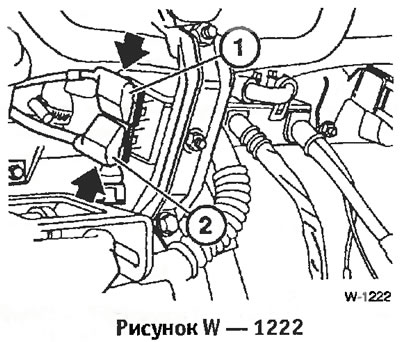
Connectors: 1 Cylinder Identification Sensor; 2 DME pulse sensor.
Disconnect connector "2" from the cable channel. The figure shows a four-cylinder engine, on a six-cylinder engine the connectors are located in the same order next to the oil dipstick mount.
Pull the sensor wires out of the guides. On a six-cylinder engine, remove cover "1" for this (Figure W 10156).
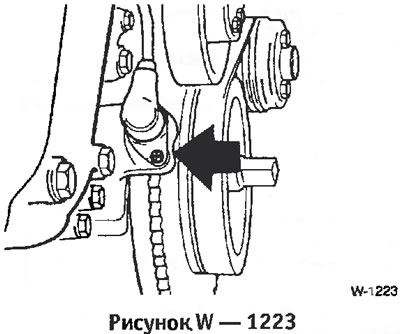
Loosen the crankshaft pulley bolt and remove the sensor with the cover.
Insert the sensor and tighten the bolt with a tightening torque of 10 Nm.
Check the distance of the sensor from the gear with a feeler gauge. Specified value: 0.7-1.0 mm.
Carefully lay the connection wires in the guides so that they do not rub against the V-belt. Connect the connector.
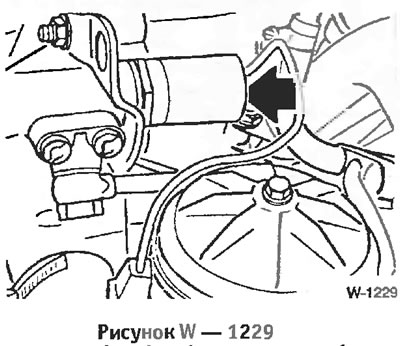
Models 320i, 325i, 328i from September 1992: The sensor is difficult to access. Therefore, first remove the connector of the solenoid valve of the VANOS actuator and unscrew the valve.
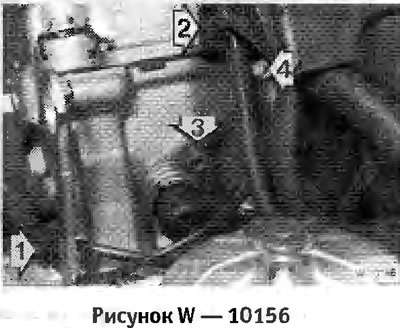
Models 318i, 318i produced since September 1993, 318is/ti, 320i, 3251, 328i: Unscrew bolt "3" on the cylinder head and remove the sensor.
Remove the distributor cap.
Disconnect the ignition wire of cylinder 4 at the ignition distributor.
Remove the angled connector from this ignition wire using side cutters.
Disconnect the induction loop of the sensor from the wire.
Pull the sensor wire out of the guide.
Disconnect the sensor connector.
Insert the sensor. Ensure that the sensor rubber gasket is correctly installed, replace the gasket if necessary.
Models 316i, 318i produced before August 1993: Assemble the spark plug wires and install the distributor cap.
Models 320i, 325i, 328i from September 1992: Screw in the VANOS solenoid valve, if necessary, replace the damaged seal first. Connect the electrical connector.
Examination
To check, disconnect the corresponding engine wiring harness connectors.
Measure the resistance between the connector contacts of the corresponding sensor and, if necessary, replace the sensor.
Set values at +20°C:
Crankshaft pulse sensor:
- 316i, 318i: 0.5 com;
- 318is/ti, 320i, 325i, 328i: 1.3 com.
Cylinder identification sensors (all): between contacts 1 and 2 of the connectors: maximum 1 ohm; between contacts 2 and 3: more than 10 mohm.
Removal the sensor on the crankshaft
Four-cylinder engine: Remove the radiator fan.
Connectors: 1 Cylinder Identification Sensor; 2 DME pulse sensor.
Disconnect connector "2" from the cable channel. The figure shows a four-cylinder engine, on a six-cylinder engine the connectors are located in the same order next to the oil dipstick mount.
Pull the sensor wires out of the guides. On a six-cylinder engine, remove cover "1" for this (Figure W 10156).
Loosen the crankshaft pulley bolt and remove the sensor with the cover.
Installation
Insert the sensor and tighten the bolt with a tightening torque of 10 Nm.
Check the distance of the sensor from the gear with a feeler gauge. Specified value: 0.7-1.0 mm.
Carefully lay the connection wires in the guides so that they do not rub against the V-belt. Connect the connector.
Removal the cylinder identification sensor
Models 320i, 325i, 328i from September 1992: The sensor is difficult to access. Therefore, first remove the connector of the solenoid valve of the VANOS actuator and unscrew the valve.
Models 318i, 318i produced since September 1993, 318is/ti, 320i, 3251, 328i: Unscrew bolt "3" on the cylinder head and remove the sensor.
Models 316i, 318i produced before August 1993:
Remove the distributor cap.
Disconnect the ignition wire of cylinder 4 at the ignition distributor.
Remove the angled connector from this ignition wire using side cutters.
Note: A special tool is required to install the new connector.
Disconnect the induction loop of the sensor from the wire.
Pull the sensor wire out of the guide.
Disconnect the sensor connector.
Installation
Insert the sensor. Ensure that the sensor rubber gasket is correctly installed, replace the gasket if necessary.
Models 316i, 318i produced before August 1993: Assemble the spark plug wires and install the distributor cap.
Models 320i, 325i, 328i from September 1992: Screw in the VANOS solenoid valve, if necessary, replace the damaged seal first. Connect the electrical connector.
This article is available at russian, bulgarian, belarusian, ukrainian, serbian, croatian, romanian, polish, slovak, hungarian
Article verified: Chebotarev Vladislav
Share information:
Previous articles
БМВ E36: Ignition system
Next articles
Similar articles on other types of BMW cars:
Checking/replacing the pulse sensor BMW 5 Series E39 (1995-2003)
Checking and replacing the pulse sensor and ignition control unit… BMW 5 Series E28 (1981-1988)
Pulse Generator — Checking and Replacing BMW 7 Series E32 (1986-1994)
Replacing the boost pressure sensor BMW 7 Series E38 (1994-2001)
Front pulse sensor BMW X3 E83 (2003-2010)
Checking the engine oil level and replacing it BMW X5 E53 (1999-2006)
Checking/replacing the pulse sensor BMW 5 Series E39 (1995-2003)
Checking and replacing the pulse sensor and ignition control unit… BMW 5 Series E28 (1981-1988)
Pulse Generator — Checking and Replacing BMW 7 Series E32 (1986-1994)
Replacing the boost pressure sensor BMW 7 Series E38 (1994-2001)
Front pulse sensor BMW X3 E83 (2003-2010)
Checking the engine oil level and replacing it BMW X5 E53 (1999-2006)
Link in different formats to this page
Visitor comments
No comments yet
- General information
- Manual
- Maintenance
- Power unit
- Engine repair
- Cooling system
- Power system (gasoline)
- Injection system (gasoline)
- Fuel system (diesel)
- Exhaust system
- Ignition system
- Charge and launch systems
- Transmission
- Car gearbox
- Clutch and drive shafts
- Chassis
- Brake system
- Suspension front and rear
- Steering
- Body
- Body care and repair
- Exterior
- Interior
- Electrical equipment
- Troubleshooting
- Lighting and signaling
- Equipment and devices
- Heater and air conditioner
- Electrical circuits
- General information
- Manual
- Repair on the road
- Weekly checks
- Maintenance
- Troubleshooting
- Power unit
- 4 cylinder engines
- 6 cylinder engines
- Engine overhaul
- Cooling and heating
- Fuel and exhaust system
- Starting and charging system
- Ignition system
- Transmission
- Clutch
- Mechanical gearbox
- Automatic gearbox
- Cardan and drive shafts
- Chassis
- Brake system
- Wheel suspension
- Steering
- Body
- Exterior
- Interior
- Electrical equipment
- Equipment and devices
- Electrical circuits
- General information
- Maintenance
- Power unit
- Engine repair
- Cooling system
- Ignition system
- Supply system
- Fuel injection system
- Exhaust system
- Transmission
- Clutch
- Car gearbox
- Front and rear axle
- Chassis
- Steering
- Brake system
- Body
- Exterior
- Interior
- Electrical equipment
- Heating system
- Equipment and devices
- Power devices
- Electrical circuits
- Power unit
- M10/M20 engine
- M40 engine
- Ignition system
- Lubrication system
- Cooling system
- Supply system
- Fuel injection
- Exhaust system
- Transmission
- Clutch
- Manual gearbox
- Front axle
- Rear axle
- Chassis
- Steering
- Brake system
- Body
- Exterior
- Interior
- Electrical equipment
- Heating system
- Equipment and devices
- Electrical circuits
- General information
- Specifications
- Operation and maintenance
- 4-cylinder engine
- Engine repair
- Cooling and lubrication system
- Supply system
- Ignition system
- 6-cylinder engine
- Engine repair
- Cooling and lubrication system
- Supply system
- Fuel injection system
- Ignition system
- Transmission
- Clutch
- 4-speed manual gearbox
- 5-speed manual gearbox
- Automatic gearbox
- Cardan and rear axle
- Chassis
- Steering
- Front suspension
- Rear suspension
- Brake system
- Electrical equipment
- Equipment and devices
- Electrical circuits