
- Home
- BMW 3 Series
- E46
- Power unit
- Charge and launch systems
- Checking the battery
Checking the battery (BMW 3 Series E46)
Built-in battery charge indicator
The indicator is green - the battery has a sufficient level of charge.
The indicator is black - The battery needs charging.
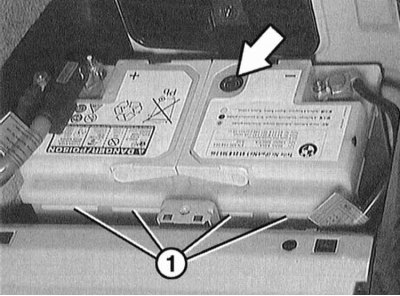
The BMW 3 Series battery has a built-in battery charge indicator (arrow on the illustration), located on the top side of the battery. This "magic eye" can, of course, only show the basic state of charge.
The battery is maintenance-free. No need to add distilled water. The electrolyte level can be determined from the outside. It is located around the MAX "1" mark, approximately 5 mm above the lead plates.
Checking the electrolyte level (for batteries requiring maintenance)
If you buy a non-BMW battery, it is usually a so-called low-maintenance battery. In this case, if the electrolyte level drops below the MIN mark, you need to top up with distilled water once or twice a year. All battery sections should have the same electrolyte level, between the MAX and MIN marks.
The electrolyte level must be checked from the outside. If this is not possible, remove the threaded caps and look into the section from above. The electrolyte level should be 5 mm above the lead plates.
Checking the density of the electrolyte
The density of the electrolyte in combination with the battery voltage gives an indication of the state of charge of the battery.
The electrolyte temperature during measurement should not be below +10°C.
1. Turn off the ignition.
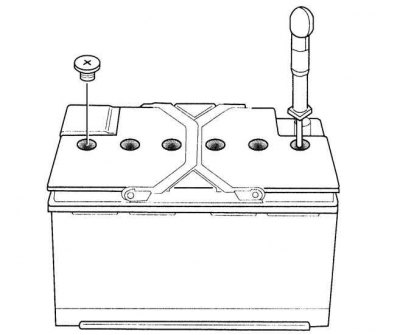
2. Unscrew the plugs from all sections of the battery. If there is a cover strip, first remove it with a screwdriver.
3. Immerse the densimeter in the electrolyte and suck out such a quantity of electrolyte that the float floats up. The higher the specific gravity (density) of the sampled electrolyte, the more the float floats up. The specific gravity (g/ml) or Baumé degrees (+°Be) can be read from the scale of the device.
4. The density of the electrolyte should be at least 1.20 g / ml. If the density value is lower, the battery needs to be charged. Refer to Specifications.
5. Check each section of the battery one by one. All sections should have the same density (maximum difference 0.04 g/ml). A large difference indicates battery damage.
Checking the battery resting voltage
The condition of the battery is checked by measuring the voltage between the battery terminals with a voltmeter.
6. Disconnect the battery terminals, refer to Section Removal and installation the battery.
7. The battery must be disconnected 2 hours before testing.
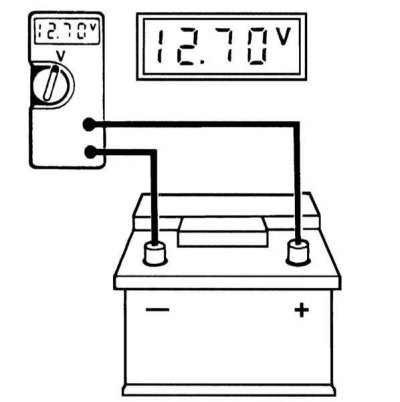
8. Connect a voltmeter to the battery terminals and measure the voltage.
9. Evaluation of measurement results:
12.5V or higher - the battery is in satisfactory condition
12.4V or below - the battery is in poor condition, charging or battery replacement is required
10. Connect the negative (-) cable to the battery, refer to Section Removal and installation the battery.
Checking battery voltage under load
11. Connect the voltmeter to the battery terminals.
12. Ask an assistant to start the engine and read the voltage.
13. During the starting process, when the battery is fully charged, the voltage should not drop below 10 V (at an electrolyte temperature of about +20°C).
14. If the voltage drops immediately and the density of the electrolyte in the sections is different, then the battery is damaged.
This article is based on data from the website: «www.bmwman.ru»
This article is available at russian, bulgarian, belarusian, ukrainian, serbian, croatian, romanian, polish, slovak, hungarian
Article verified: Sevastyanov Nikolay
Share information:
Previous articles
БМВ E46: Charge and launch systems
Next articles
Similar articles on other types of BMW cars:
Checking battery condition, care and charging BMW 5 Series E28 (1981-1988)
Checking the battery BMW 5 Series E39 (1995-2003)
Checking and caring for your battery BMW 7 Series E38 (1994-2001)
Starting the engine from an auxiliary battery BMW 7 Series E32 (1986-1994)
Bleeding the cooling system and checking it for leaks (M54, N46, N47,… BMW X3 E83 (2003-2010)
Checking the battery status BMW X5 E53 (1999-2006)
Checking battery condition, care and charging BMW 5 Series E28 (1981-1988)
Checking the battery BMW 5 Series E39 (1995-2003)
Checking and caring for your battery BMW 7 Series E38 (1994-2001)
Starting the engine from an auxiliary battery BMW 7 Series E32 (1986-1994)
Bleeding the cooling system and checking it for leaks (M54, N46, N47,… BMW X3 E83 (2003-2010)
Checking the battery status BMW X5 E53 (1999-2006)
Link in different formats to this page
Visitor comments
No comments yet
- General information
- Manual
- Maintenance
- Power unit
- Engine repair
- Cooling system
- Power system (gasoline)
- Injection system (gasoline)
- Fuel system (diesel)
- Exhaust system
- Ignition system
- Charge and launch systems
- Transmission
- Car gearbox
- Clutch and drive shafts
- Chassis
- Brake system
- Suspension front and rear
- Steering
- Body
- Body care and repair
- Exterior
- Interior
- Electrical equipment
- Troubleshooting
- Lighting and signaling
- Equipment and devices
- Heater and air conditioner
- Electrical circuits
- General information
- Manual
- Repair on the road
- Weekly checks
- Maintenance
- Troubleshooting
- Power unit
- 4 cylinder engines
- 6 cylinder engines
- Engine overhaul
- Cooling and heating
- Fuel and exhaust system
- Starting and charging system
- Ignition system
- Transmission
- Clutch
- Mechanical gearbox
- Automatic gearbox
- Cardan and drive shafts
- Chassis
- Brake system
- Wheel suspension
- Steering
- Body
- Exterior
- Interior
- Electrical equipment
- Equipment and devices
- Electrical circuits
- General information
- Maintenance
- Power unit
- Engine repair
- Cooling system
- Ignition system
- Supply system
- Fuel injection system
- Exhaust system
- Transmission
- Clutch
- Car gearbox
- Front and rear axle
- Chassis
- Steering
- Brake system
- Body
- Exterior
- Interior
- Electrical equipment
- Heating system
- Equipment and devices
- Power devices
- Electrical circuits
- Power unit
- M10/M20 engine
- M40 engine
- Ignition system
- Lubrication system
- Cooling system
- Supply system
- Fuel injection
- Exhaust system
- Transmission
- Clutch
- Manual gearbox
- Front axle
- Rear axle
- Chassis
- Steering
- Brake system
- Body
- Exterior
- Interior
- Electrical equipment
- Heating system
- Equipment and devices
- Electrical circuits
- General information
- Specifications
- Operation and maintenance
- 4-cylinder engine
- Engine repair
- Cooling and lubrication system
- Supply system
- Ignition system
- 6-cylinder engine
- Engine repair
- Cooling and lubrication system
- Supply system
- Fuel injection system
- Ignition system
- Transmission
- Clutch
- 4-speed manual gearbox
- 5-speed manual gearbox
- Automatic gearbox
- Cardan and rear axle
- Chassis
- Steering
- Front suspension
- Rear suspension
- Brake system
- Electrical equipment
- Equipment and devices
- Electrical circuits