
When bleeding the brake system, wear safety glasses. If fluid does get into your eyes, rinse them immediately with water and seek medical attention. Most types of brake fluid are flammable and can catch fire if they come into contact with, for example, hot engine parts. Therefore, brake fluid should be handled with the same care as gasoline. When adding or replacing brake fluid, always use the recommended type and take it from a container that has just been opened. Never reuse fluid left over from bleeding the system or add fluid to the reservoir that has been open for a long time, as this is potentially dangerous.
Brake fluid actively dissolves paint and plastic; if it spills, rinse it off immediately with plenty of water.
Bleeding the hydraulic system is necessary to remove any air that may have entered the system during removal or installation of hoses, brake lines, calipers or master cylinders.
If air has entered the system due to low brake fluid levels, or as a result of the brake lines being disconnected from the master cylinder, then all four brake systems will likely need to be bled.
If the brake pipe was disconnected only at the wheel, then only the caliper or wheel cylinder is bled.
If the brake pipe has been disconnected at the connector located between the master cylinder and one of the brake mechanisms, then the part of the system that is served by the disconnected pipe should be bled.
When bleeding the entire system, bleed it in this order: right rear, left rear, right front, and finally the left front brake mechanism.
1. Remove any residual vacuum from the booster by depressing the brake pedal about 30 times with the engine off. This will also relieve pressure in the anti-lock brake system, where fitted.
2. Remove the master cylinder reservoir cap and fill the reservoir with brake fluid. Install the cap.
During the bleeding procedure, check the fluid level as often as possible and add fluid as needed to prevent the fluid level from dropping below the acceptable level, which could cause air bubbles to enter the master cylinder.
3. To perform the bleeding procedure, you will need an assistant, an empty clear plastic container, and a piece of clear plastic or vinyl tubing that can be inserted onto the bleeder valves. You can also use a special "no-assistant" bleeder kit. This kit usually contains a tube or bottle with a built-in one-way valve - in this case, the pedal will be pressed normally, but when it is released, air will not flow back into the system. If using a "no-assistant" kit, follow the instructions included with it; same for pressure bleeding kits. In either case, you will also need a supply of fresh brake fluid of the recommended type and a wrench to operate the bleeder valve.
4. Starting from the right rear wheel, loosen the bleed valve slightly, then tighten it until it is closed but can be opened quickly and easily.
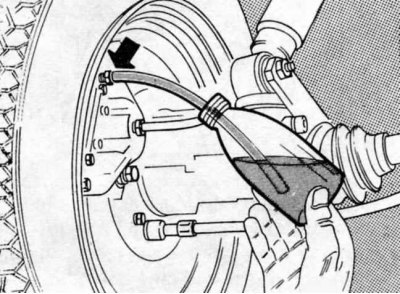
5. Place one end of the tube on the bleeder valve and immerse the other end in a container of brake fluid.
6. Ask an assistant to press the brake pedal several times and then hold it firmly pressed.
If the vehicle is equipped with ABS, have an assistant press the pedal at least 12 times.
7. With the brake pedal depressed, open the bleeder valve just enough to allow fluid to trickle out of the caliper or wheel cylinder. Have your assistant gently depress the brake pedal all the way and hold it there. Watch for air bubbles to escape through the submerged end of the tube. When the fluid flow slows after a few seconds, close the valve and have your assistant release the pedal.
8. Repeat the steps in the previous two paragraphs until no more air bubbles come out of the tube, then tighten the bleeder valve and move on to the rear left wheel, then the front right, and finally the front left, in that order, repeating the same procedure. Remember to check the fluid level in the master cylinder reservoir frequently.
Never use old brake fluid. It contains moisture, which will damage the brake system components.
9. At the end of the whole procedure, fill the master cylinder with liquid.
10. Check the operation of the brake mechanisms. The depressed pedal should remain motionless, not sink. If necessary, repeat the entire process. Do not use the car if you are not sure of the serviceability of its brake system.
[The website served as the basis for the text «bmwman»]