
Table of contents: Examination ↓ Replacement ↓
- Home
- BMW 5 Series
- E28
- Power unit
- Cooling system
- Checking the operation and replacing the thermostat
Checking the operation and replacing the thermostat (BMW 5 Series E28)
Do not remove the radiator cap, drain the coolant, or replace the thermostat before the engine has cooled completely.
Examination
1. Before you conclude that the thermostat is the cause of the cooling system malfunction, check the coolant level, drive belt tension and the serviceability of the gauge (or a signal lamp) coolant temperature.
2. If there is a suspicion that the engine warms up too slowly (based on poor heater performance or temperature meter readings), it is possible that the thermostat is stuck open. Replace the thermostat.
3. If the engine overheats while running, feel the upper radiator hose with your hand. If the hose is not hot and the engine is overheating, the thermostat may be stuck closed, preventing coolant from circulating through the radiator. Replace the thermostat.
Do not operate your vehicle without a thermostat. The engine will warm up slowly in cold weather, resulting in poor fuel economy and poor vehicle handling. A new thermostat is usually not an expensive component.
4. If the upper radiator hose is hot, coolant is circulating through the radiator and the thermostat is at least partially open. Refer to Section Diagnostics of cooling system faults at the end of this Section to identify the causes of overheating.
Replacement
All models
1. Disconnect the negative battery cable.
If your vehicle's radio is equipped with an anti-theft system, make sure you enter the correct code before disconnecting the battery.
If the instrument cluster displays the wrong language after connecting the battery, refer to Section Anti-theft audio system and instrument cluster language, which describes the procedure for installing the required language.
2. Drain the cooling system (see chapter Routine car maintenance). If the coolant is relatively new or in good condition, do not pour it out and then reuse it.
M10 engines
1. The thermostat is located in the lower hose. First remove the cooling fan.
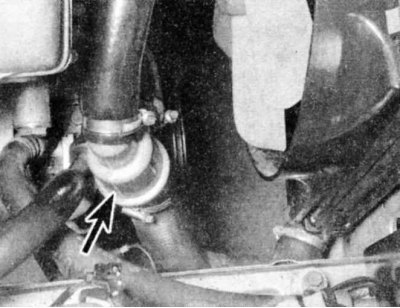
2. Note the position of the thermostat, then unscrew the hose clamps and remove the thermostat from the hose connections. On M10 engines (four-cylinder) thermostat (indicated by the arrow) built into the radiator hose
3. Install the thermostat into the hose connection and tighten the hose clamps.
4. Install the cooling fan.
Engines M20 and M30
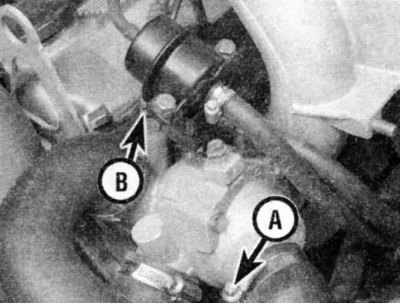
1. Loosen the hose clamp -A, then disconnect the hose(s) from the thermostat cover. Note that the coolant temperature sensor (which is almost invisible due to the fuel pressure regulator) located in the upper part of the thermostat housing -B.
2. If the outer surface of the nipple connection that mates with the hose is damaged in any way (corrosion, mechanical, etc.), its condition may be worsened by removing the hose. If so, you will need a new thermostat housing cover.
3. Loosen the bolts and remove the casing cover. If it is stuck, tap it with a soft-faced hammer. Be prepared for some coolant to spill out after the gasket sealant breaks.
4. Note the correct position of the thermostat and remove it.
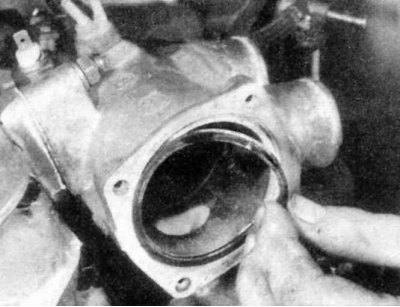
5. Seal the hole in the engine with a rag, then remove all traces of the old gasket material (if it's paper). Otherwise, remove the rubber sealing ring and scrape the sealant from the casing and cover with a special scraper.
6. Remove the rag from the hole in the engine and clean the mating surfaces of the gasket.
7. Install the new thermostat and gasket into the housing. Make sure it is installed correctly - the end of the spring should be facing the engine.
8. Install the cover and bolts. Tighten the bolts to the required torque.
M40 engines
1. Remove the cooling fan and upper timing belt cover.
2. Unscrew the hose clamp and remove the lower hose from the elbow on the front of the cylinder head.
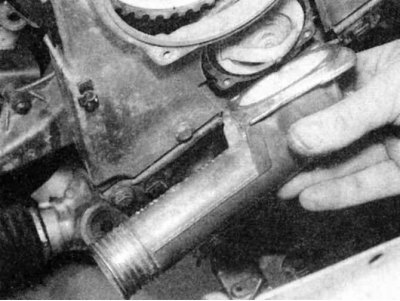
3. Unbolt the knee from the cylinder head.
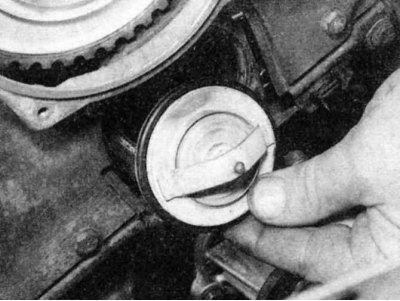
4. Note the correct position of the thermostat, then remove it.
5. Remove the rubber sealing ring; a new one will be required for assembly.
6. Place the thermostat in the cylinder head in the same position it was in before removal (the arrow points up).
7. Press the new sealing ring into the groove and install the elbow onto the cylinder head. Tighten the bolts.
8. Attach the lower hose to the elbow and tighten the hose clamp.
9. Install the upper timing belt cover and cooling fan.
All models
1. Fill the cooling system (see chapter Routine car maintenance).
2. Connect the negative battery cable.
3. Start the engine, warm it up to normal operating temperature, then check for leaks and that the thermostat is working properly (as described earlier in this Section).
This article is available at russian, bulgarian, belarusian, ukrainian, serbian, croatian, romanian, polish, slovak, hungarian
Article verified: Zhuravleva Isolda
Share information:
Previous articles
БМВ E28: Cooling system
Next articles
Similar articles on other types of BMW cars:
Checking the fuel system, replacing the fuel filter. Operation of a… BMW 3 Series E46 (1998-2006)
Checking the level and replacing the oil in the automatic transmission BMW 3 Series E21 (1975-1983)
Valve guides — checking and replacing BMW 7 Series E32 (1986-1994)
Checking the condition and replacing hoses and tubes in the engine… BMW 7 Series E38 (1994-2001)
Checking the operation of the power steering pump BMW X3 E83 (2003-2010)
Checking the engine oil level and replacing it BMW X5 E53 (1999-2006)
Checking the fuel system, replacing the fuel filter. Operation of a… BMW 3 Series E46 (1998-2006)
Checking the level and replacing the oil in the automatic transmission BMW 3 Series E21 (1975-1983)
Valve guides — checking and replacing BMW 7 Series E32 (1986-1994)
Checking the condition and replacing hoses and tubes in the engine… BMW 7 Series E38 (1994-2001)
Checking the operation of the power steering pump BMW X3 E83 (2003-2010)
Checking the engine oil level and replacing it BMW X5 E53 (1999-2006)
Link in different formats to this page
Visitor comments
No comments yet
- General information
- Governing bodies
- Manual
- Maintenance
- Power unit
- Engine repair
- Lubrication system
- Cooling system
- Ignition system
- Supply system
- Injection system (gasoline)
- Injection system (diesel)
- Exhaust system
- Transmission
- Clutch
- Car gearbox
- Front axle
- Rear axle
- Chassis
- Steering
- Brake system
- Wheels and tires
- Body
- Interior
- Exterior
- Heating system
- Electrical equipment
- Equipment and devices
- Power devices
- Windscreen wipers
- Electrical circuits
- General information
- Manual
- Maintenance
- Power unit
- Engine repair
- Ignition system
- Engine lubrication system
- Cooling system
- Fuel system (gasoline)
- Fuel system (diesel)
- Exhaust system
- Transmission
- Clutch
- Car gearbox
- Chassis
- Front and rear suspension
- Steering
- Brake system
- Body
- Exterior
- Interior
- Electrical equipment
- Heating system
- Equipment and devices
- Power devices
- Electrical circuits
- General information
- Manual
- Maintenance
- Power unit
- Engine in a car
- Engine overhaul
- Cooling system
- Supply system
- Ignition system
- Control system
- Transmission
- Clutch
- Manual gearbox
- Automatic gearbox
- Transmission line
- Chassis
- Steering
- Front suspension
- Rear suspension
- Brake system
- Body
- Body elements
- Car care and painting
- Electrical equipment
- Heater and air conditioner
- Equipment and devices
- Starter and generator
- Electrical circuits
- General information
- Operation and maintenance
- Specifications
- Power unit
- Engine repair
- Cooling and lubrication system
- Supply system
- Ecotronic power supply system
- Fuel injection system
- Ignition system
- Transmission
- Clutch
- Gearbox BMW 242/4
- Gearbox Getrag 262/8
- Gearbox Getrag 265/6
- Automatic gearbox
- Cardan gear
- Rear axle
- Chassis
- Steering
- Front suspension
- Rear suspension
- Brake system
- Electrical equipment
- Equipment and devices
- Electrical circuits