
Table of contents: Checking the control lamp ↓ Disc brakes ↓ Parking brake ↓ Checking the parking brake ↓
- Home
- BMW 7 Series
- E32
- General information
- Care and maintenance
- Checking the brake fluid level/indicator lamp
Checking the brake fluid level/indicator lamp (BMW 7 Series E32)
The brake fluid reservoir is located in the engine compartment. It has two chambers, one for each brake circuit. The threaded cap has a vent hole that should not be clogged.
The tank is transparent, so you can check the brake fluid level from the outside. When the level drops below the MIN mark, a control lamp lights up on the instrument panel. Therefore, it is recommended to periodically visually check the brake fluid level.
Remove the driver's side cabin air filter housing.
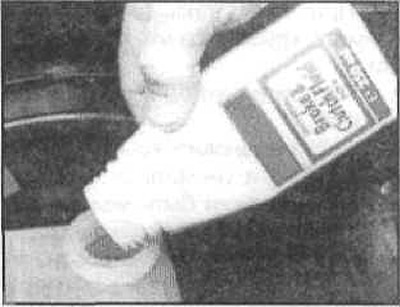
The fluid level with the cap closed should not be above the MAX mark and not below the MIN mark. Use DOT4 specification brake fluid.
Due to wear of the disc brake pads, the fluid level gradually drops, which is normal.
If the brake fluid level drops quickly, this indicates a brake fluid leak.
The leak location must be found immediately. For safety reasons, the brake system should be checked in a workshop.
Turn on the ignition, release the parking brake.
Press the contact in the tank cap down with your finger. Have an assistant check to see if the control lamp on the instrument panel lights up. If it does not, check the wires.
Install the cabin air filter housing. Checking the brake pad thickness
When the front or rear brake pads of the disc brakes are worn out, a warning light on the instrument panel lights up. In this case, the pads need to be replaced.
Mark the position of the wheel on the hub so that you can later install the balanced wheel in its original position. Loosen the wheel bolts.
Raise and support the car, remove the wheels.
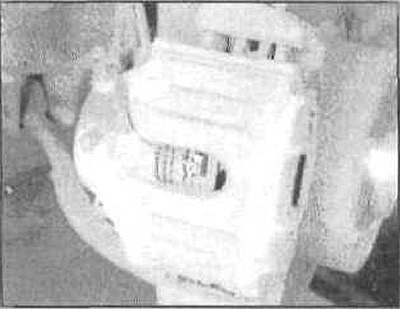
Check the thickness (excluding the thickness of the metal base) from above through the hole in the support.
Check the thickness of the outer pad from the side. If the thickness of the pad approaches the wear limit, remove the brake pads and measure the thickness with a caliper.
Wear limit of disc brake pads (front and back) achieved when the thickness of the working layer is 2 mm.
Check the caliper for brake fluid leaks. If there are any leaks, replace the caliper.
Check the brake discs on both sides for pitting, deep scratches and corroded areas and replace if necessary.
With the rear brake discs removed, the pads can be checked visually. The wear limit is reached when the thickness of the pad working layer at the thinnest point is 1.5 mm.
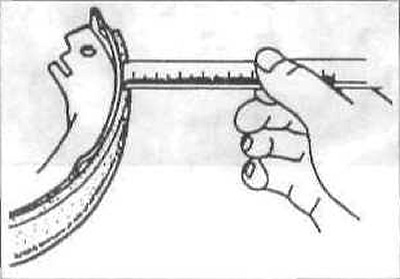
If the wear limit is reached, replace the brake pads. Be sure to replace all pads on one axle.
Install the wheels according to the marks made earlier. Do not lubricate the wheel bolts. Lower the car and tighten the wheel bolts crosswise to 100 Nm.
The parking brake is located in the rear disc brakes. Since the brake shoes of the parking brake wear little, it may happen that the brake drums corrode or the brake shoes become dirty. Therefore, before checking the parking brake, it is recommended to run in the parking brake as follows: From a speed of about 40 km / h, carefully tighten the parking brake until you feel light braking. Maintaining the specified speed, tighten the parking brake one more click and drive about 400 m. Release the parking brake and let it cool down.
Raise and support the vehicle from behind.
Apply the parking brake to the fifth click. Turn the two rear wheels by hand. They should feel a slight braking effect.
Apply the parking brake 6 clicks, the rear wheels should now be impossible to turn by hand.
Lower the car.
The tank is transparent, so you can check the brake fluid level from the outside. When the level drops below the MIN mark, a control lamp lights up on the instrument panel. Therefore, it is recommended to periodically visually check the brake fluid level.
Remove the driver's side cabin air filter housing.
The fluid level with the cap closed should not be above the MAX mark and not below the MIN mark. Use DOT4 specification brake fluid.
Due to wear of the disc brake pads, the fluid level gradually drops, which is normal.
If the brake fluid level drops quickly, this indicates a brake fluid leak.
The leak location must be found immediately. For safety reasons, the brake system should be checked in a workshop.
Checking the control lamp
Turn on the ignition, release the parking brake.
Press the contact in the tank cap down with your finger. Have an assistant check to see if the control lamp on the instrument panel lights up. If it does not, check the wires.
Install the cabin air filter housing. Checking the brake pad thickness
When the front or rear brake pads of the disc brakes are worn out, a warning light on the instrument panel lights up. In this case, the pads need to be replaced.
Mark the position of the wheel on the hub so that you can later install the balanced wheel in its original position. Loosen the wheel bolts.
Raise and support the car, remove the wheels.
Disc brakes
Check the thickness (excluding the thickness of the metal base) from above through the hole in the support.
Check the thickness of the outer pad from the side. If the thickness of the pad approaches the wear limit, remove the brake pads and measure the thickness with a caliper.
Wear limit of disc brake pads (front and back) achieved when the thickness of the working layer is 2 mm.
Note: 1 mm of pad wear corresponds approximately to a mileage of about 1000 km for disc brakes, and even then under unfavorable conditions. In normal cases, the pads last much longer. With a pad thickness of 5.0 mm (without base plate) their remaining service life is at least 3000 km.
Check the caliper for brake fluid leaks. If there are any leaks, replace the caliper.
Check the brake discs on both sides for pitting, deep scratches and corroded areas and replace if necessary.
Parking brake
With the rear brake discs removed, the pads can be checked visually. The wear limit is reached when the thickness of the pad working layer at the thinnest point is 1.5 mm.
If the wear limit is reached, replace the brake pads. Be sure to replace all pads on one axle.
Install the wheels according to the marks made earlier. Do not lubricate the wheel bolts. Lower the car and tighten the wheel bolts crosswise to 100 Nm.
Checking the parking brake
The parking brake is located in the rear disc brakes. Since the brake shoes of the parking brake wear little, it may happen that the brake drums corrode or the brake shoes become dirty. Therefore, before checking the parking brake, it is recommended to run in the parking brake as follows: From a speed of about 40 km / h, carefully tighten the parking brake until you feel light braking. Maintaining the specified speed, tighten the parking brake one more click and drive about 400 m. Release the parking brake and let it cool down.
Raise and support the vehicle from behind.
Apply the parking brake to the fifth click. Turn the two rear wheels by hand. They should feel a slight braking effect.
Apply the parking brake 6 clicks, the rear wheels should now be impossible to turn by hand.
Lower the car.
This article is available at russian, bulgarian, belarusian, ukrainian, serbian, croatian, romanian, polish, slovak, hungarian
Article verified: Sevastyanov Nikolay
Share information:
Previous articles
БМВ E32: Care and maintenance
Next articles
Similar articles on other types of BMW cars:
Checking the brake fluid level / warning light BMW 3 Series E36 (1990-2000)
Brake fluid level (and clutch) BMW 3 Series E46 (1998-2006, petrol)
Checking the brake fluid level/warning light BMW 5 Series E34 (1988-1996)
Checking the Brake Fluid Level / Low Brake Fluid Warning Light BMW 5 Series E39 (1995-2003)
Fuel level indicator BMW X3 E83 (2003-2010)
Checking the brake fluid level BMW X5 E53 (1999-2006)
Checking the brake fluid level / warning light BMW 3 Series E36 (1990-2000)
Brake fluid level (and clutch) BMW 3 Series E46 (1998-2006, petrol)
Checking the brake fluid level/warning light BMW 5 Series E34 (1988-1996)
Checking the Brake Fluid Level / Low Brake Fluid Warning Light BMW 5 Series E39 (1995-2003)
Fuel level indicator BMW X3 E83 (2003-2010)
Checking the brake fluid level BMW X5 E53 (1999-2006)
Link in different formats to this page
Visitor comments
No comments yet
- General information
- Introduction to guide
- Manual
- Maintenance
- Power unit
- Engine M60/1, M60/2 (petrol)
- M62 engine (petrol)
- M57 engine (diesel)
- M67 engine (diesel)
- Cooling system
- Fuel system (petrol)
- Fuel system (diesel)
- Exhaust system
- Ignition and control systems
- Charge and launch systems
- Transmission
- Clutch
- Mechanical gearbox
- Automatic gearbox
- Cardan and drive shafts
- Chassis
- Brake system
- Front suspension
- Rear suspension
- Steering
- Body
- Exterior
- Interior
- Electrical equipment
- Equipment and devices
- Lighting
- Heating and air conditioning
- Electrical circuits
- General information
- Care and maintenance
- Power unit
- Minor engine repair
- Engine overhaul
- Lubrication system
- Cooling system
- Ignition system
- Supply system
- Injection system (petrol)
- Injection system (diesel)
- Exhaust system
- Transmission
- Clutch
- Manual gearbox
- Automatic gearbox
- Cardan gear
- Rear axle and shafts
- Chassis
- Front suspension
- Rear suspension
- Steering
- Wheels and tires
- Brake system
- Body
- Body elements
- Electrical equipment
- Equipment and devices
- Electrical circuits