
- Home
- BMW 7 Series
- E32
- Transmission
- Clutch
- Clutch. General description
Clutch. General description (BMW 7 Series E32)
The clutch in a car performs two functions: when changing gears, it interrupts the transmission of torque between the engine and the gearbox, and when starting off, it ensures a smooth transmission of torque thanks to friction.
The clutch consists of a clutch pressure plate, a driven clutch plate and a release bearing.
The clutch pressure plate (basket) is secured with bolts to the flywheel, which in turn is connected to the engine crankshaft. Between the clutch pressure plate and the flywheel is the driven clutch disk, which is pressed by the pressure plate to the flywheel. The driven disk is centered on the splined primary (input) shaft of the manual transmission.
When pressing the clutch pedal (disengaging the clutch) with the help of a hydraulic drive, the clutch release lever is pressed against the spring of the pressure plate and presses on its petals. In this case, the pressure plate of the clutch is released, and the driven disk is no longer pressed against the flywheel. The force from the engine is not transmitted to the gearbox.
The clutch on all models has a hydraulic drive. The clutch hydraulic drive system uses brake fluid and is supplied with brake fluid from a common reservoir with the brake system.
Each time the clutch is engaged and disengaged, the working lining of the driven clutch disc wears down a little due to friction. The driven disc is therefore a wearable part, and its average service life is over 100,000 km. The wear rate depends mainly on the load (towing a trailer) and driving style. The clutch is maintenance-free, as it is self-adjusting.
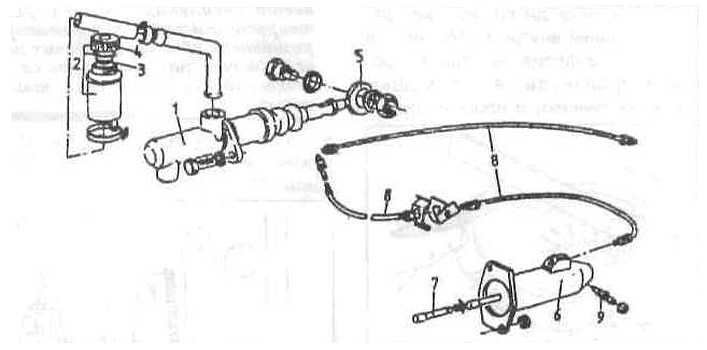
Clutch drive
1 - master cylinder;
2 — tank;
3 - filter;
4 - cork;
5 - traction;
6 — working cylinder;
7 — pusher;
8 - pipeline;
9 — air release valve.
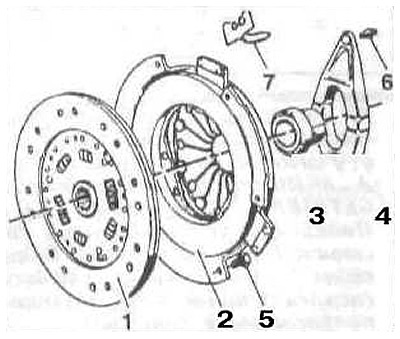
Clutch elements
1 - slave disk;
2 — clutch pressure plate (basket);
3 - release bearing;
4 — clutch release lever;
5 — mounting bolt;
6 - ball pin;
7 - spring clip.
Remove the gearbox.
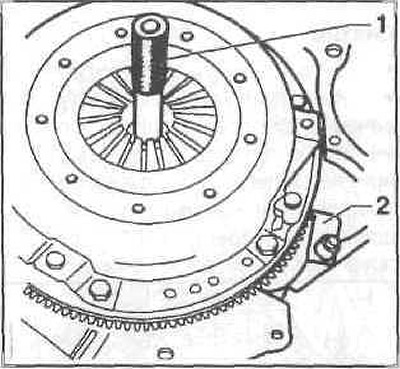
Secure the flywheel to the toothed ring using a screwdriver and rod or a special tool (1). Loosen the clutch pressure plate mounting bolts one by one by 1-1.5 turns until the pressure plate loosens.
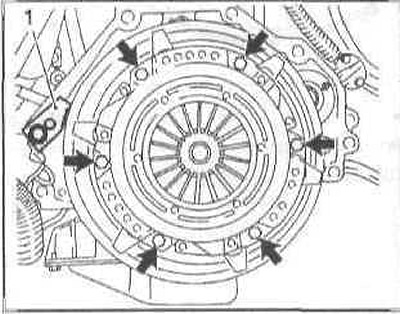
Finally, completely unscrew the bolts.
Remove the clutch pressure and driven discs.
Wipe and clean the flywheel.
Check the pressure plate for signs of burning or scratches and replace it if necessary.
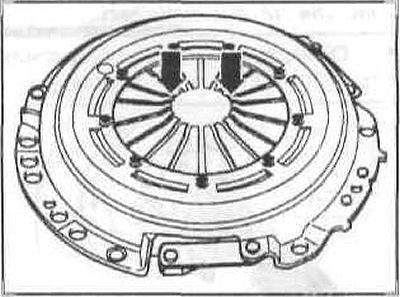
Check the diaphragm spring for damage (arrows).
Check the spring connections between the pressure plate and the cover (casing) for cracks, tightness of the rivets. Clutch discs with damaged or loose rivets must be replaced.
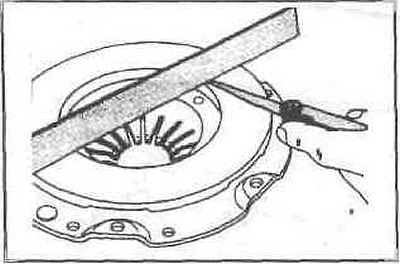
Check the working surface of the pressure plate for deep scratches, burn marks and wear. Pressure plates that are deformed inward by more than 0.3 mm must not be installed. Check with a steel ruler and flat feeler gauges.
Check the flywheel for signs of overheating and scratches and replace it if necessary. Replace the mounting bolts after each unscrewing. If the old flywheel is being installed, replace the bolts and tighten them crosswise to 105 Nm.
Clean the clutch pressure plate and flywheel with very fine sandpaper.
Oily or mechanically damaged clutch discs must be replaced.
Gently squeeze the clutch disc linings with a vice and measure the thickness with a caliper. The minimum lining thickness should be 7.5 mm, and if this is not the case, replace the driven clutch disc. The same applies to scratches on the linings.
Check the runout of the clutch driven disc in the workshop. The lateral runout of the disc should not exceed 0.5 mm.
Remove the release bearing from the tube on the gearbox and check it.
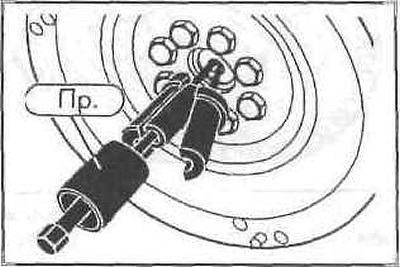
Check the ball bearing in the crankshaft for ease of movement. If necessary, remove the bearing with an internal puller and replace it with a new one.
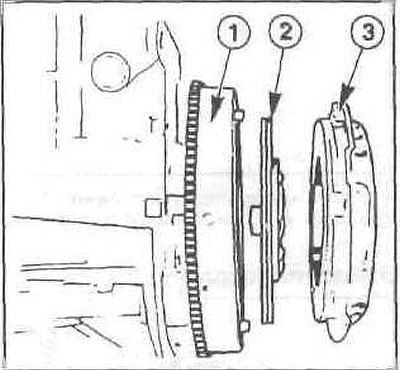
Install the driven disc (2) and the clutch pressure plate (3) onto the flywheel (1).
When installing, the driven disk must be centered using a suitable mandrel (1) or the old primary shaft.
Tighten the clutch pressure plate mounting bolts one at a time by 1 - 1.5 turns at a time.
When tightening the bolts, make sure that the pressure plate is pulled towards the flywheel evenly and without distortion.
The tightening torque is determined by the bolt class, which is stamped on their heads:
Remove the centering device.
If it was installed, remove the tool from the flywheel.
Lubricate the splines of the gearbox primary shaft with grease, applying a thin layer. Do not use too much grease, otherwise it may get on the working surfaces of the driven clutch disc, which will lead to defects in the clutch operation.
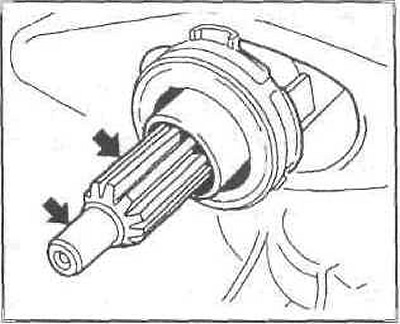
Install the gearbox.
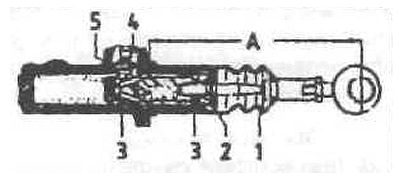
Clutch master cylinder
1 — anther;
2 - safety ring;
3 - cuffs;
4 - sealing plug;
5 - washer;
A = 140+0.5 mm – adjustment size.
The clutch consists of a clutch pressure plate, a driven clutch plate and a release bearing.
The clutch pressure plate (basket) is secured with bolts to the flywheel, which in turn is connected to the engine crankshaft. Between the clutch pressure plate and the flywheel is the driven clutch disk, which is pressed by the pressure plate to the flywheel. The driven disk is centered on the splined primary (input) shaft of the manual transmission.
When pressing the clutch pedal (disengaging the clutch) with the help of a hydraulic drive, the clutch release lever is pressed against the spring of the pressure plate and presses on its petals. In this case, the pressure plate of the clutch is released, and the driven disk is no longer pressed against the flywheel. The force from the engine is not transmitted to the gearbox.
The clutch on all models has a hydraulic drive. The clutch hydraulic drive system uses brake fluid and is supplied with brake fluid from a common reservoir with the brake system.
Each time the clutch is engaged and disengaged, the working lining of the driven clutch disc wears down a little due to friction. The driven disc is therefore a wearable part, and its average service life is over 100,000 km. The wear rate depends mainly on the load (towing a trailer) and driving style. The clutch is maintenance-free, as it is self-adjusting.
Clutch drive
1 - master cylinder;
2 — tank;
3 - filter;
4 - cork;
5 - traction;
6 — working cylinder;
7 — pusher;
8 - pipeline;
9 — air release valve.
Clutch elements
1 - slave disk;
2 — clutch pressure plate (basket);
3 - release bearing;
4 — clutch release lever;
5 — mounting bolt;
6 - ball pin;
7 - spring clip.
Removal
Remove the gearbox.
Secure the flywheel to the toothed ring using a screwdriver and rod or a special tool (1). Loosen the clutch pressure plate mounting bolts one by one by 1-1.5 turns until the pressure plate loosens.
Caution: When the bolts are almost completely unscrewed, the membrane can be damaged (plate-shaped) spring and dowel pins between the pressure plate and flywheel due to misalignment.
Finally, completely unscrew the bolts.
Remove the clutch pressure and driven discs.
Caution: The pressure plate and driven disc must not fall when removed, otherwise problems with gear shifting and clutch operation may occur after installation.
Wipe and clean the flywheel.
Examination
Check the pressure plate for signs of burning or scratches and replace it if necessary.
Check the diaphragm spring for damage (arrows).
Check the spring connections between the pressure plate and the cover (casing) for cracks, tightness of the rivets. Clutch discs with damaged or loose rivets must be replaced.
Check the working surface of the pressure plate for deep scratches, burn marks and wear. Pressure plates that are deformed inward by more than 0.3 mm must not be installed. Check with a steel ruler and flat feeler gauges.
Check the flywheel for signs of overheating and scratches and replace it if necessary. Replace the mounting bolts after each unscrewing. If the old flywheel is being installed, replace the bolts and tighten them crosswise to 105 Nm.
Clean the clutch pressure plate and flywheel with very fine sandpaper.
Oily or mechanically damaged clutch discs must be replaced.
Gently squeeze the clutch disc linings with a vice and measure the thickness with a caliper. The minimum lining thickness should be 7.5 mm, and if this is not the case, replace the driven clutch disc. The same applies to scratches on the linings.
Check the runout of the clutch driven disc in the workshop. The lateral runout of the disc should not exceed 0.5 mm.
Note: This check is only necessary when the previous driven disc is being installed and the clutch has not previously disengaged correctly.
Remove the release bearing from the tube on the gearbox and check it.
Check the ball bearing in the crankshaft for ease of movement. If necessary, remove the bearing with an internal puller and replace it with a new one.
Installation
Caution: Before installing a new clutch, remove the protective anti-corrosion coating from the working surfaces of the pressure plate and flywheel with solvent (if the flywheel is also new).
Install the driven disc (2) and the clutch pressure plate (3) onto the flywheel (1).
Caution: The flat side of the driven disc must face the pressure plate. The driven disc is marked GETRIEBESEITE (checkpoint side). The inscription in the installed state should also be visible. Place the clutch pressure plate on the corresponding guide pins.
When installing, the driven disk must be centered using a suitable mandrel (1) or the old primary shaft.
Tighten the clutch pressure plate mounting bolts one at a time by 1 - 1.5 turns at a time.
When tightening the bolts, make sure that the pressure plate is pulled towards the flywheel evenly and without distortion.
The tightening torque is determined by the bolt class, which is stamped on their heads:
- bolts with M8 thread class 8.8 - 25 Nm;
- class 10.9 -35 Nm.
Remove the centering device.
If it was installed, remove the tool from the flywheel.
Lubricate the splines of the gearbox primary shaft with grease, applying a thin layer. Do not use too much grease, otherwise it may get on the working surfaces of the driven clutch disc, which will lead to defects in the clutch operation.
Install the gearbox.
Clutch master cylinder
1 — anther;
2 - safety ring;
3 - cuffs;
4 - sealing plug;
5 - washer;
A = 140+0.5 mm – adjustment size.
This article is available at russian, bulgarian, belarusian, ukrainian, serbian, croatian, romanian, polish, slovak, hungarian
Article verified: Sevastyanov Nikolay
Share information:
Previous articles
БМВ E32: Clutch
Next articles
Similar articles on other types of BMW cars:
Clutch. General information BMW 3 Series E30 (1982-1994)
Clutch: general information and design BMW 3 Series E36 (1990-2000)
Clutch — general information and device BMW 5 Series E34 (1988-1996)
Clutch — General Information BMW 5 Series E39 (1995-2003)
Fuses — general description BMW X3 E83 (2003-2010)
Description of the clutch design BMW X5 E53 (1999-2006)
Clutch. General information BMW 3 Series E30 (1982-1994)
Clutch: general information and design BMW 3 Series E36 (1990-2000)
Clutch — general information and device BMW 5 Series E34 (1988-1996)
Clutch — General Information BMW 5 Series E39 (1995-2003)
Fuses — general description BMW X3 E83 (2003-2010)
Description of the clutch design BMW X5 E53 (1999-2006)
Link in different formats to this page
Visitor comments
No comments yet
- General information
- Introduction to guide
- Manual
- Maintenance
- Power unit
- Engine M60/1, M60/2 (petrol)
- M62 engine (petrol)
- M57 engine (diesel)
- M67 engine (diesel)
- Cooling system
- Fuel system (petrol)
- Fuel system (diesel)
- Exhaust system
- Ignition and control systems
- Charge and launch systems
- Transmission
- Clutch
- Mechanical gearbox
- Automatic gearbox
- Cardan and drive shafts
- Chassis
- Brake system
- Front suspension
- Rear suspension
- Steering
- Body
- Exterior
- Interior
- Electrical equipment
- Equipment and devices
- Lighting
- Heating and air conditioning
- Electrical circuits
- General information
- Care and maintenance
- Power unit
- Minor engine repair
- Engine overhaul
- Lubrication system
- Cooling system
- Ignition system
- Supply system
- Injection system (petrol)
- Injection system (diesel)
- Exhaust system
- Transmission
- Clutch
- Manual gearbox
- Automatic gearbox
- Cardan gear
- Rear axle and shafts
- Chassis
- Front suspension
- Rear suspension
- Steering
- Wheels and tires
- Brake system
- Body
- Body elements
- Electrical equipment
- Equipment and devices
- Electrical circuits