
The engine has a variable valve timing drive, which automatically changes the phase (moment) of opening and closing of the intake and exhaust valves by changing the initial position of the camshaft. This system has a brand name - "Doppel VANOS" (Doppel Variable Nockenwellensteuerung). In the technical literature, there is a designation - "Vi-Vanos". The engine also has a system for changing the height of the intake valve lift – Valvetronic, which allows you to adjust the engine power, excluding the use of a throttle valve. The engine design retains the throttle valve as an element of duplication in the engine control system.
The supply of oil under pressure to the engine is provided by a mechanical oil pump with internal gears. The oil pump has a chain drive from the crankshaft sprocket and is located in the oil pan of the crankcase. Oil is taken from the oil pan by the pump receiver and is supplied through channels and pipelines to the bearings of the crankshaft and camshafts, hydraulic compensators, as well as to the working surfaces of the cylinders from the injectors. The full-flow oil filter and pump are installed on a separate frame and connected to the engine channels by hoses.
The centrifugal type liquid cooling system pump is mounted in the front wall of the engine cylinder block. It is driven by a V-belt from the engine crankshaft pulley. The same belt is used as a drive for the generator and the power steering pump. A viscous coupling is installed on the pump shaft, which ensures the fan is turned on depending on the coolant temperature. The cooling system is sealed and must be constantly filled with antifreeze.
Table 5.1. Engine specifications
Model engines | N62B44 | N62B48 |
| Car model | X5/4.4i | X5/4,8is |
| Cylinder arrangement | V8/90° | |
| Cylinder diameter, mm | 92,0 | 93,0 |
| Piston stroke, mm | 82,7 | 88,3 |
| Working volume, cm³ | 4398 | 4799 |
| Compression ratio | 10,0 | 10,5 |
| Compression pressure, kg/cm² | 9/18* | |
| Nominal power, | ||
| – according to the EEC standard, kW | 235 | 265 |
| – according to DIN standard, hp. | 320 | 360 |
| Rotation speed, min⁻¹ | 6100 | 6200 |
| Maximum torque, | ||
| – according to EEC standard, N·m | 440 | 500 |
| – according to DIN standard, kgf·m | 44,9 | 51,0 |
| Rotation speed, min⁻¹ | 3600 | 3500 |
| Maximum frequency, min⁻¹ | 6100 | 6500 |
| Maximum spread of compression pressure in all cylinders | 1,5 | |
| Mixing system | ME9.2.1 | |
| Cylinder firing order | 1–5–4–8–6–3–7–2 | |
*) The numerator indicates the compression value at minimum valve lift, the denominator indicates the compression value at maximum valve lift.
The engine has a system of adjustable resonant supercharging, due to the change of the length of the intake channels. Engines can be removed from the car only upwards, using a special device and a lift (hoist), with a lifting capacity of at least 0.5 tons, with the hood of the car completely tilted upwards and secured with a special device.
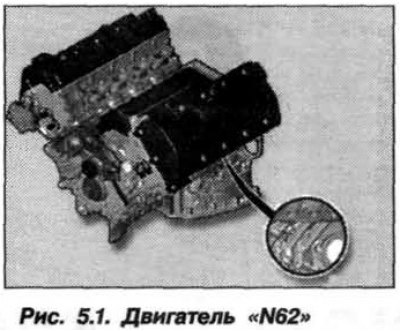
The general layout of the engine and the location of its serial number are shown in Fig. 5.1.
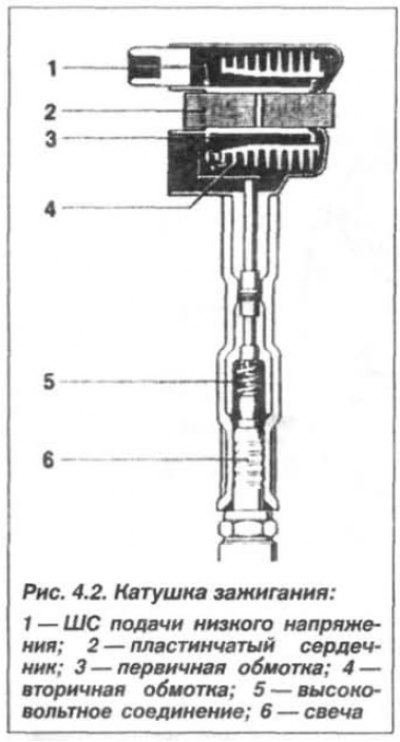
The engine uses a modification of the fuel injection and ignition system from Bosch (Germany), which has the index DME ("Digital Motor-Elektronik"), Motronic models - digital electronic engine management system, series ME9.2.1, which will be referred to as DME hereinafter. Electronic ignition system, with individual ignition coils (see fig. 4.2) for each cylinder, and controlled by an electronic unit from the DME.
The engines use gasoline with an octane number (ROZ) of 95 as fuel, however, the ability to suppress detonation in individual cylinders allows the use of fuels with octane numbers from ROZ 91 to ROZ 98. In the first case, fuel consumption increases due to loss of power, in the second case, there is fuel savings and increased power.
The transmission, with manual or automatic control, is mounted on the rear end of the engine and has all-wheel drive (4x4) with torque distribution.