It is recommended to use a special installation for bleeding hydraulic drives under pressure. If you do not have one, you can bleed the brake system by pressing the brake pedal. In this case, you will need an assistant. The efficiency of this method is lower, and the labor costs are greater than when using a special installation. When bleeding the brake system, monitor the presence of fluid in the tank, preventing its bottom from being exposed.
Warning: Due to the presence of a pressure regulator, bleeding must be carried out under load (and not hung out) wheels of the car. To eliminate the influence of the vacuum booster, it should be done with the engine off and after repeatedly pressing the brake pedal to bleed the vacuum.
Check the free travel of the brake pedal and the fluid level in the hydraulic reservoir.
Remove air first from one circuit, then from the other, starting each time from the wheel furthest from the master cylinder, observing the following sequence: brake cylinders of the right rear, left rear, right front and left front wheels.
Add brake fluid to the reservoir to the normal level.
Remove the protective caps from the air outlet fittings. Clean the fittings from dust and dirt.
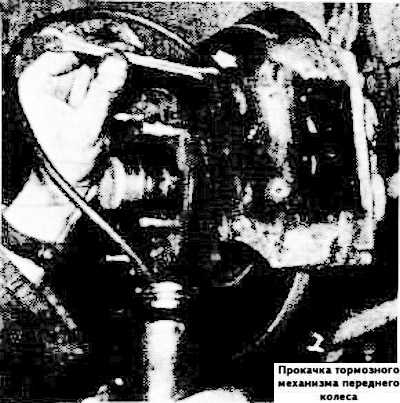
On disc brakes, place a transparent tube on the top nipple head and lower its free end into a container partially filled with clean brake fluid. Unscrew the nipple by 1/4 turn. After this, the assistant should slowly press the brake pedal and slowly release it, while the fluid along with the air will be forced out of the system through the hose into the container. Repeat this process until the bubbles stop coming out and clean fluid starts coming out of the hose. Hold the pedal in the pressed position and tightly screw the nipple to release air. Remove the hose and put a protective cap on the nipple.
Repeat the operations, unscrewing the lower fittings one by one, starting with the inner fitting.
Repeat the operations for the other wheels.
Bleeding air from the rear wheel drum brakes is done in the usual way.
After bleeding, restore the brake fluid level in the reservoir if necessary.
Since the 1978 model year, when bleeding the brake hydraulic system, the following points must be taken into account:
- the charging pressure should not exceed 2 kg/cm²;
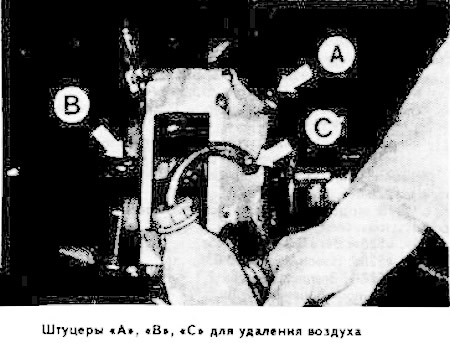
- to bleed the front wheel brakes, remove the wheels and bleed air through fittings A, B and C (see photo). Be sure to bleed air from both lower wheel cylinders first through fitting B, then through fitting C.