
- Home
- BMW 5 Series
- E12
- Power unit
- Ecotronic power supply system
- Maintenance, inspection and adjustment of the 2BE carburetor
Maintenance, inspection and adjustment of the 2BE carburetor (BMW 5 Series E12)
Before proceeding to check and adjust the 2BE "Ekotronik" carburetor, it is necessary to make sure that the controller is in good condition and check the wires and their connections. If the controller and wires are in good condition, then the carburetor should be checked to determine the cause of the malfunction. The position of the throttle stop screws is adjusted at the manufacturer and should not be changed during operation. Violation of the adjustment of these screws will lead to interruptions in the engine operation at idle and at low speeds.
The carburetor requires virtually no maintenance during operation. If necessary, you can check and adjust the carbon monoxide (CO) content in the exhaust gases. The reliability of the air hose connections should be checked periodically. After washing the engine, the carburetor should be treated with an anti-corrosion compound such as WD40 or Um-Spray Termal.
To clean the carburetor after checking the condition of the engine, ignition system and the Ecotronic system, remove the carburetor and clean its outer surfaces. Cast and steel parts are cleaned by immersing the carburetor in a bath filled with a special cleaning compound, after removing all electrical elements and plastic parts from the carburetor (including fuel inlet filter). After drying, wash all carburetor parts with white spirit and blow out the holes and internal channels with compressed air. When assembling the carburetor, replace worn parts (make sure there is no play in the throttle valve axles) and ensure free movement of all moving parts
Check the tightness of the connection between the carburetor and the intake manifold. The tightening torque of the carburetor mounting bolts should be within 8-10 N·m.
To check the controller, wires and electrical elements of the Ecotronic system installed on the carburetor, it is best to use the universal test device SIS from Bosch. If you do not have one, you can use a tester for these purposes (in ohmmeter and voltmeter modes).
Before checking the idle speed, check:
In addition, it is necessary to disconnect the crankcase gas discharge hose from the carburetor behind the throttle device, turn off the power consumers and warm up the engine (oil temperature is about 70°C), then check the engine idle speed, which should be within 800-900 rpm (up to 1985 model year) or 750-900 rpm (since 1985 model year).
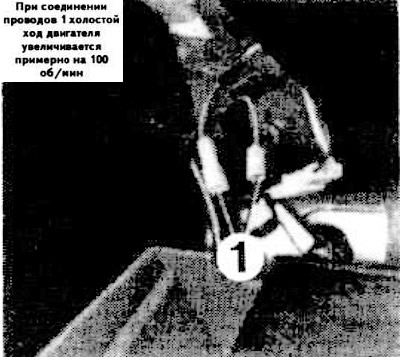
The engine idle speed is controlled by the controller and is not adjusted during operation (the carburetor design does not have an idle mixture quantity adjustment screw). However, if necessary, you can increase the idle speed of the crankshaft by approximately 100 rpm by connecting two wires (see photo) under the instrument panel on the right.
Check the CO content in the exhaust gases, which should be no more than 1.5% (up to 1985 model year) or within 0.3-0.7% (since 1985 model year).
If the obtained value does not fit within the specified limits, use the mixture quality adjusting screw to achieve the proper CO content in the exhaust gases, after removing the screw plug.
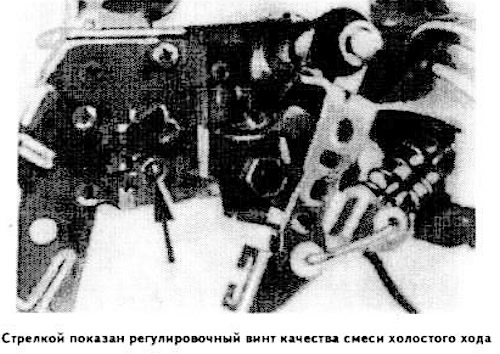
After adjustment, install a new plug into the hole for the mixture quality adjusting screw.
Disconnect the sensor connector and check its resistance directly on the plugs, which at a temperature of the intake manifold walls of 20°C should be within 2-3 kOhm. At a temperature of 80°C - within 280-360 Ohm.
If there is any deviation from the norm, replace the inlet air temperature sensor.
Information obtained from this online resource BMWMAN.ru
Carburetor Maintenance
The carburetor requires virtually no maintenance during operation. If necessary, you can check and adjust the carbon monoxide (CO) content in the exhaust gases. The reliability of the air hose connections should be checked periodically. After washing the engine, the carburetor should be treated with an anti-corrosion compound such as WD40 or Um-Spray Termal.
To clean the carburetor after checking the condition of the engine, ignition system and the Ecotronic system, remove the carburetor and clean its outer surfaces. Cast and steel parts are cleaned by immersing the carburetor in a bath filled with a special cleaning compound, after removing all electrical elements and plastic parts from the carburetor (including fuel inlet filter). After drying, wash all carburetor parts with white spirit and blow out the holes and internal channels with compressed air. When assembling the carburetor, replace worn parts (make sure there is no play in the throttle valve axles) and ensure free movement of all moving parts
Check the tightness of the connection between the carburetor and the intake manifold. The tightening torque of the carburetor mounting bolts should be within 8-10 N·m.
Checking and adjusting the carburetor
To check the controller, wires and electrical elements of the Ecotronic system installed on the carburetor, it is best to use the universal test device SIS from Bosch. If you do not have one, you can use a tester for these purposes (in ohmmeter and voltmeter modes).
Checking the engine idle speed
Before checking the idle speed, check:
- adjustment of clearances in the valve timing mechanism and compression in the engine cylinders;
- setting the ignition timing and the serviceability of the spark plugs;
- serviceability of electrical components, wires and their connections;
- intake tract tightness;
- cleanliness of the air filter element;
- serviceability of the intake air heating system;
- adjustment of the carburetor control drive.
In addition, it is necessary to disconnect the crankcase gas discharge hose from the carburetor behind the throttle device, turn off the power consumers and warm up the engine (oil temperature is about 70°C), then check the engine idle speed, which should be within 800-900 rpm (up to 1985 model year) or 750-900 rpm (since 1985 model year).
The engine idle speed is controlled by the controller and is not adjusted during operation (the carburetor design does not have an idle mixture quantity adjustment screw). However, if necessary, you can increase the idle speed of the crankshaft by approximately 100 rpm by connecting two wires (see photo) under the instrument panel on the right.
Check the CO content in the exhaust gases, which should be no more than 1.5% (up to 1985 model year) or within 0.3-0.7% (since 1985 model year).
If the obtained value does not fit within the specified limits, use the mixture quality adjusting screw to achieve the proper CO content in the exhaust gases, after removing the screw plug.
After adjustment, install a new plug into the hole for the mixture quality adjusting screw.
Checking the incoming air temperature sensor
Disconnect the sensor connector and check its resistance directly on the plugs, which at a temperature of the intake manifold walls of 20°C should be within 2-3 kOhm. At a temperature of 80°C - within 280-360 Ohm.
If there is any deviation from the norm, replace the inlet air temperature sensor.
Information obtained from this online resource BMWMAN.ru
This article is available at russian, bulgarian, belarusian, ukrainian, serbian, croatian, romanian, polish, slovak, hungarian
Article verified: Polikarpov Saveliy
Share information:
Previous articles
БМВ E12: Ecotronic power supply system
Next articles
Similar articles on other types of BMW cars:
Carburetor adjustment BMW 3 Series E30 (1982-1994)
Mechanical fuel pump — checking, adjustment, removal and installation BMW 3 Series E21 (1975-1983)
Vehicle maintenance plan BMW 7 Series E32 (1986-1994)
Schedule of current maintenance BMW 7 Series E38 (1994-2001)
Maintenance upcoming indicator (MOT) BMW X3 E83 (2003-2010)
Headlight re-adjustment BMW X5 E53 (1999-2006)
Carburetor adjustment BMW 3 Series E30 (1982-1994)
Mechanical fuel pump — checking, adjustment, removal and installation BMW 3 Series E21 (1975-1983)
Vehicle maintenance plan BMW 7 Series E32 (1986-1994)
Schedule of current maintenance BMW 7 Series E38 (1994-2001)
Maintenance upcoming indicator (MOT) BMW X3 E83 (2003-2010)
Headlight re-adjustment BMW X5 E53 (1999-2006)
Link in different formats to this page
Visitor comments
No comments yet
- General information
- Governing bodies
- Manual
- Maintenance
- Power unit
- Engine repair
- Lubrication system
- Cooling system
- Ignition system
- Supply system
- Injection system (gasoline)
- Injection system (diesel)
- Exhaust system
- Transmission
- Clutch
- Car gearbox
- Front axle
- Rear axle
- Chassis
- Steering
- Brake system
- Wheels and tires
- Body
- Interior
- Exterior
- Heating system
- Electrical equipment
- Equipment and devices
- Power devices
- Windscreen wipers
- Electrical circuits
- General information
- Manual
- Maintenance
- Power unit
- Engine repair
- Ignition system
- Engine lubrication system
- Cooling system
- Fuel system (gasoline)
- Fuel system (diesel)
- Exhaust system
- Transmission
- Clutch
- Car gearbox
- Chassis
- Front and rear suspension
- Steering
- Brake system
- Body
- Exterior
- Interior
- Electrical equipment
- Heating system
- Equipment and devices
- Power devices
- Electrical circuits
- General information
- Manual
- Maintenance
- Power unit
- Engine in a car
- Engine overhaul
- Cooling system
- Supply system
- Ignition system
- Control system
- Transmission
- Clutch
- Manual gearbox
- Automatic gearbox
- Transmission line
- Chassis
- Steering
- Front suspension
- Rear suspension
- Brake system
- Body
- Body elements
- Car care and painting
- Electrical equipment
- Heater and air conditioner
- Equipment and devices
- Starter and generator
- Electrical circuits
- General information
- Operation and maintenance
- Specifications
- Power unit
- Engine repair
- Cooling and lubrication system
- Supply system
- Ecotronic power supply system
- Fuel injection system
- Ignition system
- Transmission
- Clutch
- Gearbox BMW 242/4
- Gearbox Getrag 262/8
- Gearbox Getrag 265/6
- Automatic gearbox
- Cardan gear
- Rear axle
- Chassis
- Steering
- Front suspension
- Rear suspension
- Brake system
- Electrical equipment
- Equipment and devices
- Electrical circuits