
Install the satellites and satellite axle.
Install the device with the pointer-type indicator as shown in the photo and use two screwdrivers to move the axle gear until it stops at the satellites. In this position, set the indicator arrow to zero.
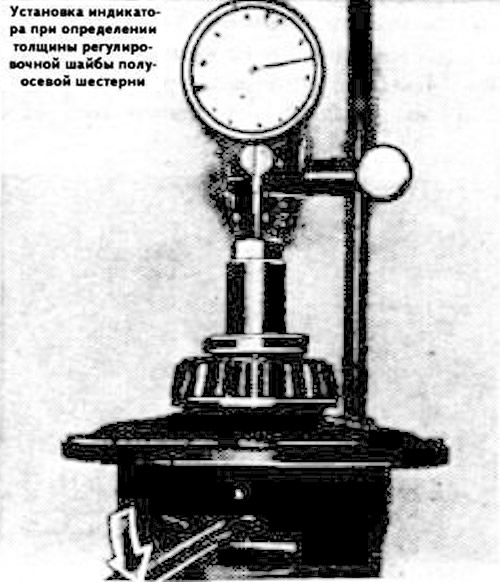
Move the axle gear until it stops in the differential box and read the indicator reading.
Subtract 0.05 mm from the obtained value to obtain the total thickness of the support and adjusting washers of the axle gear.
After installing the washers (the thrust washer is installed with the concave side facing the axle gear) the moment of resistance to rotation of the axle gear should not exceed 2 kgf·m.
Repeat the above operations for the other axle gear.
Remove the satellite axle and satellites from the differential box.
Remove the indicator and, by screwing in the measuring device bolt, which the indicator leg previously rested against, compress the support washers of the axle gears installed in the differential box so as to move the gears apart by a distance sufficient for installing the satellites and the satellite axle.
Insert the satellites and the satellite shaft and secure with a pin.
Install the driven gear, lubricating the threads of its mounting bolts with a special adhesive such as Loctite AW. If it is difficult to install the driven gear on the differential box, heat the gear evenly to a temperature of 80-100°C. It is prohibited to heat the gear to a temperature above 100°C.
Install the assembled differential into the rear axle housing, install the side housing cover, evenly tighten its mounting bolts to a torque of 2±0.5 kgf·m and measure the torque of resistance to rotation (preload) differential box bearings, which for new bearings should be within 14-16 kgf·cm.
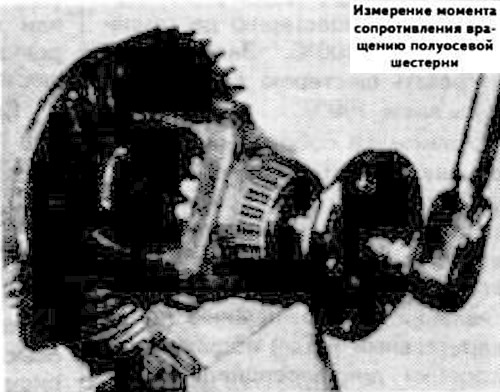
If the measured torque is less than 14 kgf·cm, install an increased thickness adjusting washer under the outer ring of the cover bearing and repeat the above check.
After adjusting the bearing preload, remove the differential from the rear axle housing.