
- Home
- BMW 5 Series
- E39
- General information
- Manual
- Automatic air conditioner
Automatic air conditioner (BMW 5 Series E39)
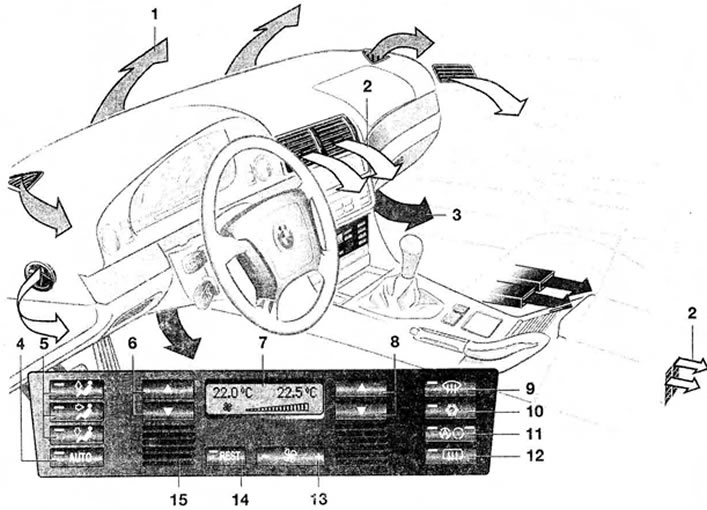
1. Air supply to the windshield and side windows.
2. Air supply to the upper body. The wheels allow you to smoothly open and close the air supply, and the levers provide a change in the direction of the incoming air flow.
3. Air supply to the feet in the front part of the cabin. Similar air blowers are also available in the rear part of the cabin.
4. Automatic air distribution.
5. individual air distribution.
6. Temperature regulator for the left side of the passenger compartment.
7. Temperature indicator, air supply.
8. Temperature regulator for the right side of the passenger compartment.
9. drying and defrosting glass.
10. air conditioner.
11. recirculation mode.
12. heated rear window (please also refer to Section 1).
13. Air supply regulator.
14. Key for switching on the engine residual heat mode.
15. Air intake grille for temperature sensor - please do not block it.
A pleasant temperature in the cabin in any weather conditions ensures comfortable conditions on the road. This contributes not only to your well-being, but also to road safety. Separate temperature control for the driver and front passenger takes into account the fact that well-being is an exclusively subjective concept. A large number of air vents, their location, and the possibility of individual adjustment ensure such air distribution that is not accompanied by drafts. A microfilter and an activated carbon filter clean the outside air entering the cabin. And the use of a refrigerant in the air conditioner that does not contain fluorochlorine hydrocarbons helps protect the environment.
Automatic air distribution

The automatic program will relieve you of the burden of adjusting the air distribution and, in addition, will bring the air supply and temperature parameters you entered into line with external conditions (summer, winter). The system will provide pleasant climate comfort in the car at any time of the year. Select a comfortable temperature in the cabin and the air supply power level. The parameters you entered are displayed on the indicator 7, refer to the overview illustration of the air flow distribution. Open the holes to supply air to the upper part of the body. In the warm season, turn on the air conditioner. Maximum cooling is provided by installing the knurled wheel 3 (refer to illustration) to the "Cold" position.
Individual air distribution

You can set the air distribution mode yourself, thus disabling the automatic system. Air is supplied to the glasses, to the upper part of the body, to the legs.
Temperature

The driver and front passenger can select the desired temperature for their side of the cabin. The scale divisions serve as a guide when selecting the cabin temperature. It is advisable to set the temperature to 22°C, including with the air conditioner on. Once the vehicle starts moving, the selected temperature is set very quickly and maintained at a constant level - both in summer and winter.
Defrosting and drying glass

This program will provide quick defrosting and drying of the windshield and side windows.
Air conditioner

When the air conditioner is on, the incoming outside air is cooled, dried and, if necessary, - depending on the selected temperature - heated again. Avoid frequently switching the air conditioner on and off to prevent the windows from fogging up. Depending on the weather conditions, the windshield may fog up for a while after starting the engine. Water condensation settles in the air conditioner and drains under the car. According to this, water marks on the road are not a sign of a malfunction.
Recirculation mode / Automatic control of outdoor air pollution (AUC)

If there are unpleasant odors in the outside air, you can stop it from entering the cabin.
In this case, the system will use only the air in the cabin. Pressing the button successively allows you to select three operating modes: Indicator lights are off - outside air is supplied.
The left indicator lamp is on: the system has detected an increased concentration of harmful substances in the outside air and has blocked its flow into the passenger compartment. Only the air in the passenger compartment is used.
Right indicator lamp lights: Outside air supply is interrupted for a long period of time. Only air from inside the vehicle is used.
If your vehicle is equipped with a multifunction steering wheel with a recirculation button, you can also control this mode from the steering wheel (refer to Section 1).
If the windows fog up when the recirculation mode is on, turn off the recirculation mode/automatic outside air pollution control.
Rear window heating

When the rear window heating is on, the indicator lamp lights up. The rear window heating is switched off automatically.
Air supply

You can smoothly adjust the air supply. The parameters you enter are displayed on indicator 7, refer to the overview illustration of the air distribution in the passenger compartment. If necessary, these parameters are automatically adjusted to the need for heating or cooling.
If you press "-" when the fan is running at its lowest power, all the indicators go out. The fan, heating system and air conditioner are switched off, the air supply is stopped. By pressing any button of the automatic air conditioner you switch the system on again.
Using the heat of a cooling engine

After the ignition is turned off, for example when stopping at a barrier, the heat accumulated in the engine continues to be used to heat the air in the cabin.
When you turn the key to position 0, heated air is automatically directed to blow the windshield and side windows, as well as to your feet. If the ignition key is turned to position 1, you can change all the parameters of the automatic air conditioner.
Chemical heat accumulator
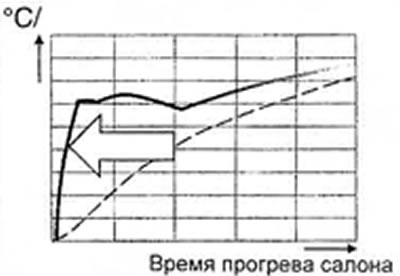
The heat accumulator accumulates heat from the engine even at extremely low ambient temperatures. And after starting the engine, this heat can be used directly to defrost and dry the windshield and side windows. The time required to warm up the interior and engine is also significantly reduced. The heat accumulator consists of a well-insulated accumulator connected to the engine cooling system. Its operating principle is based on the use of heat that is released when the environmentally friendly salt mixture is converted from a liquid to a solid state. Similar to the heat of melting ice, the heat of a heated engine is accumulated as a result of liquefying the salt mixture.
Thus, the heat accumulator increases driving safety and vehicle comfort without causing additional stress on the environment.
The battery does not require maintenance, as it is controlled by electronics.
This function can only be implemented when the outside air temperature is no higher than +15°C, the engine is warmed up to operating temperature, and the battery voltage is sufficient.
Draft-free ventilation
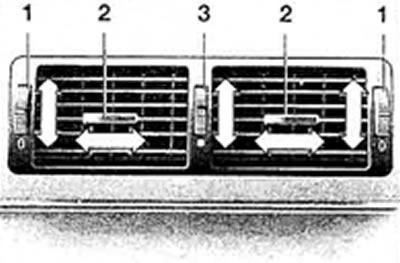
You can adjust the air flow to your upper body according to your wishes.
The grooved wheels 1 allow you to smoothly open and close the deflectors. The levers 2 allow you to change the direction of the air entering the cabin. The grooved wheel 3 allows you to add more or less cold air to the air entering the upper part of the body.
Turn towards the blue marking - cooler.
Turn towards the red marking - it's warmer.
The adjustment of the deflectors in the rear of the cabin is carried out in the same way as described above. The incoming air is not heated.
Microfilter, activated carbon filter
The microfilter traps dust particles and pollen present in the air taken from outside. The activated carbon filter removes gaseous substances from the incoming air. During maintenance, the combined filter is replaced. The need for early replacement can be determined by a significant decrease in the maximum air supply.
This article is available at russian, bulgarian, belarusian, ukrainian, serbian, croatian, romanian, polish, slovak, hungarian
Article verified: Ilyinsky Matvey
Share information:
Previous articles
БМВ E39: Manual
Next articles
Similar articles on other types of BMW cars:
Automatic transmission BMW 3 Series E21 (1975-1983)
Automatic transmission (AT). General description BMW 7 Series E32 (1986-1994)
General information about automatic transmission BMW 7 Series E38 (1994-2001)
Checking the level and topping up oil in the automatic transmission… BMW X3 E83 (2003-2010)
Automatic diagnostic system BMW X5 E53 (1999-2006)
Automatic transmission BMW 3 Series E21 (1975-1983)
Automatic transmission (AT). General description BMW 7 Series E32 (1986-1994)
General information about automatic transmission BMW 7 Series E38 (1994-2001)
Checking the level and topping up oil in the automatic transmission… BMW X3 E83 (2003-2010)
Automatic diagnostic system BMW X5 E53 (1999-2006)
Link in different formats to this page
Visitor comments
No comments yet
- General information
- Governing bodies
- Manual
- Maintenance
- Power unit
- Engine repair
- Lubrication system
- Cooling system
- Ignition system
- Supply system
- Injection system (gasoline)
- Injection system (diesel)
- Exhaust system
- Transmission
- Clutch
- Car gearbox
- Front axle
- Rear axle
- Chassis
- Steering
- Brake system
- Wheels and tires
- Body
- Interior
- Exterior
- Heating system
- Electrical equipment
- Equipment and devices
- Power devices
- Windscreen wipers
- Electrical circuits
- General information
- Manual
- Maintenance
- Power unit
- Engine repair
- Ignition system
- Engine lubrication system
- Cooling system
- Fuel system (gasoline)
- Fuel system (diesel)
- Exhaust system
- Transmission
- Clutch
- Car gearbox
- Chassis
- Front and rear suspension
- Steering
- Brake system
- Body
- Exterior
- Interior
- Electrical equipment
- Heating system
- Equipment and devices
- Power devices
- Electrical circuits
- General information
- Manual
- Maintenance
- Power unit
- Engine in a car
- Engine overhaul
- Cooling system
- Supply system
- Ignition system
- Control system
- Transmission
- Clutch
- Manual gearbox
- Automatic gearbox
- Transmission line
- Chassis
- Steering
- Front suspension
- Rear suspension
- Brake system
- Body
- Body elements
- Car care and painting
- Electrical equipment
- Heater and air conditioner
- Equipment and devices
- Starter and generator
- Electrical circuits
- General information
- Operation and maintenance
- Specifications
- Power unit
- Engine repair
- Cooling and lubrication system
- Supply system
- Ecotronic power supply system
- Fuel injection system
- Ignition system
- Transmission
- Clutch
- Gearbox BMW 242/4
- Gearbox Getrag 262/8
- Gearbox Getrag 265/6
- Automatic gearbox
- Cardan gear
- Rear axle
- Chassis
- Steering
- Front suspension
- Rear suspension
- Brake system
- Electrical equipment
- Equipment and devices
- Electrical circuits