
- Home
- BMW 5 Series
- E39
- General information
- Manual
- Automatic stability control with traction control (ASC+T)
Automatic stability control with traction control (ASC+T) (BMW 5 Series E39)
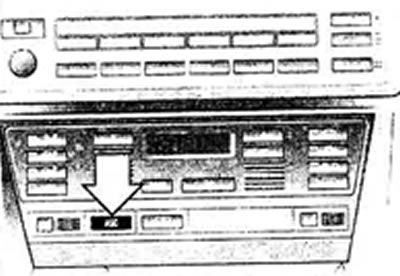
This system improves driving stability, especially during acceleration and cornering.
The automatic stability control system with traction control ASC+T prevents wheel slip and ensures maximum possible driving stability.
The wheel sensors determine their angular velocities. On this basis, the control system makes a conclusion about the slippage of the drive wheels. Depending on the road conditions, two adjustment mechanisms are used. In the case of a large excess of power and, consequently, slippage of the drive wheels, the engine torque is reduced. In addition to this, and without the driver's intervention, automatic braking of the slipping drive wheel is performed. This achieves an effect comparable to the effect of an adjustable limited-slip differential. Such braking is possible at a speed of up to 40 km/h. At a speed above 40 km/h, but not more than 100 km/h, braking of lesser intensity is used to increase traction.
The system is switched on after each engine start.
The control lamp on the instrument panel goes out after some time after the ignition is turned on (refer to Section 1).
System shutdown
Press the key. The indicator lamp will light.
Reversing the system
Press the key again. The indicator lamp will go out.
Flashing indicator light
Flashing means that the system is adjusting traction forces based on the actual driving mode.
If the control lamp does not go out after starting the engine or lights up while driving, this is a signal of a system malfunction. However, the car remains suitable for normal operation even without ASC+T. For repairs, contact a BMW service station.
[You can read the original on the website «BMWman»]
This article is available at russian, bulgarian, belarusian, ukrainian, serbian, croatian, romanian, polish, slovak, hungarian
Article verified: Ilyinsky Matvey
Share information:
Previous articles
БМВ E39: Manual
Next articles
Similar articles on other types of BMW cars:
Automatic stability control system with engine torque control ASC+T /… BMW 3 Series E46 (1998-2006)
Automatic transmission control mechanism parts BMW 3 Series E21 (1975-1983)
Control dimensions and adjustment data. Cars produced since 1986 BMW 7 Series E32 (1986-1994)
Checking fluid levels, leak control BMW 7 Series E38 (1994-2001)
Automatic transmission control system BMW X3 E83 (2003-2010)
Adjusting the automatic transmission control unit lever BMW X5 E53 (1999-2006)
Automatic stability control system with engine torque control ASC+T /… BMW 3 Series E46 (1998-2006)
Automatic transmission control mechanism parts BMW 3 Series E21 (1975-1983)
Control dimensions and adjustment data. Cars produced since 1986 BMW 7 Series E32 (1986-1994)
Checking fluid levels, leak control BMW 7 Series E38 (1994-2001)
Automatic transmission control system BMW X3 E83 (2003-2010)
Adjusting the automatic transmission control unit lever BMW X5 E53 (1999-2006)
Link in different formats to this page
Visitor comments
No comments yet
- General information
- Governing bodies
- Manual
- Maintenance
- Power unit
- Engine repair
- Lubrication system
- Cooling system
- Ignition system
- Supply system
- Injection system (gasoline)
- Injection system (diesel)
- Exhaust system
- Transmission
- Clutch
- Car gearbox
- Front axle
- Rear axle
- Chassis
- Steering
- Brake system
- Wheels and tires
- Body
- Interior
- Exterior
- Heating system
- Electrical equipment
- Equipment and devices
- Power devices
- Windscreen wipers
- Electrical circuits
- General information
- Manual
- Maintenance
- Power unit
- Engine repair
- Ignition system
- Engine lubrication system
- Cooling system
- Fuel system (gasoline)
- Fuel system (diesel)
- Exhaust system
- Transmission
- Clutch
- Car gearbox
- Chassis
- Front and rear suspension
- Steering
- Brake system
- Body
- Exterior
- Interior
- Electrical equipment
- Heating system
- Equipment and devices
- Power devices
- Electrical circuits
- General information
- Manual
- Maintenance
- Power unit
- Engine in a car
- Engine overhaul
- Cooling system
- Supply system
- Ignition system
- Control system
- Transmission
- Clutch
- Manual gearbox
- Automatic gearbox
- Transmission line
- Chassis
- Steering
- Front suspension
- Rear suspension
- Brake system
- Body
- Body elements
- Car care and painting
- Electrical equipment
- Heater and air conditioner
- Equipment and devices
- Starter and generator
- Electrical circuits
- General information
- Operation and maintenance
- Specifications
- Power unit
- Engine repair
- Cooling and lubrication system
- Supply system
- Ecotronic power supply system
- Fuel injection system
- Ignition system
- Transmission
- Clutch
- Gearbox BMW 242/4
- Gearbox Getrag 262/8
- Gearbox Getrag 265/6
- Automatic gearbox
- Cardan gear
- Rear axle
- Chassis
- Steering
- Front suspension
- Rear suspension
- Brake system
- Electrical equipment
- Equipment and devices
- Electrical circuits