
- Home
- BMW 5 Series
- E39
- General information
- Manual
- Automatic transmission (AT)
Automatic transmission (AT) (BMW 5 Series E39)
The automatic transmission of your BMW is equipped with an adaptive control system (AGS). The adaptive transmission control system (AGS) selects the most appropriate gear shift mode for vehicles equipped with AT, taking into account many factors. The system takes into account your individual driving style, driving conditions, road conditions and the traffic situation.
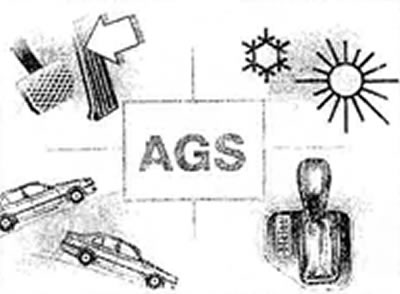
The AGS system determines your individual driving style by evaluating the position and travel of the accelerator pedal, deceleration during braking and the lateral acceleration acting on the car when cornering. From four different settings - from extremely comfortable to one aimed at maximising the vehicle's capabilities - the AGS system selects the most suitable one for the given situation.
To take into account the driving conditions, the system registers turns, climbs and slopes. When cornering at high speed, it does not shift to higher gears. On climbs, shifts to higher gears are performed only at high engine speeds in order to better utilize the engine's power capabilities. On descents, the system shifts to lower gears if it registers an increase in vehicle speed and the brake pedal is pressed.
In terms of taking into account the road conditions, the AGS system monitors the coefficient of adhesion between the tires and the road surface; on snow or ice, it automatically switches to the winter program. For starting off, second gear is used, upshifts are made in advance, and on descents in the mountains, despite pressing the brake pedal, downshifts are not made. This allows you to feel the situation more subtly and contributes to greater driving safety. As soon as the system recognizes a road with good grip properties, it switches to the normal program. The winter program is also deactivated if you move the AT control lever from position "D" to position "'S", "3" or "2", as well as if you switch off the ASC+T system.
The AGS system is able to determine the traffic situation, which ensures the greatest possible comfort. For example, it recognizes traffic jams and leaves only the second gear engaged until it determines an increase in the power expended on acceleration.
Of course, the automatic transmission can also be controlled manually. You can fully exploit the vehicle's capabilities by moving the AT control lever from position "D" to position "S", "3" or "2". Positions "3" and "2" limit the maximum permissible gear. Position "2" is used primarily for driving on steep mountain roads, with a large vehicle load.
P, R, N, D, S, 3, 2
The indication of the selected gear varies and depends on the configuration of your vehicle (see illustrations).
The engine can only be started when the AT control lever is set to position P or N.
Before engaging a forward gear, press the brake pedal, as the vehicle will move slowly even at idle when in a forward gear.
After moving the lever to the position corresponding to forward movement, wait for the moment when the gear is engaged, accompanied by a slight push, and only then press the accelerator pedal.
Before you leave the vehicle with the engine running, move the AT control lever to position P or N and apply the parking brake.
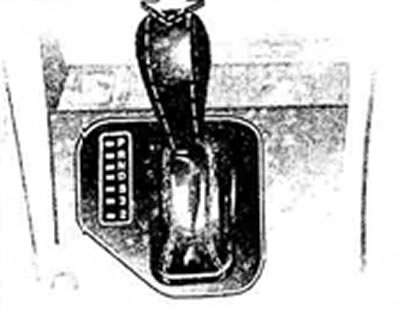
On the front side of the AT control lever handle there is (shown by arrow) lock button, preventing the lever from being accidentally moved to some of the positions. To release the lock, press the button.
If you accidentally move the lever to the N position while driving at high speed, release the gas immediately. Wait until the engine reaches idle speed, and then move the lever to the desired position.
Turn on only after the vehicle has stopped.
Turn on only after the vehicle has come to a complete stop.
Switch on only during long breaks in movement. Switching on while driving is only permitted if there is a risk of skidding of the vehicle.
This position corresponds to the normal driving mode. All gears are automatically switched all forward gears. The functioning of the AGS system is completely unlimited.
With this position of the AT control lever, the AGS system uses exclusively the sports program. AT shifts up to 4th gear (bMW 525tds up to 5th gear).
It is recommended to switch to the sports program if - regardless of the actual driving style - there is a desire to implement a gear shift mode oriented towards using the available power reserve.
Switch on to limit the number of working gears, for example on steep climbs or descents in the mountains. Shifts are performed automatically, but only up to the selected limiting gear.
In position 3 the sports program is switched on.
Position 2 is particularly suitable for towing a trailer thanks to the appropriate selection of gear ratios.
The gearbox shifts down to a lower gear when the speed drops accordingly.
It is activated when the accelerator pedal is pressed all the way down. At the same time, the AT downshifts for maximum acceleration of the car.
If the indicator lamp lights up or a message appears on the automatic diagnostic display "Getriebenotprogramm" (Gearbox control emergency program), this means that there is a malfunction either in the electronics that control the switching or in the box itself.
At the same time, it is possible to move the AT control lever to any position, but when forward gear is engaged, the car will only move in fourth or fifth gear.
Therefore, you should avoid excessive loads and drive to the nearest BMW service station.
Work in the engine compartment must not be carried out under any circumstances when the automatic transmission control lever is set to the drive position.
The rules for starting the engine by towing and from an external battery, as well as towing a faulty vehicle are set out in the Introduction.
Even though your vehicle is equipped with an automatic transmission with AGS, you can still use manual gear shifting.
To change gears manually, move the AT control lever from position "D" to the left to the M/S line. This activates the sports shift program. By touching the lever in the "+" direction or giving the Steptronic system a command to change gears, move the lever to the right to position "D".
P, R, N, D, M/S
The indication of the AT control lever position varies depending on the vehicle configuration (see illustrations). Adaptive program (position D of the AT control lever) will allow you to take advantage of the AGS system. Explanations for manual switching in M/S mode can be found below.
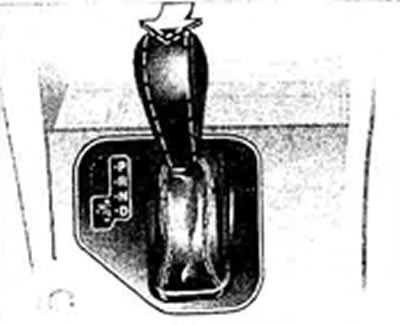
On the front side of the AT control lever handle there is (shown by arrow) a lock button that prevents the lever from being moved to positions R and P by mistake. To release the lock, press this button.
The engine can only be started when the AT control lever is set to position P or N.
Before engaging forward gear, press the brake pedal, as the car will move slowly even at idle when this gear is engaged.
Having moved the lever to the position corresponding to the forward movement, wait for the moment of engagement of the gear, accompanied by a slight push, and only then press the accelerator pedal. If you want to get out of the car without turning off the engine, then move the AT control lever to the P or N position and tighten the parking brake.
If you accidentally move the lever to the N position while driving at high speed, release the gas immediately. Wait until the engine reaches idle speed, and then move the lever to the desired position.
P - parking position
Switch on only after the car has come to a complete stop. The drive wheels are locked.
R - reverse gear
Turn on only after the vehicle has stopped.
N - neutral position
Switch on only during long breaks in movement. Switching on while driving is allowed only in case of danger of skidding of the car.
D - the main driving mode with automatic gear shifting
Corresponds to normal driving mode. All forward gears are switched automatically. The AGS system is in working condition.
For rapid acceleration, the accelerator pedal can be pressed beyond the full throttle position, passing the point of increased resistance.
M/S - Manual mode and sports program
When switching from D mode to M/S mode, the sports program is activated, as indicated by the letter S appearing on the indicator of the selected gear shift program.
In the S position, the AGS system uses only the sportiest gear shift program. AT will only shift up to 4th gear; it is recommended to switch to the sport program if, regardless of the actual driving style, there is a desire to implement a gear shift mode oriented towards using the available power reserve.
If you move the lever forward in the "+" direction, the gearbox switches to a higher gear, and if you move the lever in the "-" direction, it switches to a lower gear. At the same time, the first touch causes a transition to manual control.
Depending on the vehicle configuration, the selected gear indicator shows 1...5 or M1...M5.
Inadmissible upshifts or downshifts are ignored. For example, downshifts at too high engine speeds are not performed. The selected gear is briefly displayed on the instrument cluster. If several gear shifts are performed in succession, the last inadmissible gear selected is briefly displayed. The currently engaged gear is then displayed.
When driving in manual mode, to accelerate from 4th or 5th gear at low speeds - for example when overtaking - downshifting must be done manually or using the "Kick-Down" function.
Switching from M to P, R, N is only possible via position D.
The "Stepuonic" system thinks for you in the following situations:
Using the maximum acceleration function causes the transmission to shift to the lowest possible gear at the given engine speed. Depending on the situation, for example in winter conditions, starting off may be done in 2nd or 3rd gear.
If the indicator lamp lights up or a message appears on the automatic diagnostic display "Getnebenotprogramm" (Gearbox control emergency program), this means that there is a malfunction either in the electronics that control the switching, or in the box itself.
At the same time, it is possible to move the AT control lever to any position, but when forward gear is engaged, the car will only move in fourth or fifth gear
Therefore, you should avoid excessive loads and drive to the nearest BMW service station.
Work in the engine compartment must never be carried out with the automatic transmission control lever in the drive position.
The rules for starting the engine by towing from an external battery, as well as towing a faulty vehicle, are presented in the Introduction to the Manual.
You can read the original on the website BMWMAN.ru
The AGS system determines your individual driving style by evaluating the position and travel of the accelerator pedal, deceleration during braking and the lateral acceleration acting on the car when cornering. From four different settings - from extremely comfortable to one aimed at maximising the vehicle's capabilities - the AGS system selects the most suitable one for the given situation.
To take into account the driving conditions, the system registers turns, climbs and slopes. When cornering at high speed, it does not shift to higher gears. On climbs, shifts to higher gears are performed only at high engine speeds in order to better utilize the engine's power capabilities. On descents, the system shifts to lower gears if it registers an increase in vehicle speed and the brake pedal is pressed.
In terms of taking into account the road conditions, the AGS system monitors the coefficient of adhesion between the tires and the road surface; on snow or ice, it automatically switches to the winter program. For starting off, second gear is used, upshifts are made in advance, and on descents in the mountains, despite pressing the brake pedal, downshifts are not made. This allows you to feel the situation more subtly and contributes to greater driving safety. As soon as the system recognizes a road with good grip properties, it switches to the normal program. The winter program is also deactivated if you move the AT control lever from position "D" to position "'S", "3" or "2", as well as if you switch off the ASC+T system.
The AGS system is able to determine the traffic situation, which ensures the greatest possible comfort. For example, it recognizes traffic jams and leaves only the second gear engaged until it determines an increase in the power expended on acceleration.
Of course, the automatic transmission can also be controlled manually. You can fully exploit the vehicle's capabilities by moving the AT control lever from position "D" to position "S", "3" or "2". Positions "3" and "2" limit the maximum permissible gear. Position "2" is used primarily for driving on steep mountain roads, with a large vehicle load.
AT control lever positions
 |
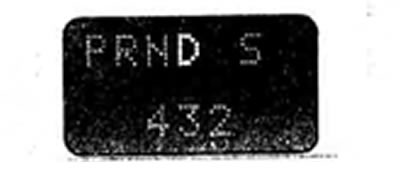 |
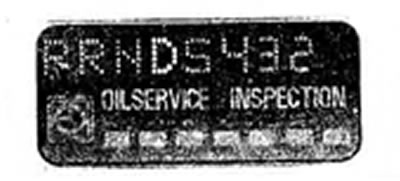
P, R, N, D, S, 3, 2
The indication of the selected gear varies and depends on the configuration of your vehicle (see illustrations).
Changing the position of the AT control lever
The engine can only be started when the AT control lever is set to position P or N.
Before engaging a forward gear, press the brake pedal, as the vehicle will move slowly even at idle when in a forward gear.
After moving the lever to the position corresponding to forward movement, wait for the moment when the gear is engaged, accompanied by a slight push, and only then press the accelerator pedal.
Before you leave the vehicle with the engine running, move the AT control lever to position P or N and apply the parking brake.
On the front side of the AT control lever handle there is (shown by arrow) lock button, preventing the lever from being accidentally moved to some of the positions. To release the lock, press the button.
If you accidentally move the lever to the N position while driving at high speed, release the gas immediately. Wait until the engine reaches idle speed, and then move the lever to the desired position.
P - parking position
Turn on only after the vehicle has stopped.
R - reverse
Turn on only after the vehicle has come to a complete stop.
N - neutral position
Switch on only during long breaks in movement. Switching on while driving is only permitted if there is a risk of skidding of the vehicle.
D - the main driving mode with automatic gear shifting
This position corresponds to the normal driving mode. All gears are automatically switched all forward gears. The functioning of the AGS system is completely unlimited.
S - sports program
With this position of the AT control lever, the AGS system uses exclusively the sports program. AT shifts up to 4th gear (bMW 525tds up to 5th gear).
It is recommended to switch to the sports program if - regardless of the actual driving style - there is a desire to implement a gear shift mode oriented towards using the available power reserve.
3 and 2 - driving on mountain roads and in braking mode
Switch on to limit the number of working gears, for example on steep climbs or descents in the mountains. Shifts are performed automatically, but only up to the selected limiting gear.
In position 3 the sports program is switched on.
Position 2 is particularly suitable for towing a trailer thanks to the appropriate selection of gear ratios.
The gearbox shifts down to a lower gear when the speed drops accordingly.
Maximum acceleration mode (Kick-Down)
It is activated when the accelerator pedal is pressed all the way down. At the same time, the AT downshifts for maximum acceleration of the car.
Electronic gear shift control system
If the indicator lamp lights up or a message appears on the automatic diagnostic display "Getriebenotprogramm" (Gearbox control emergency program), this means that there is a malfunction either in the electronics that control the switching or in the box itself.
At the same time, it is possible to move the AT control lever to any position, but when forward gear is engaged, the car will only move in fourth or fifth gear.
Therefore, you should avoid excessive loads and drive to the nearest BMW service station.
Work in the engine compartment must not be carried out under any circumstances when the automatic transmission control lever is set to the drive position.
The rules for starting the engine by towing and from an external battery, as well as towing a faulty vehicle are set out in the Introduction.
Steptronic system*
Even though your vehicle is equipped with an automatic transmission with AGS, you can still use manual gear shifting.
To change gears manually, move the AT control lever from position "D" to the left to the M/S line. This activates the sports shift program. By touching the lever in the "+" direction or giving the Steptronic system a command to change gears, move the lever to the right to position "D".
Possible positions of the selector lever
 |
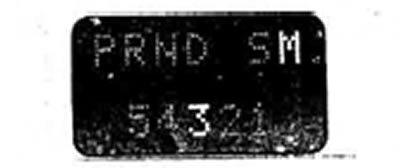 |
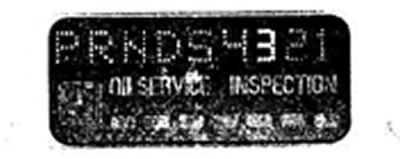
P, R, N, D, M/S
- Adaptive program - D
- Sports program - S
- Manual shift - M
- Shifting to higher gears — "+"
- Shifting to lower gears — "-"
The indication of the AT control lever position varies depending on the vehicle configuration (see illustrations). Adaptive program (position D of the AT control lever) will allow you to take advantage of the AGS system. Explanations for manual switching in M/S mode can be found below.
Changing the position of the lever
On the front side of the AT control lever handle there is (shown by arrow) a lock button that prevents the lever from being moved to positions R and P by mistake. To release the lock, press this button.
The engine can only be started when the AT control lever is set to position P or N.
Before engaging forward gear, press the brake pedal, as the car will move slowly even at idle when this gear is engaged.
Having moved the lever to the position corresponding to the forward movement, wait for the moment of engagement of the gear, accompanied by a slight push, and only then press the accelerator pedal. If you want to get out of the car without turning off the engine, then move the AT control lever to the P or N position and tighten the parking brake.
If you accidentally move the lever to the N position while driving at high speed, release the gas immediately. Wait until the engine reaches idle speed, and then move the lever to the desired position.
P - parking position
Switch on only after the car has come to a complete stop. The drive wheels are locked.
R - reverse gear
Turn on only after the vehicle has stopped.
N - neutral position
Switch on only during long breaks in movement. Switching on while driving is allowed only in case of danger of skidding of the car.
D - the main driving mode with automatic gear shifting
Corresponds to normal driving mode. All forward gears are switched automatically. The AGS system is in working condition.
Maximum acceleration mode (Kick-Down)
For rapid acceleration, the accelerator pedal can be pressed beyond the full throttle position, passing the point of increased resistance.
M/S - Manual mode and sports program
When switching from D mode to M/S mode, the sports program is activated, as indicated by the letter S appearing on the indicator of the selected gear shift program.
In the S position, the AGS system uses only the sportiest gear shift program. AT will only shift up to 4th gear; it is recommended to switch to the sport program if, regardless of the actual driving style, there is a desire to implement a gear shift mode oriented towards using the available power reserve.
If you move the lever forward in the "+" direction, the gearbox switches to a higher gear, and if you move the lever in the "-" direction, it switches to a lower gear. At the same time, the first touch causes a transition to manual control.
Depending on the vehicle configuration, the selected gear indicator shows 1...5 or M1...M5.
Inadmissible upshifts or downshifts are ignored. For example, downshifts at too high engine speeds are not performed. The selected gear is briefly displayed on the instrument cluster. If several gear shifts are performed in succession, the last inadmissible gear selected is briefly displayed. The currently engaged gear is then displayed.
When driving in manual mode, to accelerate from 4th or 5th gear at low speeds - for example when overtaking - downshifting must be done manually or using the "Kick-Down" function.
Switching from M to P, R, N is only possible via position D.
The "Stepuonic" system thinks for you in the following situations:
- To prevent the engine speed from reaching unacceptable values, shortly before reaching the speed limited by the regulator, a shift to a higher gear is performed.
- At low speeds, downshifting occurs without your intervention.
Using the maximum acceleration function causes the transmission to shift to the lowest possible gear at the given engine speed. Depending on the situation, for example in winter conditions, starting off may be done in 2nd or 3rd gear.
Electronic gear shift control system
If the indicator lamp lights up or a message appears on the automatic diagnostic display "Getnebenotprogramm" (Gearbox control emergency program), this means that there is a malfunction either in the electronics that control the switching, or in the box itself.
At the same time, it is possible to move the AT control lever to any position, but when forward gear is engaged, the car will only move in fourth or fifth gear
Therefore, you should avoid excessive loads and drive to the nearest BMW service station.
Work in the engine compartment must never be carried out with the automatic transmission control lever in the drive position.
The rules for starting the engine by towing from an external battery, as well as towing a faulty vehicle, are presented in the Introduction to the Manual.
You can read the original on the website BMWMAN.ru
This article is available at russian, bulgarian, belarusian, ukrainian, serbian, croatian, romanian, polish, slovak, hungarian
Article verified: Ilyinsky Matvey
Share information:
Previous articles
БМВ E39: Manual
Next articles
Similar articles on other types of BMW cars:
Automatic transmission BMW 3 Series E21 (1975-1983)
Automatic transmission — removal and installation BMW 3 Series E46 (1998-2006, petrol)
Automatic transmission (AT). General description BMW 7 Series E32 (1986-1994)
Automatic Transmission Specifications BMW 7 Series E38 (1994-2001)
Checking the level and topping up oil in the automatic transmission… BMW X3 E83 (2003-2010)
Work carried out on automatic transmission BMW X5 E53 (1999-2006)
Automatic transmission BMW 3 Series E21 (1975-1983)
Automatic transmission — removal and installation BMW 3 Series E46 (1998-2006, petrol)
Automatic transmission (AT). General description BMW 7 Series E32 (1986-1994)
Automatic Transmission Specifications BMW 7 Series E38 (1994-2001)
Checking the level and topping up oil in the automatic transmission… BMW X3 E83 (2003-2010)
Work carried out on automatic transmission BMW X5 E53 (1999-2006)
Link in different formats to this page
Visitor comments
No comments yet
- General information
- Governing bodies
- Manual
- Maintenance
- Power unit
- Engine repair
- Lubrication system
- Cooling system
- Ignition system
- Supply system
- Injection system (gasoline)
- Injection system (diesel)
- Exhaust system
- Transmission
- Clutch
- Car gearbox
- Front axle
- Rear axle
- Chassis
- Steering
- Brake system
- Wheels and tires
- Body
- Interior
- Exterior
- Heating system
- Electrical equipment
- Equipment and devices
- Power devices
- Windscreen wipers
- Electrical circuits
- General information
- Manual
- Maintenance
- Power unit
- Engine repair
- Ignition system
- Engine lubrication system
- Cooling system
- Fuel system (gasoline)
- Fuel system (diesel)
- Exhaust system
- Transmission
- Clutch
- Car gearbox
- Chassis
- Front and rear suspension
- Steering
- Brake system
- Body
- Exterior
- Interior
- Electrical equipment
- Heating system
- Equipment and devices
- Power devices
- Electrical circuits
- General information
- Manual
- Maintenance
- Power unit
- Engine in a car
- Engine overhaul
- Cooling system
- Supply system
- Ignition system
- Control system
- Transmission
- Clutch
- Manual gearbox
- Automatic gearbox
- Transmission line
- Chassis
- Steering
- Front suspension
- Rear suspension
- Brake system
- Body
- Body elements
- Car care and painting
- Electrical equipment
- Heater and air conditioner
- Equipment and devices
- Starter and generator
- Electrical circuits
- General information
- Operation and maintenance
- Specifications
- Power unit
- Engine repair
- Cooling and lubrication system
- Supply system
- Ecotronic power supply system
- Fuel injection system
- Ignition system
- Transmission
- Clutch
- Gearbox BMW 242/4
- Gearbox Getrag 262/8
- Gearbox Getrag 265/6
- Automatic gearbox
- Cardan gear
- Rear axle
- Chassis
- Steering
- Front suspension
- Rear suspension
- Brake system
- Electrical equipment
- Equipment and devices
- Electrical circuits