
Cars Mazda Cars Mitsubishi Cars Toyota Cars Chevrolet Cars AvtoVAZ Cars Kia Cars Nissan
English Русский
Български
Беларускі
Український
Српски
Hrvatski
Română
Polski
Slovenský
Magyar
| Articles | Contacts | Sitemap |   
BMWman.ru


3 series   5 series   7 series   BMW X3   BMW X5   BMW X6

E38 (1994-2001) E32 (1986-1994)
  • Home
  • BMW 7 Series
  • E32
  • Electrical equipment
  • Equipment and devices
  • Air conditioning system

Air conditioning system (BMW 7 Series E32)

            0

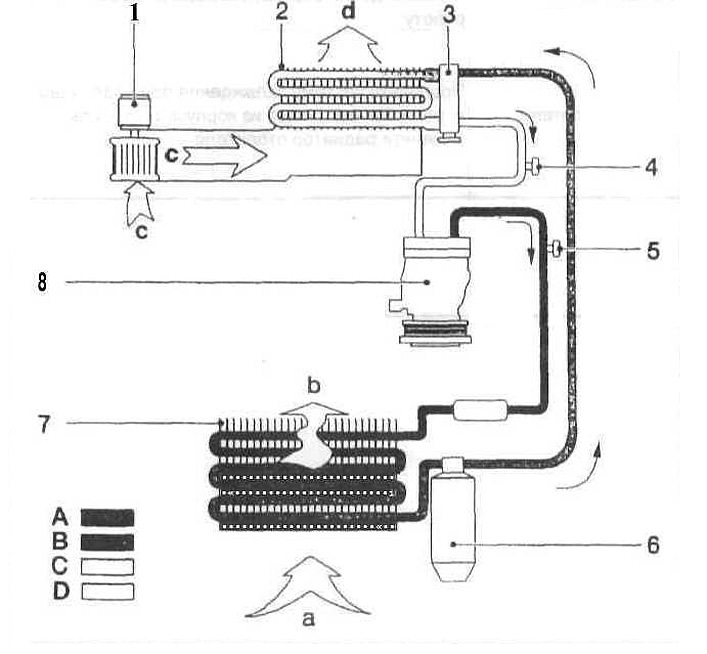
Elements of the air conditioning system (air conditioner)

Elements of the air conditioning system (air conditioner)
1 - fan;
2 - evaporator;
3 — throttle;
4 - Low pressure service connection;
5 - High pressure service connection;
6 - dehydrator tank;
7 — capacitor;
8 — compressor;
a - counter air flow for cooling the condenser;
b - warm air, taken from outside;
c - uncooled air passes through the heater fan;
d — cooled air enters the cabin;
A - high pressure (gas);
B - high pressure (liquid);
C - low pressure (liquid);
D — low pressure (gas).


With the help of the air conditioning system, the temperature in the passenger compartment can drop below the ambient temperature. In a fully automatic system, any set temperature is maintained, and the air distribution and quantity are controlled by an electronic control unit, regardless of the vehicle speed: various temperature sensors inform the control unit of the ambient temperature and the temperature in the passenger compartment. In accordance with the programmed values, the actuator motors of the air flaps and the fan are controlled, thus maintaining the climate in the passenger compartment. Malfunctions of the control unit, sensors and actuators are stored in the memory of the diagnostic device of the control unit. For diagnostics, contact a workshop with the appropriate diagnostic equipment.


Operation of the air conditioning system


The air conditioner compressor is driven by a poly V-belt from the crankshaft. It increases the pressure in the refrigerant line to 30 bar, causing the refrigerant to heat up. In the condenser, the flowing air absorbs heat (cooling air remains outside), whereby the hot refrigerant (gas) cools and condenses. The refrigerant becomes liquid. It flows under high pressure to the throttle, which reduces the pressure. In this case, the refrigerant evaporates into the main line and simultaneously cools down significantly. In the evaporator, the refrigerant absorbs heat from the passing air. The air is cooled. This cold air now flows into the car's interior. Due to the heat absorbed in the evaporator, the refrigerant becomes gaseous and flows under low pressure to the compressor. There the process is repeated.

Note: Air conditioning repair operations are not described, as they should only be performed in a workshop. In addition, the refrigerant line should not be opened, as if the refrigerant gets on the skin, it can cause frostbite.

This article is available at russian, bulgarian, belarusian, ukrainian, serbian, croatian, romanian, polish, slovak, hungarian
Article verified: Sevastyanov Nikolay

Share information:
Previous articles
БМВ E32: Equipment and devices
Next articles

Heater Temperature Sensor — Removal and Installation
Heating/Air Conditioning Control Unit — Removal and Installation
Heating system. General description
Diagnostics of heating faults
Electrical equipment. General information
Measuring instruments
Measurement technique
Troubleshooting electrical equipment


Similar articles on other types of BMW cars:
Air conditioning system components — removal and installation BMW 3 Series E46 (1998-2006, petrol)
Power supply system BMW 3 Series E21 (1975-1983)
Air conditioning system BMW 5 Series E39 (1995-2003)
Automatic air conditioning system BMW 5 Series E28 (1981-1988)
Air conditioning system — equipment and tools BMW X3 E83 (2003-2010)
Automatic diagnostic system BMW X5 E53 (1999-2006)
Link in different formats to this page


Visitor comments

No comments yet


How much 16 + 41 =


BMW E38 (1994-2001) 
  • General information
  • Introduction to guide
  • Manual
  • Maintenance
  • Power unit
  • Engine M60/1, M60/2 (petrol)
  • M62 engine (petrol)
  • M57 engine (diesel)
  • M67 engine (diesel)
  • Cooling system
  • Fuel system (petrol)
  • Fuel system (diesel)
  • Exhaust system
  • Ignition and control systems
  • Charge and launch systems
  • Transmission
  • Clutch
  • Mechanical gearbox
  • Automatic gearbox
  • Cardan and drive shafts
  • Chassis
  • Brake system
  • Front suspension
  • Rear suspension
  • Steering
  • Body
  • Exterior
  • Interior
  • Electrical equipment
  • Equipment and devices
  • Lighting
  • Heating and air conditioning
  • Electrical circuits
BMW E32 (1986-1994) 
  • General information
  • Care and maintenance
  • Power unit
  • Minor engine repair
  • Engine overhaul
  • Lubrication system
  • Cooling system
  • Ignition system
  • Supply system
  • Injection system (petrol)
  • Injection system (diesel)
  • Exhaust system
  • Transmission
  • Clutch
  • Manual gearbox
  • Automatic gearbox
  • Cardan gear
  • Rear axle and shafts
  • Chassis
  • Front suspension
  • Rear suspension
  • Steering
  • Wheels and tires
  • Brake system
  • Body
  • Body elements
  • Electrical equipment
  • Equipment and devices
  • Electrical circuits
BMWman.ru © 2017-2026 · Mobile version · News and articles · Sitemap: EN BG BY UA RS HR RO PL SK HU · Feedback · Site search
3er E21 · 3er E30 · 3er E36 · 3er E46 [petrol] · 3er E46 · 5er E12 · 5er E28 · 5er E34 · 5er E39 · 7er E32 · 7er E38 · X3 E83 · X5 E53 ·
This site uses cookies 🍪, without them some features simply would not work.