
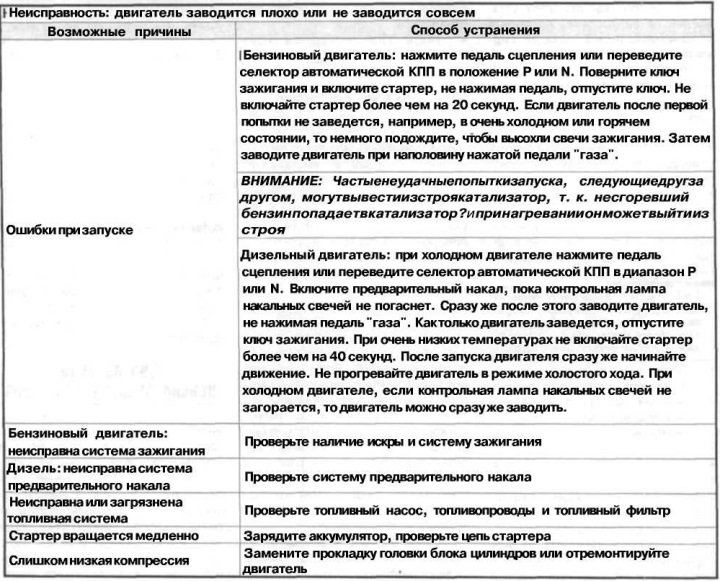
To determine whether there is a spark, you need to unscrew the spark plug, insert it into the spark plug plug and press it to ground. Do not hold the spark plug plug or high-voltage wire with your hands, but use insulated clamps. An assistant should turn the engine with the starter.
Note: To prevent damage to the catalytic converter, gasoline must not be injected. To do this, remove the fuel pump relay.
Caution: Care must be taken when working with the electronic ignition system. For diesel engines, the preheating system and fuel system must be checked.
If the engine starts to "knock"
Knocking sounds from the engine compartment that increase in intensity as the oil warms up are a sign of faulty engine bearings.
Reasons
Insufficient lubrication due to too low oil level.
Water entering the engine oil due to a blown cylinder head gasket.
Too high revs with a cold engine and therefore viscous oil.
Breakdown of the oil film on parts at high oil temperatures, for example, due to incorrectly selected oil viscosity.
What to do if engine bearings fail
First of all, you need to know that connecting rod bearings are the ones that fail most often. If you managed to recognize a bearing failure at an early stage, then perhaps you can get by with replacing the liners. Therefore:
- If you hear sharp knocks from the engine compartment, immediately turn off the engine and do not start it again! In addition to knocks, the oil pressure indicator light often lights up.
- Tow the car to a workshop.
- If the engine is "younger" than 100 thousand km, then perhaps it will be possible to get by with a partial repair.
The original is located on the internet portal: BMWMAN