
Checking the oil clearance of the main bearings
Regardless of how the bearing size was determined, use a plastic gap gauge to determine the clearance size.
Clean the backs of the new main bearing inserts and place the halves with the oil groove on the main bearing seats in the cylinder block. Install the other halves of each set into their corresponding bearing caps. Make sure the key on each insert fits into the cutout in the cylinder block or cap.
Caution: Do not hammer the bearings or scratch the bearing faces.
Wipe the faces of the block inserts and the crankshaft journals with a clean cloth. Check or clean the crankshaft oil holes.
Carefully place the crankshaft on the main bearings. Before finally installing the crankshaft, it is necessary to check the oil clearance of the main bearings.
Cut off several pieces of plastic of suitable size to measure the gap (they should be slightly shorter than the width of the main bearings) and place one piece on each main journal of the shaft parallel to its axis.
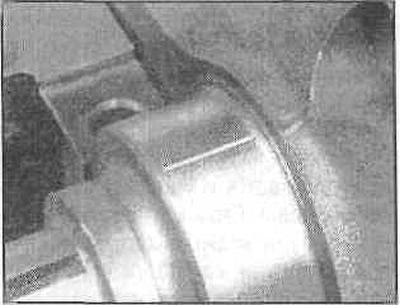
Clean the bearing surfaces in the caps and install the caps in place. Do not move the plastic. Apply a little oil to the threads and the underside of the nuts.
Tighten the main bearing cap nuts in three stages to the specified torque. Do not turn the crankshaft during this operation.
Unscrew the nut and carefully remove the bearing caps.
Compare the width of the crushed plastic on each neck with the scale printed on the bag of plastic and determine the gap. Compare the results with the technical data.
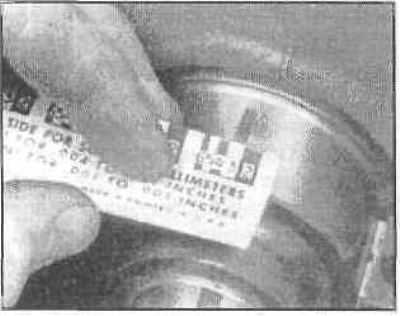
Attention: The plastic bag has scales in mm and inches, do not confuse them.
If the gap is not within specification, the bearings may be the wrong size. Before deciding to replace the bearings, check to see if any dirt or oil has gotten between the bearing and the cover. If one end of the plastic gap gauge is significantly wider than the other, the neck may be tapered.
Carefully clean all traces of clearance plastic from journals and bearings. Be careful not to scratch bearing surfaces.
Final installation of the crankshaft
Carefully remove the crankshaft from the engine. Clean the bearing surfaces in the block, then apply a uniform layer of engine oil to them.
Lubricate the surface of the crankshaft that contacts the seals with clean engine oil.
Make sure the crankshaft journals are clean, then place the shaft in place in the cylinder block. Clean the bearing surfaces in the caps and apply grease to them. Install the caps in their places so that the arrows on the caps point forward.
Apply a thin coat of oil to the threads and underside of the bolt heads, then install them.
Tighten all main bearing cap bolts except thrust bearing cap No.4 to the specified torque value. Move the shaft back and forth to seat the thrust bearing shells, and then tighten cap bolts No.4 to the specified torque value.
Note: Depending on the model, the thrust bearing (combination liner) can be located on different main journals of the crankshaft.
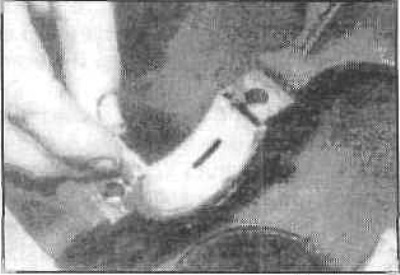
Measure the shaft play using feeler gauges or an indicator.
Turn the crankshaft by hand several times and check if it is seizing.