
Cars Mazda Cars Mitsubishi Cars Toyota Cars Chevrolet Cars AvtoVAZ Cars Kia Cars Nissan
English Русский
Български
Беларускі
Український
Српски
Hrvatski
Română
Polski
Slovenský
Magyar
| Articles | Contacts | Sitemap |   
BMWman.ru


3 series   5 series   7 series   BMW X3   BMW X5   BMW X6

E38 (1994-2001) E32 (1986-1994)
  • Home
  • BMW 7 Series
  • E32
  • Power unit
  • Engine overhaul
  • Inspection and repair of the flywheel

Inspection and repair of the flywheel (BMW 7 Series E32)

            0

If the flywheel end surface shows scratches or pits due to clutch slippage, it may be necessary to resurface the surface. Overheating can cause surface cracks. The appearance of such cracks means that the flywheel should be replaced. It is difficult to determine the maximum permissible number of such defects. If in doubt, consult an experienced mechanic.

The working surface can be processed up to 26.6 mm, but in general no more than 1.5 mm.

In rare cases, damage to the toothed ring occurs. If necessary, the toothed ring can be removed from the flywheel. To do this, drill a hole between two teeth and cut the remaining bridge with a chisel. The new ring should be heated to 250°C, put on the flywheel and allowed to cool slowly in the air. If you do not have experience in this type of work and do not have devices for precise temperature measurement, it is better to leave this work to specialists. If the ring does not press the flywheel correctly when seated on it, the ring should be removed, cut as described above, and another new one installed.

The flywheel can be removed without removing the engine from the vehicle if the gearbox and clutch are removed.

Some models with a manual transmission are equipped with a twin-disc flywheel with a torsional vibration damper. The purpose of this device is to prevent the torsional vibrations of the crankshaft, which occur during cylinder flashes, from being transmitted to the transmission. This dampens the jerks that occur due to vibrations.
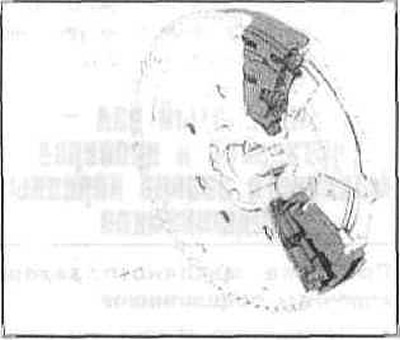
Some models with a manual transmission are equipped with a twin-disc flywheel with a torsional…


The design of a two-disc flywheel is as follows: the front part of the flywheel is rigidly bolted to the crankshaft. A torsional vibration damper is mounted on it, which is a complex system of spring dampers.

The rear part of the flywheel is fixed to this vibration damper, which provides an elastic connection between the two parts of the flywheel. Thus, the connection between the crankshaft and the clutch mounted on the rear part of the flywheel becomes elastic.

This article is available at russian, bulgarian, belarusian, ukrainian, serbian, croatian, romanian, polish, slovak, hungarian
Article verified: Sevastyanov Nikolay

Share information:
Previous articles
БМВ E32: Engine overhaul
Next articles

Main and connecting rod bearings — inspection
Crankshaft — Check
Pistons and connecting rods — check
Cylinder honing
Cylinder Block — Check
General instructions for engine assembly
Crankshaft — Installation and Checking of Main Bearing Oil Clearance
Piston rings — installation
Pistons and connecting rods — installation and checking of connecting…
Initial start-up and debugging of the engine after repair


Similar articles on other types of BMW cars:
Cylinder head repair BMW 3 Series E21 (1975-1983)
Timing chain — removal, inspection and installation BMW 3 Series E46 (1998-2006, petrol)
Cylinder head repair BMW 5 Series E12 (1972-1981)
Removal and installation, inspection of the rear shock absorber BMW 5 Series E34 (1988-1996)
Introduction to the Automotive Repair Manual BMW X3 E83 (2003-2010)
Preface to the BMW X5 E53 repair manual BMW X5 E53 (1999-2006)
Link in different formats to this page


Visitor comments

No comments yet


How much 20 + 40 =


BMW E38 (1994-2001) 
  • General information
  • Introduction to guide
  • Manual
  • Maintenance
  • Power unit
  • Engine M60/1, M60/2 (petrol)
  • M62 engine (petrol)
  • M57 engine (diesel)
  • M67 engine (diesel)
  • Cooling system
  • Fuel system (petrol)
  • Fuel system (diesel)
  • Exhaust system
  • Ignition and control systems
  • Charge and launch systems
  • Transmission
  • Clutch
  • Mechanical gearbox
  • Automatic gearbox
  • Cardan and drive shafts
  • Chassis
  • Brake system
  • Front suspension
  • Rear suspension
  • Steering
  • Body
  • Exterior
  • Interior
  • Electrical equipment
  • Equipment and devices
  • Lighting
  • Heating and air conditioning
  • Electrical circuits
BMW E32 (1986-1994) 
  • General information
  • Care and maintenance
  • Power unit
  • Minor engine repair
  • Engine overhaul
  • Lubrication system
  • Cooling system
  • Ignition system
  • Supply system
  • Injection system (petrol)
  • Injection system (diesel)
  • Exhaust system
  • Transmission
  • Clutch
  • Manual gearbox
  • Automatic gearbox
  • Cardan gear
  • Rear axle and shafts
  • Chassis
  • Front suspension
  • Rear suspension
  • Steering
  • Wheels and tires
  • Brake system
  • Body
  • Body elements
  • Electrical equipment
  • Equipment and devices
  • Electrical circuits
BMWman.ru © 2017-2026 · Mobile version · News and articles · Sitemap: EN BG BY UA RS HR RO PL SK HU · Feedback · Site search
3er E21 · 3er E30 · 3er E36 · 3er E46 [petrol] · 3er E46 · 5er E12 · 5er E28 · 5er E34 · 5er E39 · 7er E32 · 7er E38 · X3 E83 · X5 E53 ·
This site uses cookies 🍪, without them some features simply would not work.