
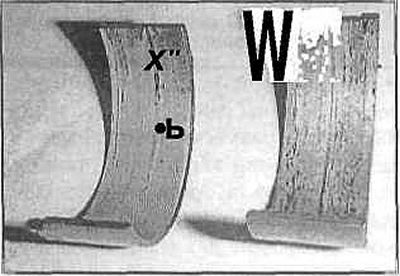
Bearing damage is caused by lack of lubrication, dirt or foreign particles, engine overload, and corrosion. Regardless of why the bearings are damaged, the cause must be corrected before the engine is assembled.
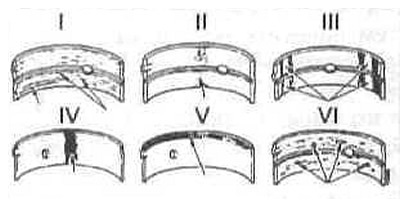
Typical damage to bearings
I - the surface is scratched (foreign particles have entered the working layer of the bearing shell);
II - the top layer is worn (lack of oil);
III - polished areas (incorrect insert placement);
IV - the top layer is completely erased (the neck is tapered);
V — wear of the edge of the liner;
VI - craters or pockets (metal fatigue).
When checking bearings, remove them from the cylinder block, main bearing caps, connecting rods and their caps and lay them out on a clean surface in the same order as they are in the engine. This will allow you to determine the cause of damage for each specific journal.
Dirt and foreign particles are pressed into the soft material of the bearings. Large particles cannot be pressed in completely and will scratch the bearing and the shaft journal. This cause is eliminated by thoroughly cleaning all parts and keeping them clean during assembly. It is also recommended to change the oil and oil filter as often as possible.
Lack of lubrication has several interrelated causes. Excessive heat (which makes the oil liquid), overload (causes oil to be squeezed out of the bearing), oil leak or spill (due to too much bearing clearance, worn oil pump or high engine speed) can lead to a lack of lubrication. Blocked oil passages, usually caused by misalignment of the oil holes when the bearing is assembled, also disrupt the bearing lubrication and cause it to fail. When a bearing fails due to lack of lubrication, the bearing material is rubbed off or squeezed out of the steel backing of the bearing. The temperature can rise so high that the steel backing turns blue from overheating,
The way the vehicle is driven can also affect the life of the bearing. Low RPM operation in high gear (engine overload) results in very high bearing loads and causes the oil film to be squeezed out. These loads cause the bearings to bend, which leads to surface cracking (fatigue failures). Eventually, the bearing material is chipped and carried away from the steel base. Short distance driving causes bearing corrosion because the engine does not warm up enough to remove condensed water and corrosive gases. These accumulate in the oil, forming acids and sludge. When oil gets into the bearings, the acid causes the bearing material to corrode.
Incorrect installation of the bearing can also lead to its destruction. Too tight bearings have reduced oil clearance, which leads to insufficient lubrication. Dirt or foreign particles also destroy bearings.
(The original article is located on www.bmwman.ru)