
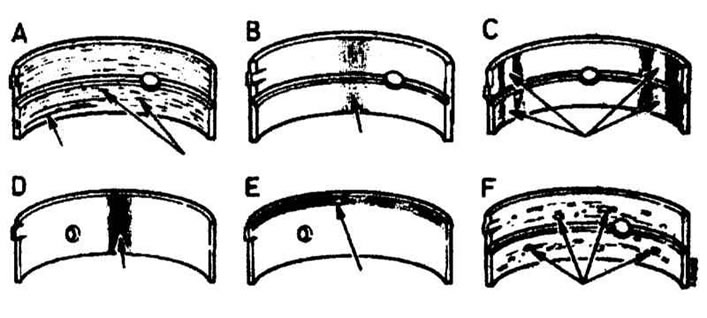
A - Dirt scratches: dirt embedded in the bearing material
B - Lack of oil: contact area is worn out
C - Incorrect installation: light polished areas
D — Taper of the neck: the contact area is worn by the neck itself
E - Lateral wear
F - Fatigue failure: pits or scuffs
Bearing failure occurs due to lack of lubrication, presence of dirt and other foreign particles, engine overload and corrosion. Regardless of the cause of bearing failure, before assembling the engine, the cause must be eliminated so that it does not happen again.
To inspect, remove the bearings from the cylinder block and caps, remove them from the connecting rods and caps, and then lay them out on a clean surface in the same order they were installed in the engine. This will allow you to match bearing problems to the corresponding crankshaft journal.
Dirt and other foreign particles enter the engine in a variety of ways. They may be left in the engine during assembly, or they may enter through filters or the positive crankcase ventilation (PCV) system. Dirt may enter the oil and from there into the bearings. Metal particles from machining and normal engine wear are often present. Abrasive particles may sometimes be left behind from grinding engine components, especially if the parts are not thoroughly cleaned using appropriate methods. Whatever the source, these foreign objects often become embedded in the soft bearing material and can be easily detected. Large particles do not become embedded in the bearing, but scratch or damage the bearing and journal. The best way to prevent this type of bearing failure is to thoroughly clean all parts and keep all components spotlessly clean during assembly. Frequent and regular oil and filter changes are also recommended.
Lack of lubrication (or stopping lubrication) have several interconnected causes. Overheating (which reduces the thickness of the lubricant layer), overload (which squeezes oil out of the gap between the sliding surfaces) and oil leakage or leakage (due to increased bearing clearances, oil pump wear or high engine speeds) - all of these factors contribute to a lack of lubrication. Clogged lubrication channels, usually caused by misalignment of lubrication holes in the bearing shell, also lead to insufficient lubrication of the bearing and its failure. If the cause of bearing failure is a lack of lubrication, the bearing material wears away or is torn off the steel substrate. The temperature can reach a point where the steel substrate turns blue from overheating.
Driving style can have a definite effect on bearing life. Riding with the throttle wide open at low rpm (overloading the engine) creates very high loads on the bearings, which tend to squeeze out the oil film. These loads bend the bearings, which leads to the appearance of fine cracks on the surface of the bearings (metal fatigue failure). Sometimes the bearing material weakens in some places and breaks away from the steel backing. Short trips lead to bearing corrosion, because when the engine is not warmed up enough, condensation and corrosive gases are not removed. These products accumulate in the engine oil, forming acid and sludge. When oil enters the engine bearings, the acid attacks the bearing material, causing it to corrode.
Incorrect installation of bearings during engine assembly also leads to bearing failure. Tight bearings will leave little clearance for lubrication, which will result in insufficient lubrication. Dirt or foreign particles that get on the back surface of the bearing shell will cause ridges on the bearing surface, which will cause failure.