
Cars Mazda Cars Mitsubishi Cars Toyota Cars Chevrolet Cars AvtoVAZ Cars Kia Cars Nissan
English Русский
Български
Беларускі
Український
Српски
Hrvatski
Română
Polski
Slovenský
Magyar
| Articles | Contacts | Sitemap |   
BMWman.ru


3 series   5 series   7 series   BMW X3   BMW X5   BMW X6

E46 (1998-2006) E46 (1998-2006, petrol) E36 (1990-2000) E30 (1982-1994) E21 (1975-1983)
  • Home
  • BMW 3 Series
  • E46
  • Power unit
  • Engine overhaul
  • Main and connecting rod bearings — checking condition

Main and connecting rod bearings — checking condition (BMW 3 Series E46)

            0

1. Even if you decide to replace the main and connecting rod bearing shells, you need to inspect them very carefully, since they can say a lot about the general condition of the engine.

2. Bearing failure occurs due to insufficient lubrication, dirt ingress, engine overload and corrosion (Fig. 14.2). The causes of bearing failure must be identified and corrected before engine assembly to prevent recurrence.
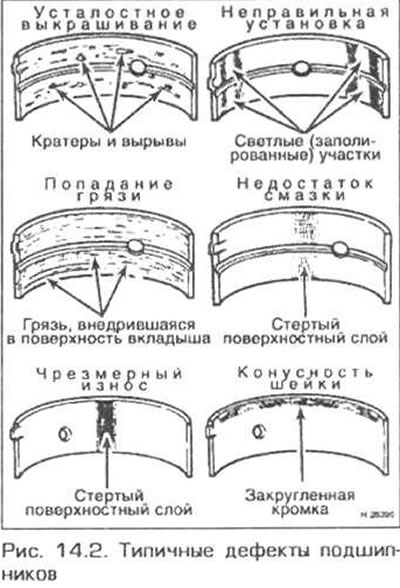
2. Bearing failure occurs due to insufficient lubrication, dirt ingress, engine overload and…


3. To inspect the bearing shells, they must be removed from the main bearings of the cylinder block and from the lower heads of the connecting rods, then laid out on a clean surface in the order in which they are installed in the engine. This will allow you to match the defects of the shells with the corresponding journals. Do not touch the working surfaces of the shells with your hands during inspection - they can be easily scratched.

4. Dirt and other foreign matter can get into the engine in different ways. They could have been left in the engine during its previous assembly, they can get through the filter or through the crankcase ventilation system. They can get into the oil, and along with it, into the bearings. The oil may contain metal particles from mechanical processing of the engine, as well as from natural wear of the engine during its operation. Sometimes the oil may contain abrasive left after repair, especially if the engine was not thoroughly washed afterwards. Regardless of the origin, such particles can penetrate the soft surface of the liner and can be easily detected. Large particles do not penetrate the bearing, but can leave scratches on it and on the shaft journal. The best way to avoid these troubles is to thoroughly wash all engine parts before assembly and maintain cleanliness during the assembly process. It is also recommended to change the oil and oil filter regularly and often.


5. Insufficient lubrication or loss of oil supply also has several causes. Engine overheating (it leads to a decrease in the thickness of the oil film), overload (which squeezes oil out of the gap in the bearing) and oil leaks (due to excessively large clearances, worn oil pump or high engine speed) — all this leads to deterioration of lubrication. Blocking of oil holes due to incorrect arrangement of liners during assembly can also leave the bearing without lubrication and lead to its destruction. With insufficient lubrication, the material of the liner can be worn out or smeared from the surface of the steel base. The temperature in the bearing can increase to a level where the color of the steel base of the liner turns blue.

6. The life of bearings is also affected by the driving characteristics of the car. Sharp opening of the throttle valve at low engine speeds creates high loads on the bearings, from which the oil film is squeezed out. Such loads can cause the surface layer of the liner to flow with the formation of small cracks (fatigue failure). Over time, the liner material may break apart and come off the steel base

7. Short distance driving can cause bearing corrosion because the engine does not warm up enough to evaporate water condensation and remove corrosive gases. These products collect in the oil, forming acid and deposits. The acid then gets into the bearings along with the oil and causes their corrosion.

8. Incorrect installation of liners during engine assembly also leads to bearing failure. Overtightening of the bearing leads to a decrease in clearance and oil starvation. Dirt and foreign inclusions are captured by the bearing's oil wedge, accumulate on its surface in the form of large spots, which eventually lead to damage.


9. Do not touch the working surfaces of the liners with your fingers during assembly, as this may scratch the delicate surfaces or introduce dirt onto them.

10. As noted at the beginning of this paragraph, the liners must definitely be replaced when repairing the engine. Not changing them is bad economics.

[This publication was borrowed from an online resource BMWMAN]

This article is available at russian, bulgarian, belarusian, ukrainian, serbian, croatian, romanian, polish, slovak, hungarian
Article verified: Ilyinsky Matvey

Share information:
Previous articles
БМВ E46: Engine overhaul
Next articles

Crankshaft — Checking the condition
Pistons and connecting rods — condition check
Cylinder block/crankcase — cleaning and condition check
Crankshaft — Removal
Pistons and connecting rods — removal
Engine Repair — Assembly Procedure
Piston rings — installation
Crankshaft — installation
Pistons with connecting rods — installation
First engine start after repair


Similar articles on other types of BMW cars:
Checking the condition of main and connecting rod bearings BMW 5 Series E28 (1981-1988)
Checking the clearance between the bearings and the connecting rod… BMW 5 Series E12 (1972-1981)
Main and connecting rod bearings — inspection BMW 7 Series E32 (1986-1994)
Checking the condition of the exhaust system BMW 7 Series E38 (1994-2001)
Identifying engine faults by the condition of spark plugs BMW X3 E83 (2003-2010)
Checking the condition of the tires BMW X5 E53 (1999-2006)
Link in different formats to this page


Visitor comments

No comments yet


How much 36 + 29 =


BMW E46 (1998-2006) 
  • General information
  • Manual
  • Maintenance
  • Power unit
  • Engine repair
  • Cooling system
  • Power system (gasoline)
  • Injection system (gasoline)
  • Fuel system (diesel)
  • Exhaust system
  • Ignition system
  • Charge and launch systems
  • Transmission
  • Car gearbox
  • Clutch and drive shafts
  • Chassis
  • Brake system
  • Suspension front and rear
  • Steering
  • Body
  • Body care and repair
  • Exterior
  • Interior
  • Electrical equipment
  • Troubleshooting
  • Lighting and signaling
  • Equipment and devices
  • Heater and air conditioner
  • Electrical circuits
BMW E46 (1998-2006, petrol) 
  • General information
  • Manual
  • Repair on the road
  • Weekly checks
  • Maintenance
  • Troubleshooting
  • Power unit
  • 4 cylinder engines
  • 6 cylinder engines
  • Engine overhaul
  • Cooling and heating
  • Fuel and exhaust system
  • Starting and charging system
  • Ignition system
  • Transmission
  • Clutch
  • Mechanical gearbox
  • Automatic gearbox
  • Cardan and drive shafts
  • Chassis
  • Brake system
  • Wheel suspension
  • Steering
  • Body
  • Exterior
  • Interior
  • Electrical equipment
  • Equipment and devices
  • Electrical circuits
BMW E36 (1990-2000) 
  • General information
  • Maintenance
  • Power unit
  • Engine repair
  • Cooling system
  • Ignition system
  • Supply system
  • Fuel injection system
  • Exhaust system
  • Transmission
  • Clutch
  • Car gearbox
  • Front and rear axle
  • Chassis
  • Steering
  • Brake system
  • Body
  • Exterior
  • Interior
  • Electrical equipment
  • Heating system
  • Equipment and devices
  • Power devices
  • Electrical circuits
BMW E30 (1982-1994) 
  • Power unit
  • M10/M20 engine
  • M40 engine
  • Ignition system
  • Lubrication system
  • Cooling system
  • Supply system
  • Fuel injection
  • Exhaust system
  • Transmission
  • Clutch
  • Manual gearbox
  • Front axle
  • Rear axle
  • Chassis
  • Steering
  • Brake system
  • Body
  • Exterior
  • Interior
  • Electrical equipment
  • Heating system
  • Equipment and devices
  • Electrical circuits
BMW E21 (1975-1983) 
  • General information
  • Specifications
  • Operation and maintenance
  • 4-cylinder engine
  • Engine repair
  • Cooling and lubrication system
  • Supply system
  • Ignition system
  • 6-cylinder engine
  • Engine repair
  • Cooling and lubrication system
  • Supply system
  • Fuel injection system
  • Ignition system
  • Transmission
  • Clutch
  • 4-speed manual gearbox
  • 5-speed manual gearbox
  • Automatic gearbox
  • Cardan and rear axle
  • Chassis
  • Steering
  • Front suspension
  • Rear suspension
  • Brake system
  • Electrical equipment
  • Equipment and devices
  • Electrical circuits
BMWman.ru © 2017-2026 · Mobile version · News and articles · Sitemap: EN BG BY UA RS HR RO PL SK HU · Feedback · Site search
3er E21 · 3er E30 · 3er E36 · 3er E46 [petrol] · 3er E46 · 5er E12 · 5er E28 · 5er E34 · 5er E39 · 7er E32 · 7er E38 · X3 E83 · X5 E53 ·
This site uses cookies 🍪, without them some features simply would not work.