
Table of contents: Checking axial play ↓ Checking the status ↓
- Home
- BMW 3 Series
- E46
- Power unit
- Engine overhaul
- Crankshaft — Checking the condition
Crankshaft — Checking the condition (BMW 3 Series E46)
Checking axial play
1. To measure axial play, the crankshaft must be in place in the main bearings, but free in the axial direction.
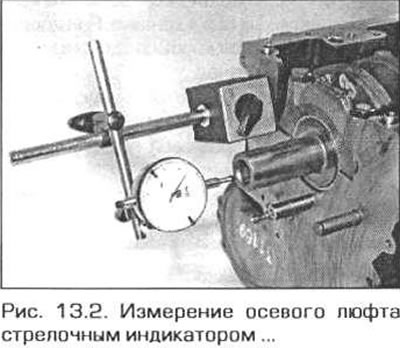
2. Install a dial indicator at the end of the shaft and rest its feeler against the end of the shaft (Fig. 13.2). Move the shaft to one side until it stops and reset the indicator. Now move it to the other side until it stops and read the indicator reading. This is the axial play. Compare the result with the specified play value (see Technical data) and decide whether the thrust bearing needs to be replaced.
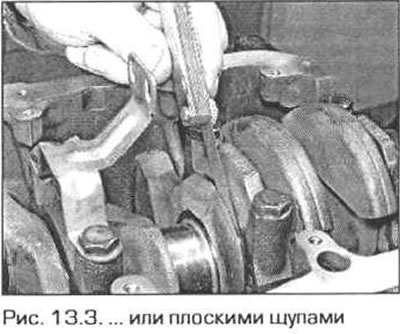
3. If you do not have a dial indicator, you can measure the clearance with flat feeler gauges. Move the shaft towards the flywheel and measure the clearance between the crankshaft cheek and the thrust bearing (Fig. 13.3).
Checking the status
4. Wash the crankshaft in kerosene or other suitable solvent. Dry the shaft, preferably with compressed air if possible. Clean the oil holes.
Caution: Wear safety glasses when working with compressed air.
5. Inspect the main and connecting rod journals for excessive wear, scratches, scoring, pitting and cracks.
6. Wear of the lower connecting rod head bearings is indicated by a clearly audible metallic knock when the engine is running (especially when accelerating the engine from low revs), as well as some drop in oil pressure.
7. Wear of the main bearings is accompanied by strong engine vibration and rumble, especially loud when accelerating the engine, as well as a drop in oil pressure.
8. Run your finger along the neck with light pressure - if grooves have developed on the neck. You will easily feel them. In this case, the shaft needs to be turned (if that's still possible) or replace.
9. After turning the journals, check to see if there are any burrs left at the edges of the oil holes. The ends of the holes are usually chamfered, so burrs are unlikely to cause any problems if the turning is done carefully. Burrs can be removed with a scraper or a thin file.
10. Leave the turning of the journals to service station specialists. They will also select new bearings of the repair size.
(Information taken from this resource bmwman)
This article is available at russian, bulgarian, belarusian, ukrainian, serbian, croatian, romanian, polish, slovak, hungarian
Article verified: Ilyinsky Matvey
Share information:
Previous articles
БМВ E46: Engine overhaul
Next articles
Similar articles on other types of BMW cars:
Checking the condition of the crankshaft BMW 5 Series E28 (1981-1988)
Checking the technical condition of the cylinder head BMW 5 Series E12 (1972-1981)
Crankshaft — Installation and Checking of Main Bearing Oil Clearance BMW 7 Series E32 (1986-1994)
Checking the condition of the exhaust system BMW 7 Series E38 (1994-2001)
Identifying engine faults by the condition of spark plugs BMW X3 E83 (2003-2010)
Checking the condition of the tires BMW X5 E53 (1999-2006)
Checking the condition of the crankshaft BMW 5 Series E28 (1981-1988)
Checking the technical condition of the cylinder head BMW 5 Series E12 (1972-1981)
Crankshaft — Installation and Checking of Main Bearing Oil Clearance BMW 7 Series E32 (1986-1994)
Checking the condition of the exhaust system BMW 7 Series E38 (1994-2001)
Identifying engine faults by the condition of spark plugs BMW X3 E83 (2003-2010)
Checking the condition of the tires BMW X5 E53 (1999-2006)
Link in different formats to this page
Visitor comments
No comments yet
- General information
- Manual
- Maintenance
- Power unit
- Engine repair
- Cooling system
- Power system (gasoline)
- Injection system (gasoline)
- Fuel system (diesel)
- Exhaust system
- Ignition system
- Charge and launch systems
- Transmission
- Car gearbox
- Clutch and drive shafts
- Chassis
- Brake system
- Suspension front and rear
- Steering
- Body
- Body care and repair
- Exterior
- Interior
- Electrical equipment
- Troubleshooting
- Lighting and signaling
- Equipment and devices
- Heater and air conditioner
- Electrical circuits
- General information
- Manual
- Repair on the road
- Weekly checks
- Maintenance
- Troubleshooting
- Power unit
- 4 cylinder engines
- 6 cylinder engines
- Engine overhaul
- Cooling and heating
- Fuel and exhaust system
- Starting and charging system
- Ignition system
- Transmission
- Clutch
- Mechanical gearbox
- Automatic gearbox
- Cardan and drive shafts
- Chassis
- Brake system
- Wheel suspension
- Steering
- Body
- Exterior
- Interior
- Electrical equipment
- Equipment and devices
- Electrical circuits
- General information
- Maintenance
- Power unit
- Engine repair
- Cooling system
- Ignition system
- Supply system
- Fuel injection system
- Exhaust system
- Transmission
- Clutch
- Car gearbox
- Front and rear axle
- Chassis
- Steering
- Brake system
- Body
- Exterior
- Interior
- Electrical equipment
- Heating system
- Equipment and devices
- Power devices
- Electrical circuits
- Power unit
- M10/M20 engine
- M40 engine
- Ignition system
- Lubrication system
- Cooling system
- Supply system
- Fuel injection
- Exhaust system
- Transmission
- Clutch
- Manual gearbox
- Front axle
- Rear axle
- Chassis
- Steering
- Brake system
- Body
- Exterior
- Interior
- Electrical equipment
- Heating system
- Equipment and devices
- Electrical circuits
- General information
- Specifications
- Operation and maintenance
- 4-cylinder engine
- Engine repair
- Cooling and lubrication system
- Supply system
- Ignition system
- 6-cylinder engine
- Engine repair
- Cooling and lubrication system
- Supply system
- Fuel injection system
- Ignition system
- Transmission
- Clutch
- 4-speed manual gearbox
- 5-speed manual gearbox
- Automatic gearbox
- Cardan and rear axle
- Chassis
- Steering
- Front suspension
- Rear suspension
- Brake system
- Electrical equipment
- Equipment and devices
- Electrical circuits