
Cars Mazda Cars Mitsubishi Cars Toyota Cars Chevrolet Cars AvtoVAZ Cars Kia Cars Nissan
English Русский
Български
Беларускі
Український
Српски
Hrvatski
Română
Polski
Slovenský
Magyar
| Articles | Contacts | Sitemap |   
BMWman.ru


3 series   5 series   7 series   BMW X3   BMW X5   BMW X6

E46 (1998-2006) E46 (1998-2006, petrol) E36 (1990-2000) E30 (1982-1994) E21 (1975-1983)
  • Home
  • BMW 3 Series
  • E46
  • Power unit
  • Engine overhaul
  • Pistons and connecting rods — condition check

Pistons and connecting rods — condition check (BMW 3 Series E46)

            0

1. Before checking, the pistons and connecting rods must be thoroughly cleaned and washed, and the rings must be removed from the pistons.

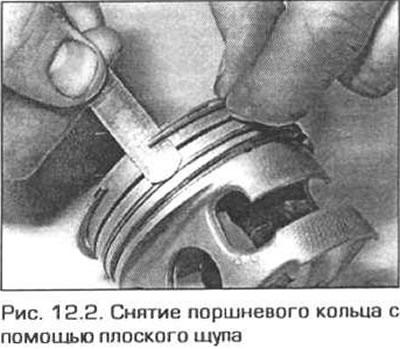
2. To remove the ring, spread its ends and pull the ring up through the piston. To prevent the ring from falling into the free grooves, you can insert two or three old feeler gauges under the ring (Fig. 12.2). The rings have sharp ends - do not injure your hands or scratch the piston surface. In addition, the rings are very fragile and break easily. Keep in mind that the third (oil scraper) the ring is equipped with a spring. Remove the rings only through the piston bottom. If the rings are to be used further, store them together with the corresponding piston. Remember which side of each ring is up.
2. To remove the ring, spread its ends and pull the ring up through the piston. To prevent the ring…


3. Scrape off any carbon deposits from the piston bottom. Any remaining carbon deposits can be removed with a wire brush or sandpaper.

4. Clean the ring grooves from carbon deposits. You can use a broken piston ring for this. Remove only carbon deposits from the grooves, not the piston metal. The piston is made of aluminum alloy and can be easily scratched by a hard and sharp ring.


5. After cleaning off the carbon deposits, wash the piston and connecting rod with kerosene or another solvent and dry them well. Don't forget to clean the oil holes in the bottom ring groove.

6. If the cylinders and pistons are not too worn and have no damage, you can skip boring the cylinders and replace the pistons. Measure the piston diameters and make sure that their diameters are within the tolerance. Check the clearances between the pistons and cylinders. If the clearances are too large, the cylinders will still have to be bored and the pistons replaced. A normally run-in piston may have a light uniform strip on one side and a small play in the upper compression ring in the groove. When assembling the engine, the piston rings are replaced with new ones in any case.

7. Carefully inspect each piston for cracks in the skirt, in the area of the piston pin holes and between the ring grooves.

8. Inspect the piston skirt for scratches and scoring, the piston crown for burnouts and scorched or overheated areas along the edges. If there are scratches and scoring on the skirt, it is possible that the engine overheated due to insufficiently efficient cooling or due to improper combustion. In this case, it is necessary to carefully check the cooling and lubrication systems. Scorched areas along the edges of the piston crown indicate a gas breakthrough into the crankcase. Burnouts on the bottom or overheated areas along the edges of the piston occur due to improper ignition (spontaneous combustion, detonation). If such defects are detected, their cause must be identified and eliminated, otherwise the defects will reoccur. The causes may be incorrect ignition timing, leaks in the intake system, or incorrect mixture composition.


9. Pitting on the piston crown means that coolant is leaking into the combustion chamber or crankcase. In this case, the cause must also be found and eliminated.

10. New pistons can be ordered from your BMW dealer.

11. Inspect each connecting rod for damage, such as cracks around the upper and lower head bores. Make sure the connecting rods are not bent or warped. Such defects are unlikely unless the engine has seized or overheated. A full inspection of the connecting rods can be performed by a service technician using special equipment.

12. Piston pins of the floating type, secured from axial displacement by spring rings. The connecting rod can be separated from the piston as follows.

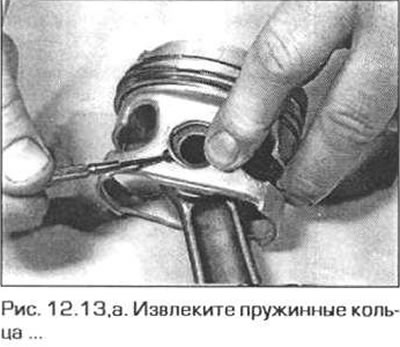
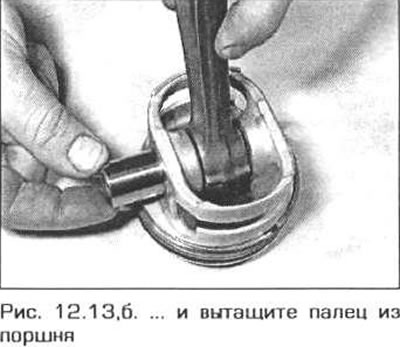
13. Using a small screwdriver, remove the spring rings holding the pin (fig. 12.13,a,b). The force of the hand should be enough to remove the pin. Mark the piston and its pin for subsequent assembly. The spring rings can be thrown away - new ones are needed for assembly. The manufacturer does not recommend changing the pins separately from the pistons - the pins are selected for specific pistons according to the dimensions within the tolerance.
13. Using a small screwdriver, remove the spring rings holding the pin (fig. 12.13,a,b). The force…


13. Using a small screwdriver, remove the spring rings holding the pin (fig. 12.13,a,b). The force…


14. Inspect the piston pins and the upper heads of the corresponding connecting rods for wear and damage. The pin should fit into the connecting rod by hand, without noticeable play. In case of significant wear, the piston and pin should be replaced as a pair.


15. Changing connecting rods is usually not necessary, except in the case of engine seizure or other serious malfunction. Visually assess the straightness of the connecting rod and, if any suspicions arise, take it to a specialist for a more thorough inspection.

16. Check all parts and purchase the necessary replacements. Pistons are usually supplied complete with pins and spring rings.

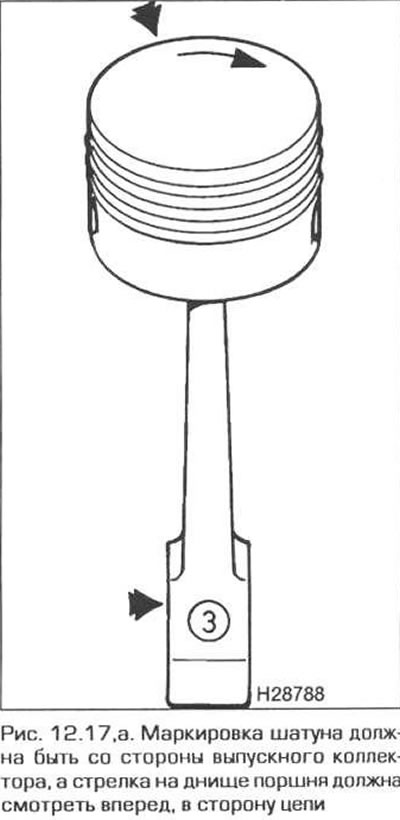
17. When connecting the connecting rod to the piston, turn them relative to each other so that after installation in the engine, the numbers on the connecting rod and the cover of its lower head are facing the exhaust manifold, and the arrow on the bottom of the piston is facing the front side of the engine (towards the chain) (fig. 12.17,a,b).
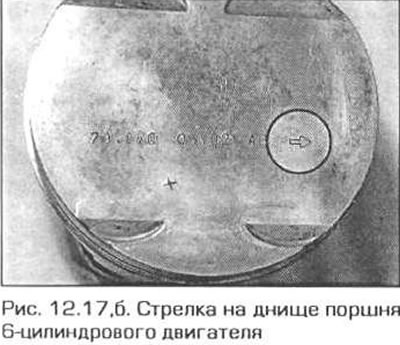
17. When connecting the connecting rod to the piston, turn them relative to each other so that…


17. When connecting the connecting rod to the piston, turn them relative to each other so that…


18. Lubricate the piston pin with engine oil and insert it into the piston and into the upper head of the connecting rod. Check that the piston rotates easily relative to the connecting rod. Secure the pin with two spring rings. Make sure that the rings are positioned in the grooves intended for them.

This article is available at russian, bulgarian, belarusian, ukrainian, serbian, croatian, romanian, polish, slovak, hungarian
Article verified: Ilyinsky Matvey

Share information:
Previous articles
БМВ E46: Engine overhaul
Next articles

Cylinder block/crankcase — cleaning and condition check
Crankshaft — Removal
Pistons and connecting rods — removal
Cylinder head — assembly
Cylinder head and valve mechanism — cleaning and checking the…
Crankshaft — Checking the condition
Main and connecting rod bearings — checking condition
Engine Repair — Assembly Procedure
Piston rings — installation
Crankshaft — installation


Similar articles on other types of BMW cars:
Checking the condition of pistons / connecting rods BMW 5 Series E28 (1981-1988)
Checking the technical condition of the cylinder head BMW 5 Series E12 (1972-1981)
Pistons and connecting rods — check BMW 7 Series E32 (1986-1994)
Identifying engine faults by the condition of spark plugs BMW X3 E83 (2003-2010)
Pistons and connecting rods — design description BMW X5 E53 (1999-2006)
Link in different formats to this page


Visitor comments

No comments yet


How much 11 + 11 =


BMW E46 (1998-2006) 
  • General information
  • Manual
  • Maintenance
  • Power unit
  • Engine repair
  • Cooling system
  • Power system (gasoline)
  • Injection system (gasoline)
  • Fuel system (diesel)
  • Exhaust system
  • Ignition system
  • Charge and launch systems
  • Transmission
  • Car gearbox
  • Clutch and drive shafts
  • Chassis
  • Brake system
  • Suspension front and rear
  • Steering
  • Body
  • Body care and repair
  • Exterior
  • Interior
  • Electrical equipment
  • Troubleshooting
  • Lighting and signaling
  • Equipment and devices
  • Heater and air conditioner
  • Electrical circuits
BMW E46 (1998-2006, petrol) 
  • General information
  • Manual
  • Repair on the road
  • Weekly checks
  • Maintenance
  • Troubleshooting
  • Power unit
  • 4 cylinder engines
  • 6 cylinder engines
  • Engine overhaul
  • Cooling and heating
  • Fuel and exhaust system
  • Starting and charging system
  • Ignition system
  • Transmission
  • Clutch
  • Mechanical gearbox
  • Automatic gearbox
  • Cardan and drive shafts
  • Chassis
  • Brake system
  • Wheel suspension
  • Steering
  • Body
  • Exterior
  • Interior
  • Electrical equipment
  • Equipment and devices
  • Electrical circuits
BMW E36 (1990-2000) 
  • General information
  • Maintenance
  • Power unit
  • Engine repair
  • Cooling system
  • Ignition system
  • Supply system
  • Fuel injection system
  • Exhaust system
  • Transmission
  • Clutch
  • Car gearbox
  • Front and rear axle
  • Chassis
  • Steering
  • Brake system
  • Body
  • Exterior
  • Interior
  • Electrical equipment
  • Heating system
  • Equipment and devices
  • Power devices
  • Electrical circuits
BMW E30 (1982-1994) 
  • Power unit
  • M10/M20 engine
  • M40 engine
  • Ignition system
  • Lubrication system
  • Cooling system
  • Supply system
  • Fuel injection
  • Exhaust system
  • Transmission
  • Clutch
  • Manual gearbox
  • Front axle
  • Rear axle
  • Chassis
  • Steering
  • Brake system
  • Body
  • Exterior
  • Interior
  • Electrical equipment
  • Heating system
  • Equipment and devices
  • Electrical circuits
BMW E21 (1975-1983) 
  • General information
  • Specifications
  • Operation and maintenance
  • 4-cylinder engine
  • Engine repair
  • Cooling and lubrication system
  • Supply system
  • Ignition system
  • 6-cylinder engine
  • Engine repair
  • Cooling and lubrication system
  • Supply system
  • Fuel injection system
  • Ignition system
  • Transmission
  • Clutch
  • 4-speed manual gearbox
  • 5-speed manual gearbox
  • Automatic gearbox
  • Cardan and rear axle
  • Chassis
  • Steering
  • Front suspension
  • Rear suspension
  • Brake system
  • Electrical equipment
  • Equipment and devices
  • Electrical circuits
BMWman.ru © 2017-2026 · Mobile version · News and articles · Sitemap: EN BG BY UA RS HR RO PL SK HU · Feedback · Site search
3er E21 · 3er E30 · 3er E36 · 3er E46 [petrol] · 3er E46 · 5er E12 · 5er E28 · 5er E34 · 5er E39 · 7er E32 · 7er E38 · X3 E83 · X5 E53 ·
This site uses cookies 🍪, without them some features simply would not work.