
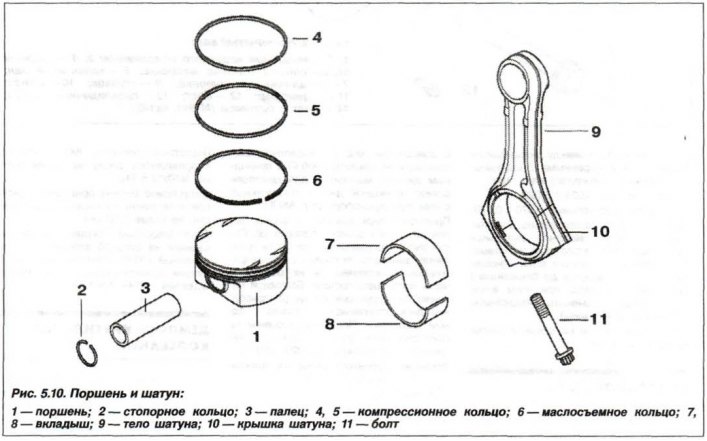
The pistons are made of aluminum alloy with steel inserts. Each piston has two compression rings and one oil scraper ring. For correct orientation of the piston when installed in the cylinder, there is an arrow on its bottom, which should face the camshaft drive, as well as a mark indicating its diameter. The piston diameter is measured at a distance of "A" = 18 mm from the lower edge of the piston skirt at an angle of 90° relative to the axis of the piston pin.
Engine model "N62B44":
Piston diameter:
- nominal - 91.986±0.016 mm;
- size of 1st class - 92.236±0.016 mm;
- size of the 2nd class - 92.486±0.016 mm.
Engine model "N62B48":
Piston diameter:
- nominal - 92.985±0.016 mm;
- size of 1st class - 93.235±0.016 mm;
- size of the 2nd class - 93.485±0.016 mm.
Calculated clearance between piston and cylinder:
- for new parts - from 0.001 to +0.044 mm;
- for working parts - from 0.026 to +0.073 mm;
- maximum permissible - 0.10 mm.
The permissible difference in weight between pistons for one engine is no more than 10 g.
The maximum permissible deviation of the piston diameter from the nominal size must not exceed 0.016 mm.
Piston pin (3) – steel, ground, floating type. It is held from axial movement by two retaining rings (2) in the piston holes (1) for the piston pin (in the bosses). The fingers are made in two classes and are marked with colored marks - black and white.
The piston pin diameter for all engine models is 21 mm, with a manufacturing tolerance of -0.003 to -0.006 mm.
The nominal clearance between the piston pin and the piston is from 0.00092 mm to 0.006 mm.
Clearance between piston pin and connecting rod upper head bushing:
- fingers with a "white" mark - 0.003 - 0.005 mm.
- fingers with a "black" mark - 0.005 - 0.007 mm.
The permissible operating clearance between the piston pin and the connecting rod upper head bushing is 0.0092 mm.
When repairing an engine, only pistons and pins of the same configuration should be installed.
The piston rings are installed in the grooves of the piston head: two compression rings (4, 5) and one oil scraper ring (6). The rings are installed on the piston with the "Top" mark ("Top") towards the piston bottom (fire belt).
The upper compression ring (4) is chrome plated with rounded edges.
The lower compression ring (5) is a conical oil scraper ring (6) with an expander.
Clearance between new piston ring and groove wall:
- upper compression - 0.002 - 0.070 mm;
- lower compression - 0.002 - 0.060 mm;
- oil scraper is not measured;
- maximum permissible - 0.12 mm.
Clearance in the lock of the new piston ring:
- upper compression - 0.10 - 0.30 mm;
- lower compression - 0.20 - 0.40 mm;
- oil scraper - 0.20 - 0.90 mm.
Maximum permissible clearance in the lock for all engine models:
- for compression rings - 0.80 mm,
- for oil scraper rings - 1.00 mm.
Connecting rods (9) – forged, with an I-section rod made of heat-treated steel and with thin-walled trimetallic bearing liners (7, 8). A bimetallic bushing is pressed into the upper head of the connecting rod. The inner diameter of the bushing of the upper head of the connecting rod is 21.006–21.014 mm.
The diameter of the opening of the lower connecting rod head, without bearing liners - 57.600-57.616 mm. The lower connecting rod head undergoes final processing with its cover (10) and, in the future, is not subject to disassembly.
The maximum permissible operating clearance between the connecting rod bearings and the crankshaft journals for all engine models is 0.12 mm.
The permissible twisting of the connecting rod body for all engine models is no more than 30'.
Tolerance for non-parallelism and skew of hole axes (misalignment) over a length of 100 mm, for all engine models – no more than 0.04 mm.
The maximum permissible axial clearance of the connecting rod on the crankshaft journal, relative to its cheek, for all engine models is 0.37 mm.
The permissible difference in weight between connecting rods on one engine, without liners, is no more than 4.0 g.