
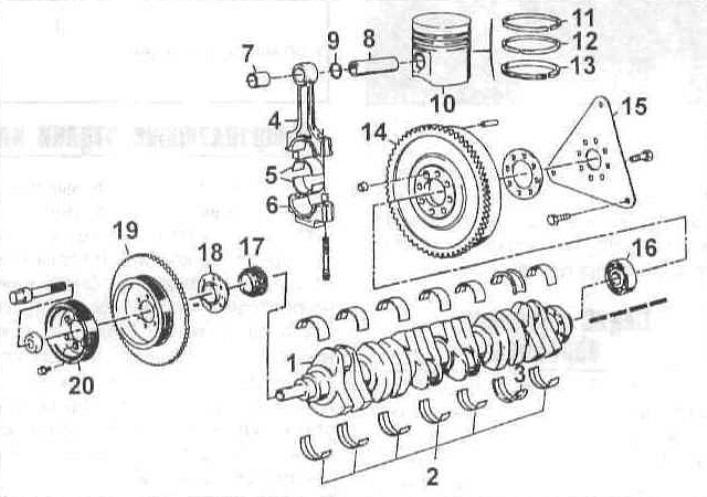
Typical elements of a crank mechanism
1 — crankshaft;
2 — main bearing shells;
3 - thrust bearings;
4 — connecting rod;
5 — connecting rod bearing shell;
6 — connecting rod cover;
7 — connecting rod upper head bushing;
8 - piston pin;
9 - retaining ring;
10 — piston;
11 - Upper compression ring;
12 - lower compression ring;
13 — oil scraper ring;
14 — flywheel;
15 - leading flange;
16 — bearing;
17 — crankshaft sprocket;
18 — coupling;
19 — torsional vibration damper;
20 — pulley.
Caution: Before removing the pistons and connecting rods, remove the cylinder head, oil pan and oil pump.
Check with your fingernail to see if a bead of carbon has formed on the upper limit of the piston ring travel (approximately 5 mm below the top of the cylinder). If rollers have formed due to carbon deposits or wear of the cylinder walls, they must be completely removed using a special device. If the rollers are not removed, the piston may be damaged when removing the pistons with connecting rods.
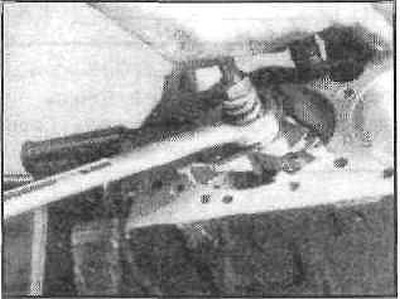
Removal the roller using a reamer
Once the rollers are removed, rotate the engine so that the crankshaft is on top.
Before removing the connecting rods, check their side clearance using feeler gauges. Insert them between the first connecting rod and the crankshaft until all the play is removed. If the play exceeds the maximum repair value, then the connecting rods must be replaced. If new connecting rods are installed (or a new crankshaft), the clearance may become less than the minimum allowable. In this case, you need to machine the connecting rods - if necessary, consult a car repair shop. Repeat the procedure for the remaining connecting rods.
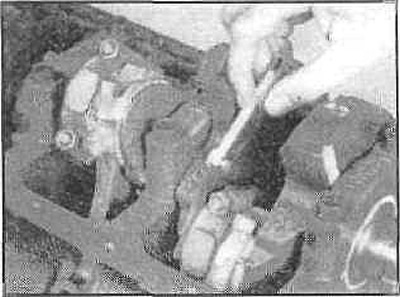
Check for identification marks on the connecting rods and connecting rod caps.
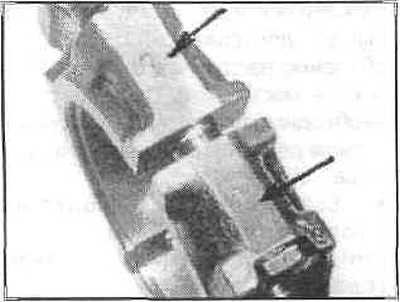
If they are not visible, use a small punch to make the appropriate number of marks on each connecting rod and cap (1, 2, etc., according to cylinder number).
Loosen each connecting rod cap nut in ½ turn increments until they can be turned by hand. Remove connecting rod cap #1 with the bearing shell - be careful not to drop the shell.
Place a piece of plastic or rubber hose over each connecting rod cap bolt to avoid damaging the crankshaft journal and cylinder bore when removing the piston.
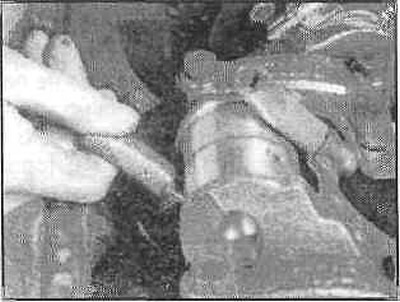
Remove the bearing shell and push the connecting rod and piston out through the top of the engine. Push with the wooden handle of the hammer against the surface of the upper connecting rod bearing. If resistance is felt, check again whether the roller is completely removed from the cylinder wall.
Repeat this operation for the remaining cylinders.
Once removed, reassemble the connecting rods by installing the bearing shell and caps, and tighten the nuts with your fingers.
Do not separate the pistons from the connecting rods.