
- Home
- BMW X5
- E53
- N62 petrol engine
- Engine repair
- Valve timing mechanism — design description
Valve timing mechanism — design description (BMW X5 E53)
The design of the engine valve timing drive is shown in Figure 5.11.
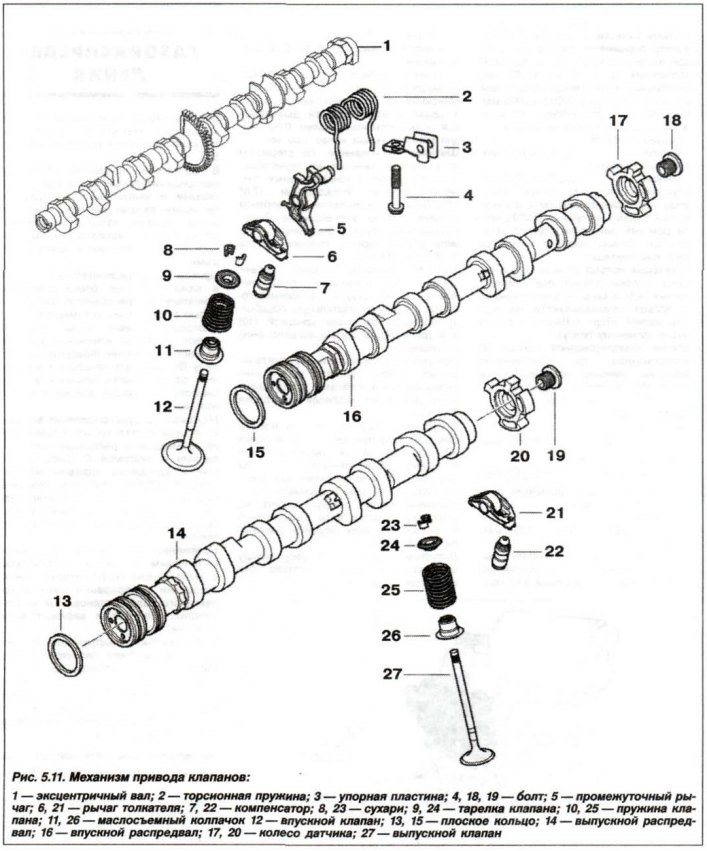
The engine uses a valve timing mechanism with overhead intake and exhaust camshafts, the cams of which act on the valves through roller levers with hydraulic compensators.
The camshafts in each cylinder head of the engine are driven by a roller chain from the crankshaft sprocket. The valve camshafts have a mechanism for changing the angle of the initial position (rotation) - the Bi-Vanos system, which leads to a change in the valve opening phase, depending on the engine load at the moment.
The valve timing mechanism includes, in addition to the cylinder head with camshafts and the Bi-Vanos system, intake and exhaust valves, valve guide bushings, valve springs with fastening parts, hydraulic compensators, camshaft drive chains with tension parts.
The chain tension is adjusted by an automatic tensioner with a hydraulic damping mechanism. The camshaft and crankshaft sprockets are mounted on segment keys and secured with bolts.
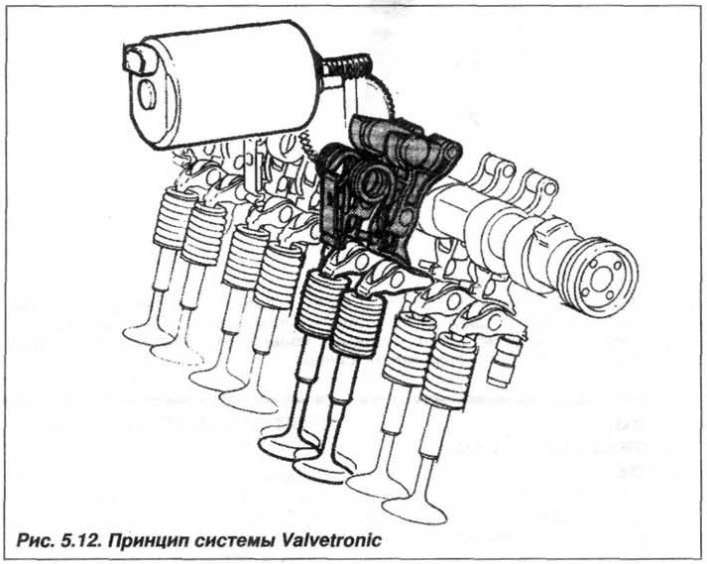
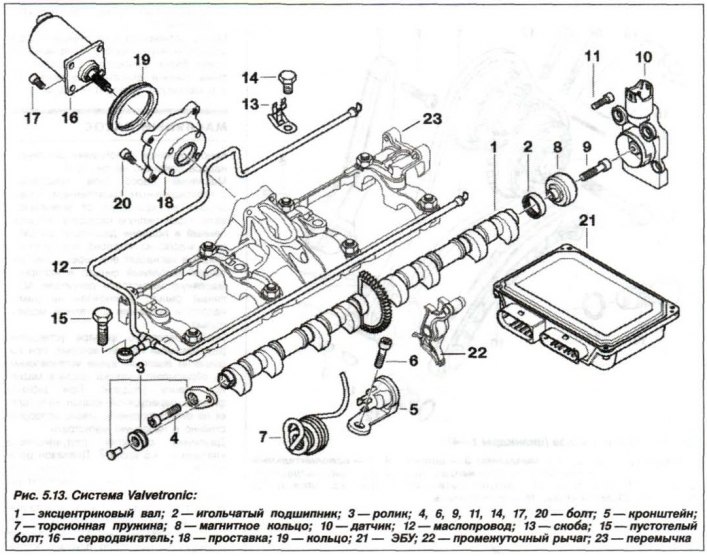
A special feature of the engine design is the Valvetronic system, which allows the lift height of the intake valves to be changed when adjusting engine power. The principle of the system is shown in Figure 5.12, and its design is shown in Figure 5.13.
The camshafts are five-bearing and rotate in plain bearings. The drive chain sprockets are installed on the camshafts.
Axial displacement of the camshaft:
Radial runout of shaft journals for engine models during assembly, no more than 0.040–0.074 mm. Limit value in operation is 0.1 mm.
Thrust bearing width 14.100–14.143 mm.
The gap between the shaft journals and their bearings is 0.040–0.082 mm.
The eccentric shaft (1) of the Valvetronic system has an axial clearance of 0.100–0.200 mm.
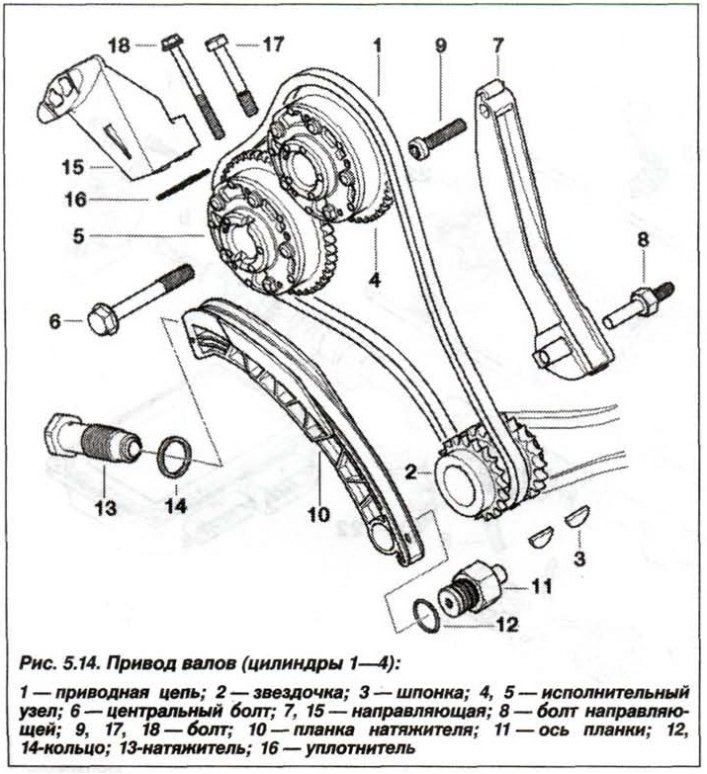
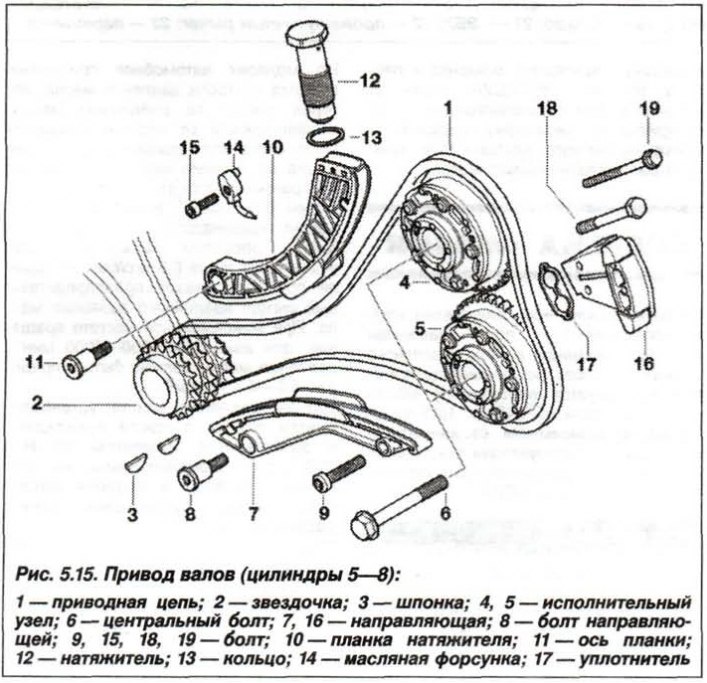
The camshaft drive is shown in Figure 5.14 (cylinders 1–4) and in Figure 5.15 (cylinders 5–8).
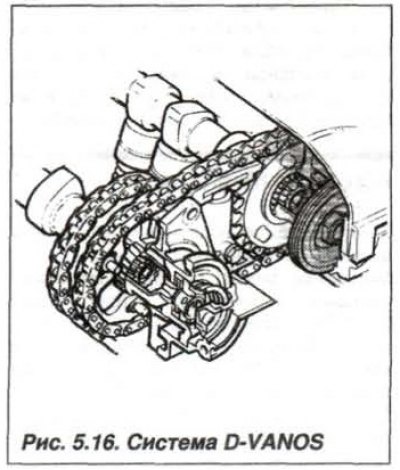
System "Doppel VANOS" ("D-Vanos") is designed to change the engine valve timing depending on the engine crankshaft speed and its load, by changing the angular position of the intake and exhaust valve camshaft (Fig. 5.16).
The camshafts are rotated by supplying oil under pressure to the actuator of the system. This allows for the optimal time to open the intake and exhaust valves, in relation to the idle mode, torque characteristics and fuel consumption. The ECU-KSUD controls the oil flow to the actuator (regulating) mechanism by means of an electromagnetic valve for each camshaft.
The engine uses a valve timing mechanism with overhead intake and exhaust camshafts, the cams of which act on the valves through roller levers with hydraulic compensators.
The camshafts in each cylinder head of the engine are driven by a roller chain from the crankshaft sprocket. The valve camshafts have a mechanism for changing the angle of the initial position (rotation) - the Bi-Vanos system, which leads to a change in the valve opening phase, depending on the engine load at the moment.
The valve timing mechanism includes, in addition to the cylinder head with camshafts and the Bi-Vanos system, intake and exhaust valves, valve guide bushings, valve springs with fastening parts, hydraulic compensators, camshaft drive chains with tension parts.
The chain tension is adjusted by an automatic tensioner with a hydraulic damping mechanism. The camshaft and crankshaft sprockets are mounted on segment keys and secured with bolts.
A special feature of the engine design is the Valvetronic system, which allows the lift height of the intake valves to be changed when adjusting engine power. The principle of the system is shown in Figure 5.12, and its design is shown in Figure 5.13.
Camshafts
The camshafts are five-bearing and rotate in plain bearings. The drive chain sprockets are installed on the camshafts.
Axial displacement of the camshaft:
- nominal - 0.065 - 0.150 mm;
- maximum permissible - 0.25 mm.
Radial runout of shaft journals for engine models during assembly, no more than 0.040–0.074 mm. Limit value in operation is 0.1 mm.
Thrust bearing width 14.100–14.143 mm.
The gap between the shaft journals and their bearings is 0.040–0.082 mm.
The eccentric shaft (1) of the Valvetronic system has an axial clearance of 0.100–0.200 mm.
Camshaft drive
The camshaft drive is shown in Figure 5.14 (cylinders 1–4) and in Figure 5.15 (cylinders 5–8).
System "DOPPEL VANOS"
System "Doppel VANOS" ("D-Vanos") is designed to change the engine valve timing depending on the engine crankshaft speed and its load, by changing the angular position of the intake and exhaust valve camshaft (Fig. 5.16).
The camshafts are rotated by supplying oil under pressure to the actuator of the system. This allows for the optimal time to open the intake and exhaust valves, in relation to the idle mode, torque characteristics and fuel consumption. The ECU-KSUD controls the oil flow to the actuator (regulating) mechanism by means of an electromagnetic valve for each camshaft.
This article is available at russian, bulgarian, belarusian, ukrainian, serbian, croatian, romanian, polish, slovak, hungarian
Article verified: Zhuravleva Isolda
Share information:
Previous articles
БМВ E53: Engine repair
Next articles
Similar articles on other types of BMW cars:
Characteristics of the valve timing mechanism BMW 3 Series E21 (1975-1983)
Valve timing drive (engine N42) — description and replacement of parts BMW 3 Series E46 (1998-2006, petrol)
Valve timing specifications BMW 5 Series E12 (1972-1981)
General description of the car BMW 7 Series E32 (1986-1994)
Removal and installation the preheating valve BMW 7 Series E38 (1994-2001)
Adjusting the valve timing BMW X3 E83 (2003-2010)
Characteristics of the valve timing mechanism BMW 3 Series E21 (1975-1983)
Valve timing drive (engine N42) — description and replacement of parts BMW 3 Series E46 (1998-2006, petrol)
Valve timing specifications BMW 5 Series E12 (1972-1981)
General description of the car BMW 7 Series E32 (1986-1994)
Removal and installation the preheating valve BMW 7 Series E38 (1994-2001)
Adjusting the valve timing BMW X3 E83 (2003-2010)
Link in different formats to this page
Visitor comments
No comments yet
- General information
- Manual
- Maintenance
- M54 petrol engine
- Engine repair
- Lubrication system
- Cooling system
- Supply system
- Injection system
- Exhaust system
- Engine electrics
- M62 petrol engine
- Engine repair
- Lubrication system
- Cooling system
- Supply system
- Exhaust system
- Engine electrics
- N62 petrol engine
- Engine repair
- Cooling and lubrication system
- Power and exhaust system
- Engine electrics
- Diesel engine M57
- Engine repair
- Lubrication system
- Cooling system
- Power and exhaust system
- Engine electrics
- Turbocharging system
- Transmission
- Clutch
- Mechanical gearbox
- Automatic gearbox
- Transfer case and cardan
- Chassis
- Brake system
- Steering
- Front suspension
- Rear suspension
- Wheels and tires
- Body
- Exterior
- Interior
- Doors and windows
- Repair and maintenance
- Heater and air conditioner
- Electrical equipment
- Equipment and devices
- Levers and switches
- Electrical circuits