
The crankshaft can only be removed after the engine has been removed from the vehicle. It is assumed that the flywheel or drive plate, torsional vibration damper, timing chain or belt, oil pan, oil pump and pistons/connecting rods assemblies have already been removed. Before removing the crankshaft, the bolts must be unscrewed and the rear oil seal housing removed.
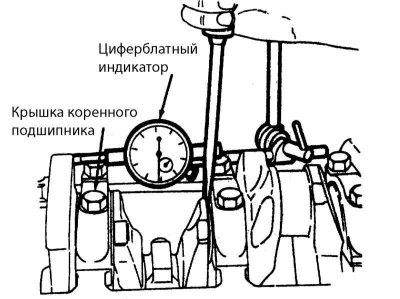
1. Before removing the crankshaft, check the axial play. Install the dial indicator so that its rod is parallel to the crankshaft and touches its end or one of the crank caps.
2. Move the crankshaft back as far as it will go and reset the indicator. Then move the crankshaft forward as far as it will go and read the indicator. The axial play is the distance the crankshaft has moved. If it exceeds the maximum axial play given in Table of sizes and adjustment data at the end of the Manual, then check the crankshaft thrust surfaces for wear. If no wear is detected, then new main bearings will correct the situation.
3. If a dial indicator is not available, feeler gauges can be used. Locate the main bearing with flanges on one side, called the "thrust" main bearing (see section Installing the crankshaft and checking the lubrication clearances of the main bearings, item 2). Carefully pry or slide the crankshaft forward until it stops. To determine the clearance, insert feeler gauges between the crankshaft and the front surface of the thrust main bearing.
4. Check for location markings on the main bearing caps. They should be numbered sequentially from the front of the engine to the rear. If not, mark them with numbers using punches or a center punch. The main bearing caps usually have cast arrows pointing to the front of the engine. Moving from the edge of the engine to the center, loosen the main bearing cap bolts in stages by a quarter turn so that they can be unscrewed by hand. If studs are used, ensure that they are subsequently installed in their original places when installing the crankshaft.
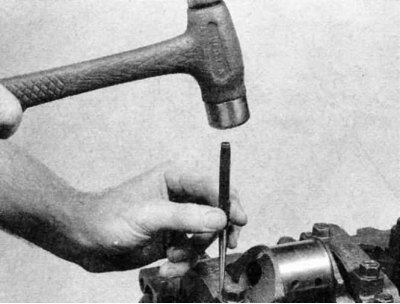
5. Lightly tap the caps with a mallet, then pry them away from the cylinder block. If necessary, use the bolts as levers to pry the caps away. Be careful not to drop the bearing shells if they are removed with the caps.
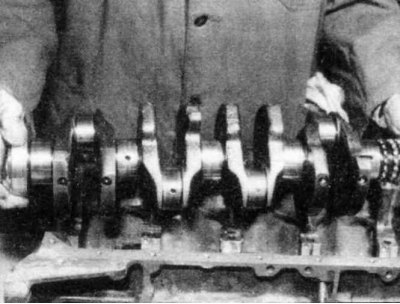
6. Carefully lift the crankshaft straight out of the engine. It may be advisable to have an assistant help you, as the crankshaft is quite heavy. Once the bearing shells are installed in the cylinder block and the main bearing caps are in place, return the caps to their proper positions on the block and hand tighten the bolts.
(The text is based on materials from the website: «BMWman.ru»)