
Table of contents: Front suspension ↓ Rear suspension ↓
- Home
- BMW 7 Series
- E38
- Chassis
- Front suspension
- General information, recommendations and safety measures
General information, recommendations and safety measures (BMW 7 Series E38)
Front suspension
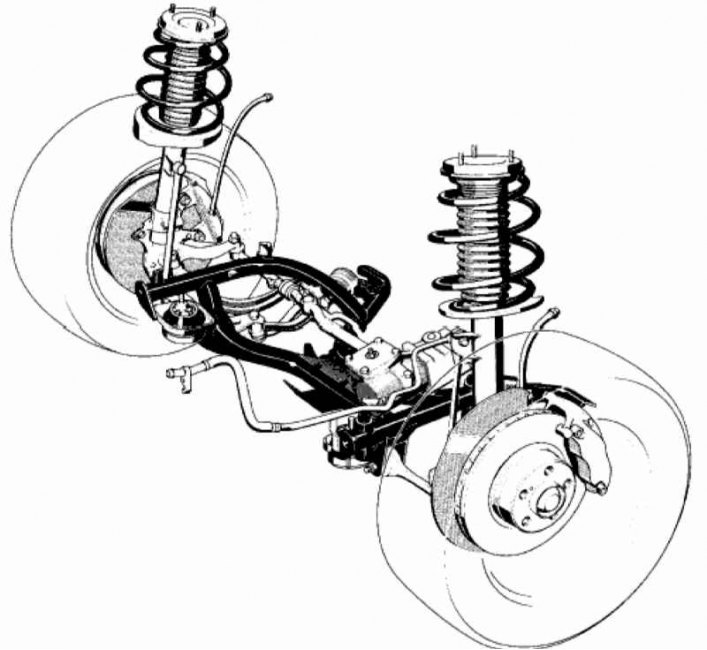
Independent front wheel suspension on double levers, aluminum, has a beam connected to the body via rubber supports. The front beam is connected to the steering knuckles via transverse levers and rods. The shock absorber struts, connected with bolts to the body and steering levers, consist of a coil spring and a gas-filled shock absorber. The anti-roll bar counteracts the tilt of the body on turns and promotes better contact of the front wheels with the road.
Rear suspension
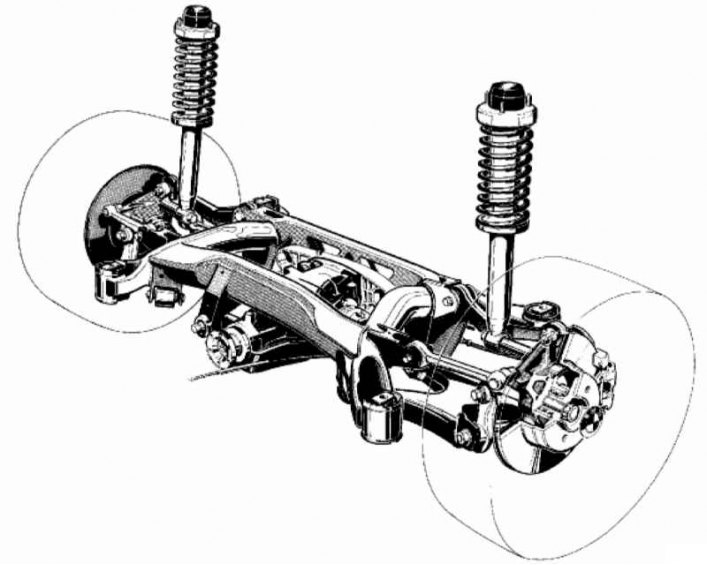
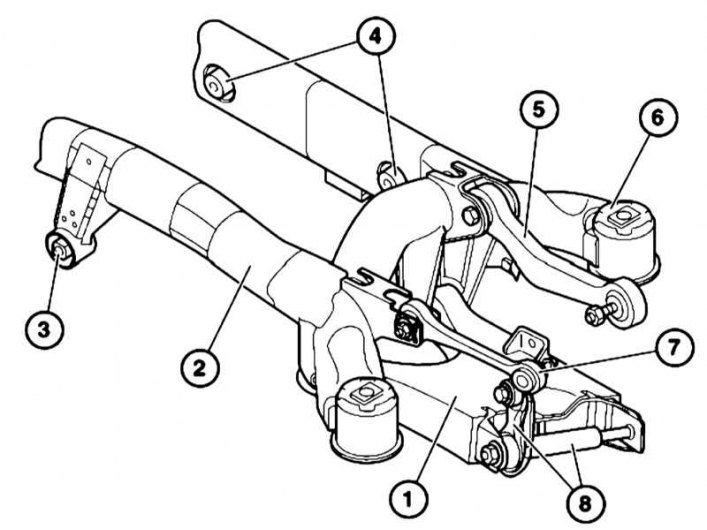
Rear suspension parts
1 - Swinging lever
2 - Beam
3 — Front gearbox mounting hinge
4 — Rear gearbox mounting hinges
5 — Transverse arm
6 — Beam hinge
7 - Stretching
8 - Integral lever
Rear suspension is a multi-link design with a subframe and double elastic mounting of the main transmission. The wheels are guided by four transverse levers elastically connected to the subframe. The subframe is also elastically connected to the body. In addition, the levers and drive wheels are geometrically arranged in such a way that they, together with the rubber-metal supports, create the effect of joint control of the rear wheels and ensure precisely calculated adjustment of the steering angle of the rear wheels. This provides a gain in driving safety in all situations.
Electronic damper control system (EDC), supplied as an additional equipment, adapts the rigidity of the shock absorbers to changing road conditions with virtually no delay. All changes in speed, vertical acceleration of the body, braking pressure, vehicle load, steering wheel angle and gas pedal position are constantly monitored by the corresponding sensors. Based on the data received, the electronic unit generates signals to control the shock absorbers, adjusting their rigidity using electromagnetic valves.
Since the front and rear suspensions are made entirely of aluminum, the following should be observed:
- Do not allow the suspension to come into contact with battery electrolyte;
- To clean the suspension, use only a stainless steel brush (not made of steel or brass);
- When grinding, cutting and welding, cover suspension components from sparks;
- Do not expose suspension components to temperatures above 80°C. Exposure to paint booth temperatures is acceptable.
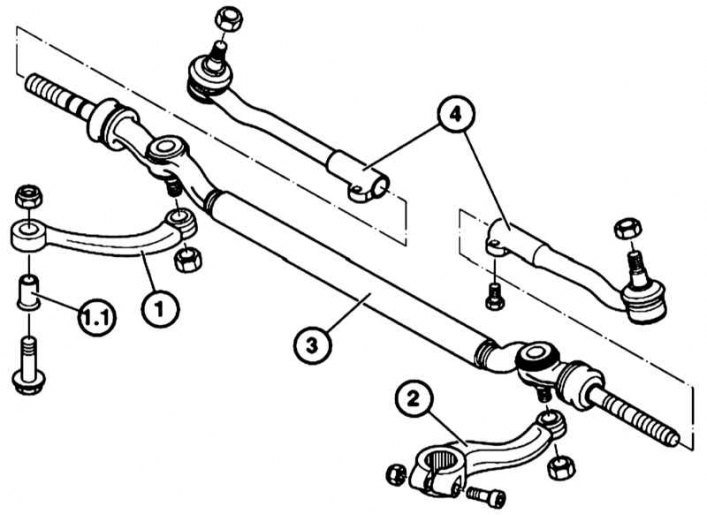
Steering gear parts
1 - Pendulum lever
2 — Bushing
3 - Bipod
4 - Medium traction
5 - Right and left lateral rods
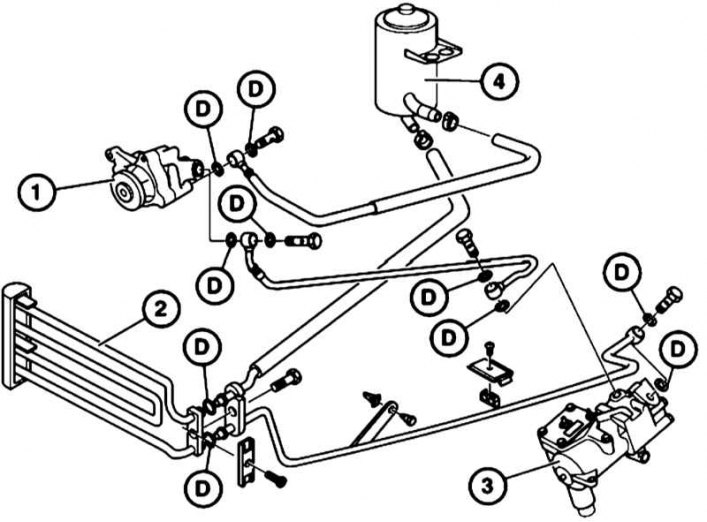
Power steering parts and lines
1 — Power steering pump
2 — Power steering fluid radiator
3 - Steering mechanism
4 — Power steering fluid reservoir
D — Sealing rings
Steering consists of a steering wheel, a steering shaft, a screw-and-ball nut steering gear, and a steering drive. The steering wheel with a built-in front driver airbag is mounted on a shaft that transmits control movements to the steering gear. To make driving easier, a power steering (PS) is used. The PS consists of a pump, a reservoir, hydraulic lines, and a radiator for the working fluid. The PS pump is driven by a multi-ribbed belt, sucks in PS fluid from the reservoir, and delivers it under pressure to the steering gear, where the adjusting element of the PS is located. The operating principle of the PS is discussed in Section Steering.
When repairing or servicing suspension and steering components, problems often arise with loosening "stuck" bolts and nuts. Fasteners located under the bottom of the car are constantly exposed to external influences and over time they corrode and partially deteriorate. Using brute force to loosen such "stuck" fasteners is associated with the risk of damaging them. First, wet the stubborn element with a small amount of a special penetrating liquid, allowing it to thoroughly soak the rust layer. Use a wire brush to remove external deposits from accessible areas of the threaded surfaces. Sometimes a sharp blow with a hammer on the nut through a drift helps to destroy the rust filling the gaps between the turns of the threaded joint - try not to damage the thread as a result of the drift jumping off. Using a long handle when releasing a "stuck" fastener allows you to significantly increase the applied torque, but it should be remembered that using extensions in a set with ratchet-type drives is associated with the risk of failure of the return mechanism, as well as the possibility of injury. Fasteners damaged during the release process must be replaced without fail.
Since most of the procedures described in this Chapter are performed with the vehicle raised above the ground, you should take care in advance of options for securely fixing it in the raised position - prepare strong supports. To jack up the vehicle, use hydraulic jacks of the rolling type - remember that the side jack included in the standard kit is intended only for temporary jacking of the vehicle when replacing a broken wheel. The hydraulic jack can also be used to hang up some suspension components when performing a particular procedure.
It is not permitted to carry out work under a vehicle that is held in a raised position only by means of jacks!
Welding and straightening of load-bearing suspension elements, as well as steering elements, is not permitted. Self-locking nuts and fasteners damaged by corrosion must be replaced during repairs.
This article is available at russian, bulgarian, belarusian, ukrainian, serbian, croatian, romanian, polish, slovak, hungarian
Article verified: Polikarpov Saveliy
Share information:
Previous articles
БМВ E38: Front suspension
Next articles
Similar articles on other types of BMW cars:
General information and safety measures when carrying out work BMW 3 Series E46 (1998-2006)
General information about engines BMW 3 Series E30 (1982-1994)
General information about the engine BMW 5 Series E12 (1972-1981)
Engine Repair Manual. General Information BMW 5 Series E34 (1988-1996)
Tachometer — general information BMW X3 E83 (2003-2010)
General information about M54 engines BMW X5 E53 (1999-2006)
General information and safety measures when carrying out work BMW 3 Series E46 (1998-2006)
General information about engines BMW 3 Series E30 (1982-1994)
General information about the engine BMW 5 Series E12 (1972-1981)
Engine Repair Manual. General Information BMW 5 Series E34 (1988-1996)
Tachometer — general information BMW X3 E83 (2003-2010)
General information about M54 engines BMW X5 E53 (1999-2006)
Link in different formats to this page
Visitor comments
No comments yet
- General information
- Introduction to guide
- Manual
- Maintenance
- Power unit
- Engine M60/1, M60/2 (petrol)
- M62 engine (petrol)
- M57 engine (diesel)
- M67 engine (diesel)
- Cooling system
- Fuel system (petrol)
- Fuel system (diesel)
- Exhaust system
- Ignition and control systems
- Charge and launch systems
- Transmission
- Clutch
- Mechanical gearbox
- Automatic gearbox
- Cardan and drive shafts
- Chassis
- Brake system
- Front suspension
- Rear suspension
- Steering
- Body
- Exterior
- Interior
- Electrical equipment
- Equipment and devices
- Lighting
- Heating and air conditioning
- Electrical circuits
- General information
- Care and maintenance
- Power unit
- Minor engine repair
- Engine overhaul
- Lubrication system
- Cooling system
- Ignition system
- Supply system
- Injection system (petrol)
- Injection system (diesel)
- Exhaust system
- Transmission
- Clutch
- Manual gearbox
- Automatic gearbox
- Cardan gear
- Rear axle and shafts
- Chassis
- Front suspension
- Rear suspension
- Steering
- Wheels and tires
- Brake system
- Body
- Body elements
- Electrical equipment
- Equipment and devices
- Electrical circuits