
Cars Mazda Cars Mitsubishi Cars Toyota Cars Chevrolet Cars AvtoVAZ Cars Kia Cars Nissan
English Русский
Български
Беларускі
Український
Српски
Hrvatski
Română
Polski
Slovenský
Magyar
| Articles | Contacts | Sitemap |   
BMWman.ru


3 series   5 series   7 series   BMW X3   BMW X5   BMW X6

E38 (1994-2001) E32 (1986-1994)
  • Home
  • BMW 7 Series
  • E38
  • Chassis
  • Steering
  • The principle of operation of the power steering

The principle of operation of the power steering (BMW 7 Series E38)

            0

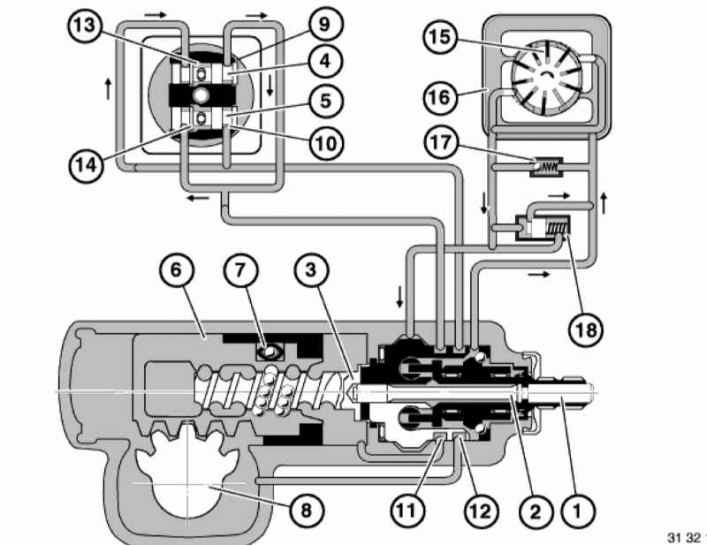
Design and operating principle of the power steering

Design and operating principle of the power steering

1 — Shaft
2 — Torsion
3 - Screw
4, 5 - Spools
6 — Piston
7 - Circulation tube
8 — Shaft with toothed sector
9, 10 — Inlet valves
11, 12 - Radial channels
13, 14 — Exhaust valves
15 — Pump
16 — Reservoir
17 — Safety valve
18 — Regulating valve


The steering gear housing contains the steering gear assembly, the control spool valve and the working cylinder. The steering shaft (1) is elastically connected to the screw (3) and rigidly to the spool valves (4 and 5) via the torsion bar (2). The spool valves are built into the distributor housing in a transverse position relative to the screw axis. The connection between the piston (6) and the screw (3) is achieved via a closed ball chain. When the screw is turned, the circulation tube (7) takes the balls from one end of the chain and moves them to the other end. The piston (6) is connected via a toothed engagement to the shaft (8), which has a toothed sector. The special tooth profile of the shaft sector makes it possible to eliminate play using the adjusting screw. In the neutral position of the spool valves (4 and 5), the oil supplied by the pump circulates in the steering mechanism and has free access to the cylinder through the open inlet and outlet control edges. The hydraulic drive comes into operation when the spools leave the neutral position. This happens when the force from the steering wheel or from the steering knuckle is transmitted to the screw through the shaft with the toothed sector and the piston. In this case, the torsion (2) acts as a connecting element. Its flexible part has the ability to deform and return the spools to the neutral position after the force from the steering wheel is removed. When the spools leave the neutral position, oil is also directed to the working cylinder - this provides force support in the movement of the steering shaft and counteraction during impacts caused by unevenness of the road. Steering wheel in neutral position: from the vane pump, oil flows into the distributor housing, through the inlet channels (9 and 10) to the radial channels (11 and 12). From there it flows further through the connecting holes to the right and left cavities of the cylinder, and then through the open outlet channels (13 and 14) back to the reservoir. The steering wheel is turned clockwise/counterclockwise: The spool (4/5) moves to the right and the inlet port (9/10) opens. The spool (5/4) moves to the left and the inlet port (10/9) closes. Thus, oil enters the right/left cylinder cavity, is pushed out of the left/right cylinder cavity and returns to the reservoir.

Original publication posted on the website «BMWMAN»

This article is available at russian, bulgarian, belarusian, ukrainian, serbian, croatian, romanian, polish, slovak, hungarian
Article verified: Polikarpov Saveliy

Share information:
Previous articles
БМВ E38: Steering
Next articles

Removal and installation the steering wheel, airbag unit and its…
Removal and installation steering column covers
Removal and installation the steering column and steering angle…
Replacing the steering column adjustment lever
Removal and installation the ignition switch and steering wheel lock


Similar articles on other types of BMW cars:
Adjusting the tension of the drive belts and the power steering pump BMW 3 Series E21 (1975-1983)
Replacing and tensioning the V-belt of the power steering pump on… BMW 3 Series E36 (1990-2000)
Power steering details BMW 5 Series E12 (1972-1981)
Power Steering — Checking Fluid Level BMW 5 Series E34 (1988-1996)
Checking the operation of the power steering pump BMW X3 E83 (2003-2010)
Bleeding the power steering system BMW X5 E53 (1999-2006)
Link in different formats to this page


Visitor comments

No comments yet


How much 40 + 45 =


BMW E38 (1994-2001) 
  • General information
  • Introduction to guide
  • Manual
  • Maintenance
  • Power unit
  • Engine M60/1, M60/2 (petrol)
  • M62 engine (petrol)
  • M57 engine (diesel)
  • M67 engine (diesel)
  • Cooling system
  • Fuel system (petrol)
  • Fuel system (diesel)
  • Exhaust system
  • Ignition and control systems
  • Charge and launch systems
  • Transmission
  • Clutch
  • Mechanical gearbox
  • Automatic gearbox
  • Cardan and drive shafts
  • Chassis
  • Brake system
  • Front suspension
  • Rear suspension
  • Steering
  • Body
  • Exterior
  • Interior
  • Electrical equipment
  • Equipment and devices
  • Lighting
  • Heating and air conditioning
  • Electrical circuits
BMW E32 (1986-1994) 
  • General information
  • Care and maintenance
  • Power unit
  • Minor engine repair
  • Engine overhaul
  • Lubrication system
  • Cooling system
  • Ignition system
  • Supply system
  • Injection system (petrol)
  • Injection system (diesel)
  • Exhaust system
  • Transmission
  • Clutch
  • Manual gearbox
  • Automatic gearbox
  • Cardan gear
  • Rear axle and shafts
  • Chassis
  • Front suspension
  • Rear suspension
  • Steering
  • Wheels and tires
  • Brake system
  • Body
  • Body elements
  • Electrical equipment
  • Equipment and devices
  • Electrical circuits
BMWman.ru © 2017-2026 · Mobile version · News and articles · Sitemap: EN BG BY UA RS HR RO PL SK HU · Feedback · Site search
3er E21 · 3er E30 · 3er E36 · 3er E46 [petrol] · 3er E46 · 5er E12 · 5er E28 · 5er E34 · 5er E39 · 7er E32 · 7er E38 · X3 E83 · X5 E53 ·
This site uses cookies 🍪, without them some features simply would not work.