
Since the hydraulic clutch system operates on brake fluid, it is necessary to familiarize yourself with the relevant instructions given in Chapter Bleeding the brake system.
Brake fluid is poisonous. Never suck out brake fluid by mouth or through a hose. Store the fluid in a container that cannot be accessed accidentally.
When removing air without using the special device described here, some air may remain in the system. This is indicated by noise and proper disengagement of the clutch. In this case, it is necessary to urgently remove air from the system at a service station using a special device.
1. Remove the lower engine compartment cover, refer to Section Removal and installation the lower engine compartment cover.
2. Check the brake fluid in the reservoir, top up to the Max mark if necessary, refer to Section Checking fluid levels.
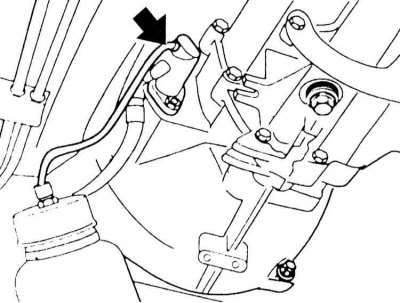
3. Remove the dust cap from the air bleed nipple (arrow on the illustration) on the working hydraulic cylinder. Put a transparent hose on the nipple.
4. Carefully check the movement of the nipple. To open it, use a spanner so as not to damage the hexagon of the nipple.
5. Immerse the free end of the hose in a container with brake fluid to prevent air from entering the system.
6. Ask an assistant to press the clutch pedal about 10 times and keep it pressed.
7. In this position, open the nipple "3", and the liquid will start to flow out. If the flowing liquid no longer contains air bubbles, close the nipple.
Make sure that the brake fluid level in the reservoir does not drop significantly. To do this, top up the fluid.
8. Release the clutch pedal and press it again 10 times. Keep it pressed and open the bleeder valve. Repeat this process as many times as necessary to ensure that the fluid that comes out is free of air bubbles. Keep adding fluid to the reservoir.
9. Close the nipple on the working hydraulic cylinder. Remove the hose and close the nipple with a cap.
10. Install the lower engine compartment cover, refer to Section Removal and installation the lower engine compartment cover.
11. Fill the system with brake fluid up to the Max mark.
12. Check the operation of the brake system and clutch.
Removal air using a device
At the service station, air is removed from the clutch drive, as a rule, using a special device. The device creates pressure on the brake fluid.
13. Connect the device to the tank as described by the manufacturer.
14. Remove the slave cylinder from the manual transmission, refer to the relevant section.
When the clutch is disengaged, do not press the clutch pedal.
15. Attach the hose to the air bleed nipple of the working cylinder. Lower the free end of the hose into a container with brake fluid.
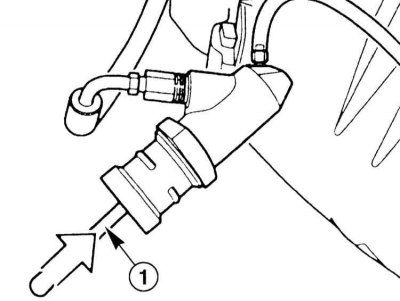
16. Hold the clutch slave cylinder so that the nipple faces upward.
17. Open the nipple and release the liquid until air bubbles stop appearing.
In order not to squeeze the piston rod out of the hydraulic cylinder, the service station uses a device with a thread, by means of which the rod is fixed or pushed in and out. If such a device is not available, the rod must be held by hand. In this case, the air removal device can only create a slight pressure and must be operated by an assistant.
18. Slowly release the rod "1" a short distance and press it again until it stops in the working cylinder. Repeat this process until the appearance of bubbles stops. Then close the nipple.
19. Reinstall the clutch slave cylinder, refer to the relevant section.
20. Remove the air bleeder.
21. Fill the reservoir with brake fluid up to the Max mark. Screw the cap onto the reservoir.