
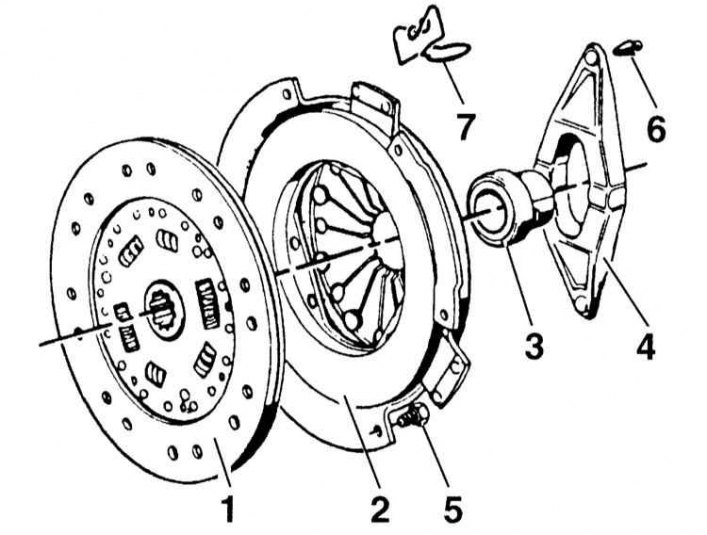
1 - slave disk
2 - pressure plate
3 — clutch release bearing
4 — clutch release lever
5 — bolt
6 - ball pin
7 - spring clamp
The models under consideration are equipped with a single-disk dry clutch with a diaphragm spring. When gears are engaged, the clutch disconnects the power connection between the engine and the gearbox and ensures, thanks to the friction connection, a smooth transfer of torque to the chassis when starting off.
The clutch consists of a basket with a pressure plate, a driven plate, and a clutch release bearing with a hydraulic drive.
The clutch basket is connected to the flywheel by bolted connections. The flywheel in turn is connected to the engine crankshaft. Between the pressure plate and the flywheel is a driven disk, which is pressed against the flywheel by a diaphragm spring of the pressure plate. The driven disk is connected to the primary shaft of the gearbox through a splined connection.
When the clutch pedal is pressed, the fluid under pressure is transferred to the slave cylinder through the master cylinder on the clutch pedal. The piston of the slave cylinder, pressing on the clutch release bearing, acts on the pressure plate. In this case, the slave disk is moved away from the flywheel. The power connection between the engine and the gearbox is interrupted.
The hydraulic clutch system operates on brake fluid supplied from a reservoir common with the brake system.
Each time the clutch is engaged and disengaged, the friction linings of the driven disk wear out as a result of the force applied. The driven disk is a fast-wearing part. However, its average service life is more than
150,000 km. Disc wear depends mainly on the load and driving style. In particular, starting off, when the clutch slips for a long time, or driving in the mountains with a trailer leads to clutch burnout. The clutch does not require maintenance, as it is self-adjusting.