
Cars Mazda Cars Mitsubishi Cars Toyota Cars Chevrolet Cars AvtoVAZ Cars Kia Cars Nissan
English Русский
Български
Беларускі
Український
Српски
Hrvatski
Română
Polski
Slovenský
Magyar
| Articles | Contacts | Sitemap |   
BMWman.ru


3 series   5 series   7 series   BMW X3   BMW X5   BMW X6

E46 (1998-2006) E46 (1998-2006, petrol) E36 (1990-2000) E30 (1982-1994) E21 (1975-1983)
  • Home
  • BMW 3 Series
  • E46
  • Chassis
  • Brake system
  • Front Brake Pads — Replacement

Front Brake Pads — Replacement (BMW 3 Series E46)

            0

Warning! Always replace the brake pads on both front brakes at the same time. Replacing the pads on only one wheel may result in uneven braking. Dust from worn brake pads may contain asbestos, which is very dangerous to health. Do not blow off dust with compressed air or inhale air containing asbestos. Use a respirator when working on the brakes. Do not use gasoline (or gasoline-based solvents) to clean dust, use brake cleaner or methyl alcohol.


1. Apply the parking brake, then raise the front of the vehicle and support it on stands (see "Lifting and installing the car on supports"). Remove the front wheels.

2. Using a screwdriver, carefully unhook the anti-noise spring from the side wall of the caliper, remembering its location (fig. 4.2, a, b).
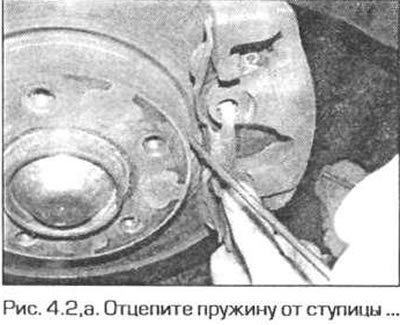
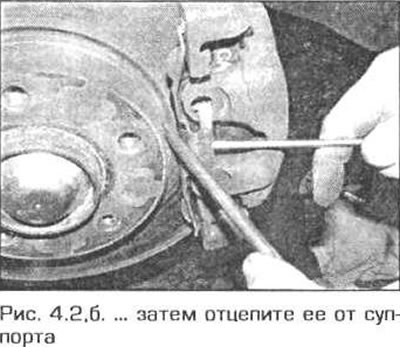
2. Using a screwdriver, carefully unhook the anti-noise spring from the side wall of the caliper,…


2. Using a screwdriver, carefully unhook the anti-noise spring from the side wall of the caliper,…


3. Remove the wear sensor from the pad (if it exists), then remove it from the caliper hole (fig. 4.3, a, b).
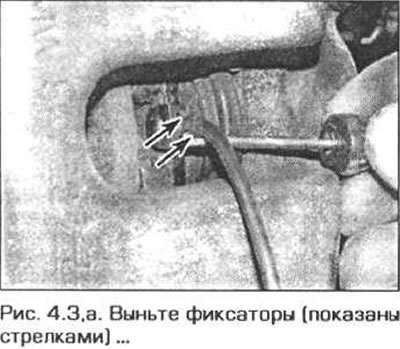
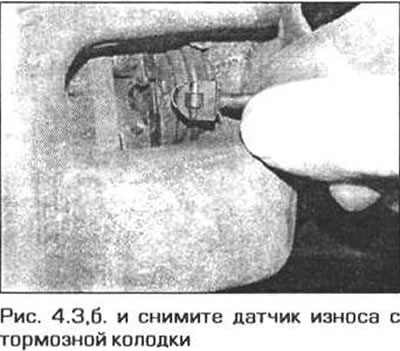

3. Remove the wear sensor from the pad (if it exists), then remove it from the caliper hole (fig.…


3. Remove the wear sensor from the pad (if it exists), then remove it from the caliper hole (fig.…


4. To access the guide bolts, remove the plastic covers from the caliper guides (Fig. 4.4).
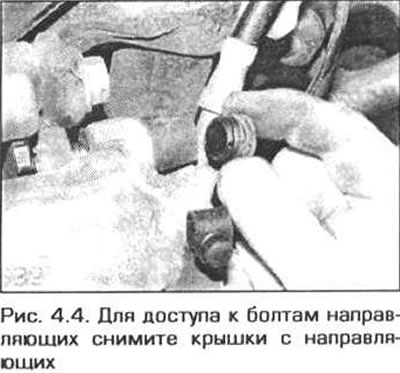
4. To access the guide bolts, remove the plastic covers from the caliper guides (Fig. 4.4).


5. Using a hex key, loosen and remove the guide bolts. Remove the caliper from the bracket and secure it to the suspension strut using a piece of wire (fig. 4.5, a-c). Do not allow the caliper hose to become strained.
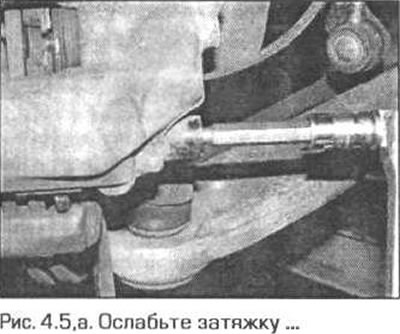
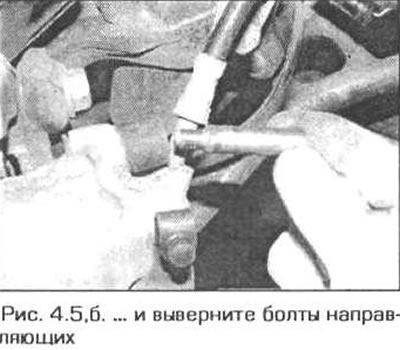
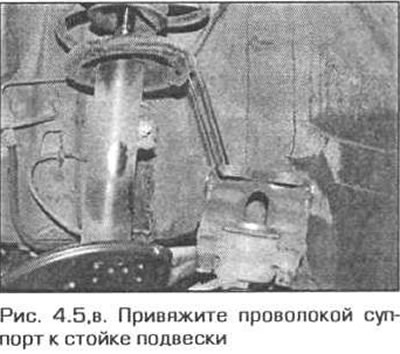
5. Using a hex key, loosen and remove the guide bolts. Remove the caliper from the bracket and…


5. Using a hex key, loosen and remove the guide bolts. Remove the caliper from the bracket and…


5. Using a hex key, loosen and remove the guide bolts. Remove the caliper from the bracket and…


6. Disconnect the inner pad from the piston, then remove the outer pad from the caliper bracket (fig. 4.6, a, b).
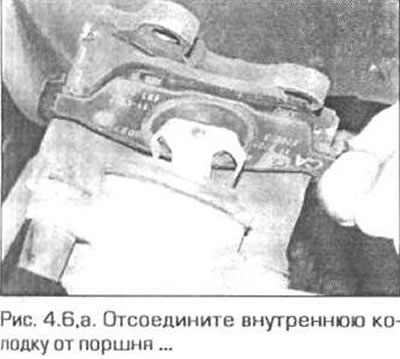
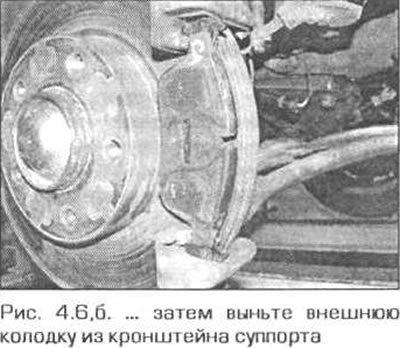
6. Disconnect the inner pad from the piston, then remove the outer pad from the caliper bracket…


6. Disconnect the inner pad from the piston, then remove the outer pad from the caliper bracket…


7. First of all, measure the thickness of the pad of each shoe (Fig. 4.7). If the thickness of any of the shoes is at the limit in any place, (or below it), then all four pads must be replaced. The pads should also be replaced if any of them are oily, as there is no reliable way to remove such contamination from the friction material. If one of the pads wears unevenly or is contaminated with oil, the cause must be identified and corrected before assembly begins.
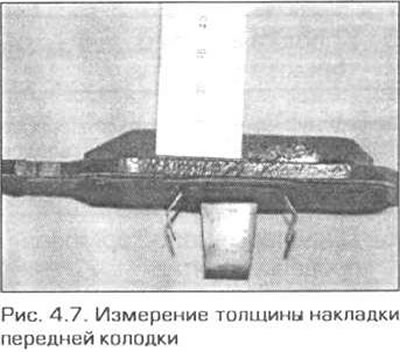


7. First of all, measure the thickness of the pad of each shoe (Fig. 4.7). If the thickness of any…


If the condition of the pads is satisfactory, clean them thoroughly with a soft brush (or something similar), not forgetting the sides and back of the metal base. Clean the grooves on the surface of the overlay (if they exist) and remove any large particles of dirt or wear products embedded in the material. Thoroughly clean the pad installation areas in the caliper and support bracket.

9. Before installing the pads, make sure the guide pins are tight enough to slide freely in the caliper bracket. Brush off any dust or dirt from the caliper and piston. Do not inhale dust, as it is hazardous to your health. Inspect the piston dust seal for damage and the piston for leaks, corrosion or damage. If any of these components require attention, contact paragraph 8.

10. If you are installing new brake pads, the caliper piston must be pressed into the cylinder to provide space for the pads. Use a clamp or a wooden block as a lever for this. Clamp the caliper brake hose and connect the brake system bleeding kit to the air bleed screw. Then unscrew the bleed screw and press the piston into the cylinder. The brake fluid displaced in this process will collect in the bleed kit container (Fig. 4.10). Before you finish pressing the piston in, tighten the bleed screw. This will prevent air from entering the brake system.
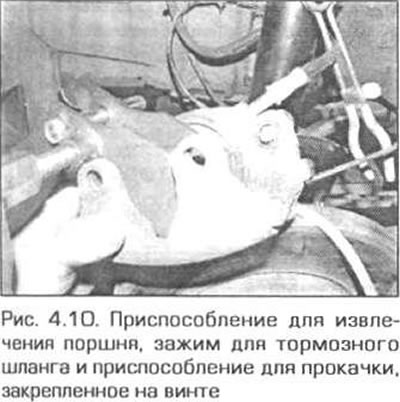


10. If you are installing new brake pads, the caliper piston must be pressed into the cylinder to…


Note: ABS systems are very sensitive to dirt in the brake fluid. Even small particles of dirt can cause blockages in the system. The method of recessing the piston described above avoids the risk of contamination of the system and damage to the seals of the brake master cylinder.


11. Apply brake grease to the back of each pad. Be careful not to apply too much grease or let it come into contact with the friction material.

12. Insert the outer pad into the caliper bracket with the working side facing the brake disc (Fig. 4.12).
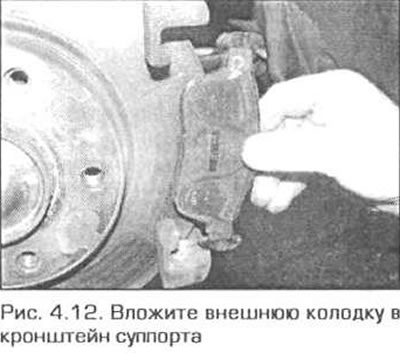
12. Insert the outer pad into the caliper bracket with the working side facing the brake disc (Fig.…


13. Secure the inner shoe to the piston, then install the caliper in place (Fig. 4.13).
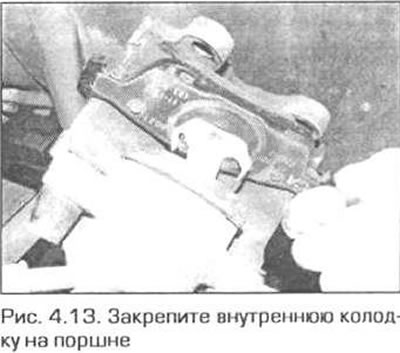
13. Secure the inner shoe to the piston, then install the caliper in place (Fig. 4.13).


14. Screw in the guide pin mounting bolts and tighten them to the specified torque. Place the covers on the guides.


15. Install the wear sensor on the outer shoe. Make sure that its wiring is correctly routed (see Fig. 4.3, a, b).

16. Fasten the anti-noise spring to the caliper (Fig. 4.16). Press the brake pedal several times to ensure that the pads approach the disc and that the brake pedal's working travel is restored.
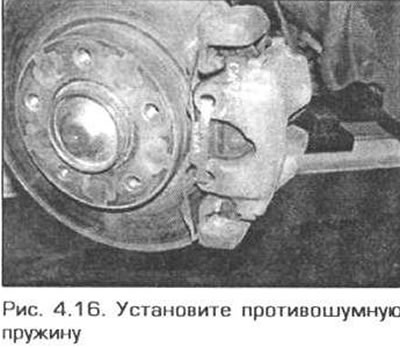
16. Fasten the anti-noise spring to the caliper (Fig. 4.16). Press the brake pedal several times to…


17. Repeat the above procedure for the other front brake.

New pads do not provide maximum braking performance until they have been broken in. With this in mind, avoid heavy braking for several hundred kilometers after replacing the pads if possible.

(The website served as the basis for the text «BMWMAN.ru»)

This article is available at russian, bulgarian, belarusian, ukrainian, serbian, croatian, romanian, polish, slovak, hungarian
Article verified: Ilyinsky Matvey

Share information:
Previous articles
БМВ E46: Brake system
Next articles

Hydraulic lines and hoses — replacement
Hydraulic system — air removal
Basic information
Tightening torques for connections, Nm
Technical data
Rear brake pads — replacement
Front Brake Disc — Checking, Removing and Installing
Rear brake disc — inspection, removal and installation
Front Brake Caliper — Removal, Repair and Installation
Rear Brake Caliper — Removal, Repair and Installation


Similar articles on other types of BMW cars:
Replacing the front brake pads BMW 5 Series E12 (1972-1981)
Removal and installation front disc brake pads BMW 5 Series E39 (1995-2003)
Front brake pads — removal and installation BMW 7 Series E32 (1986-1994)
Replacing the parking brake pads and their release mechanism BMW 7 Series E38 (1994-2001)
Brake pads for front disc brakes BMW X3 E83 (2003-2010)
Replacing the brake pads of the wheel BMW X5 E53 (1999-2006)
Link in different formats to this page


Visitor comments

No comments yet


How much 10 + 14 =


BMW E46 (1998-2006) 
  • General information
  • Manual
  • Maintenance
  • Power unit
  • Engine repair
  • Cooling system
  • Power system (gasoline)
  • Injection system (gasoline)
  • Fuel system (diesel)
  • Exhaust system
  • Ignition system
  • Charge and launch systems
  • Transmission
  • Car gearbox
  • Clutch and drive shafts
  • Chassis
  • Brake system
  • Suspension front and rear
  • Steering
  • Body
  • Body care and repair
  • Exterior
  • Interior
  • Electrical equipment
  • Troubleshooting
  • Lighting and signaling
  • Equipment and devices
  • Heater and air conditioner
  • Electrical circuits
BMW E46 (1998-2006, petrol) 
  • General information
  • Manual
  • Repair on the road
  • Weekly checks
  • Maintenance
  • Troubleshooting
  • Power unit
  • 4 cylinder engines
  • 6 cylinder engines
  • Engine overhaul
  • Cooling and heating
  • Fuel and exhaust system
  • Starting and charging system
  • Ignition system
  • Transmission
  • Clutch
  • Mechanical gearbox
  • Automatic gearbox
  • Cardan and drive shafts
  • Chassis
  • Brake system
  • Wheel suspension
  • Steering
  • Body
  • Exterior
  • Interior
  • Electrical equipment
  • Equipment and devices
  • Electrical circuits
BMW E36 (1990-2000) 
  • General information
  • Maintenance
  • Power unit
  • Engine repair
  • Cooling system
  • Ignition system
  • Supply system
  • Fuel injection system
  • Exhaust system
  • Transmission
  • Clutch
  • Car gearbox
  • Front and rear axle
  • Chassis
  • Steering
  • Brake system
  • Body
  • Exterior
  • Interior
  • Electrical equipment
  • Heating system
  • Equipment and devices
  • Power devices
  • Electrical circuits
BMW E30 (1982-1994) 
  • Power unit
  • M10/M20 engine
  • M40 engine
  • Ignition system
  • Lubrication system
  • Cooling system
  • Supply system
  • Fuel injection
  • Exhaust system
  • Transmission
  • Clutch
  • Manual gearbox
  • Front axle
  • Rear axle
  • Chassis
  • Steering
  • Brake system
  • Body
  • Exterior
  • Interior
  • Electrical equipment
  • Heating system
  • Equipment and devices
  • Electrical circuits
BMW E21 (1975-1983) 
  • General information
  • Specifications
  • Operation and maintenance
  • 4-cylinder engine
  • Engine repair
  • Cooling and lubrication system
  • Supply system
  • Ignition system
  • 6-cylinder engine
  • Engine repair
  • Cooling and lubrication system
  • Supply system
  • Fuel injection system
  • Ignition system
  • Transmission
  • Clutch
  • 4-speed manual gearbox
  • 5-speed manual gearbox
  • Automatic gearbox
  • Cardan and rear axle
  • Chassis
  • Steering
  • Front suspension
  • Rear suspension
  • Brake system
  • Electrical equipment
  • Equipment and devices
  • Electrical circuits
BMWman.ru © 2017-2026 · Mobile version · News and articles · Sitemap: EN BG BY UA RS HR RO PL SK HU · Feedback · Site search
3er E21 · 3er E30 · 3er E36 · 3er E46 [petrol] · 3er E46 · 5er E12 · 5er E28 · 5er E34 · 5er E39 · 7er E32 · 7er E38 · X3 E83 · X5 E53 ·
This site uses cookies 🍪, without them some features simply would not work.