



- Home
- BMW 3 Series
- E46
- Chassis
- Brake system
- Vacuum booster — checking, removal and installation
Vacuum booster — checking, removal and installation (BMW 3 Series E46)
Note: On models with ABS and Traction Control (ASC+T) or Dynamic Stability Control (DSC), removing the booster requires removing the ABS/ASC+T and/or DSC control unit. Since special equipment is required to remove these units, this work should be performed at a specialist workshop.
Examination
1. To check the operation of the booster, press the foot brake pedal several times to use up the remaining vacuum in the booster. Then start the engine, holding the pedal down. When starting the engine, you will feel the pedal "pull back" as the vacuum increases. After the engine has been running for some time, (at least a couple of minutes), muffle it. Now press the pedal. You should feel a normal force, and with subsequent presses the pedal should become "harder", and its stroke should decrease with each press.
2. If the amplifier does not work as described above, then first of all you need to check the amplifier valve (see paragraph 13).
3. If after checking the valve the amplifier continues to work unsatisfactorily, it is faulty. Replace the amplifier - it is impossible to repair.
Removal
Note: You will need new booster mounting nuts during installation.
4. Remove the master cylinder (see paragraph 10).
5. Disconnect the vacuum hose from the booster valve.
6. Remove the screws and remove the lower trim panel on the driver's side.
7. Unhook the spring, then remove the retainer and pin connecting the brake pedal to the booster pushrod (see paragraph 11, fig. 11.4).
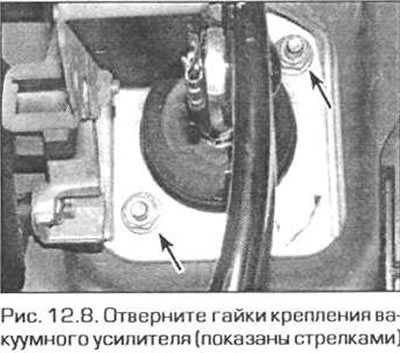
8. Unscrew the amplifier mounting nuts. Then remove the amplifier from the engine compartment and remove it from the car (Fig. 12.8).
Installation
9. Installation is performed in the reverse order of removal. When installing, pay attention to the following.
- a) Check the condition of the booster valve sealing bushing and, if necessary, replace it.
- b) Before installing the new amplifier, remove the sound insulation from the old amplifier and attach it to the new amplifier.
- c) Make sure that the booster pushrod is correctly positioned relative to the brake pedal. Then secure the booster with the nuts and tighten them to the specified torque.
- d) Lubricate the booster pushrod axle with grease, insert the axle into place and secure it with the spring clip.
- d) Install the master cylinder (paragraph 10).
- e) Finally, start the engine and check for air leaks from the vacuum booster connections. Check the operation of the brake system before driving.
[Examine the original source using the link on the website BMWman.ru]
This article is available at russian, bulgarian, belarusian, ukrainian, serbian, croatian, romanian, polish, slovak, hungarian
Article verified: Ilyinsky Matvey
Share information:
Previous articles
БМВ E46: Brake system
Next articles
Similar articles on other types of BMW cars:
Checking the vacuum and atmospheric valves BMW 5 Series E12 (1972-1981)
Removal and installation the one-way valve of the vacuum booster BMW 7 Series E38 (1994-2001)
Checking the brake system with pressure and vacuum BMW X5 E53 (1999-2006)
Bleeding the cooling system and checking it for leaks (M54, N46, N47,… BMW X3 E83 (2003-2010)
Checking the vacuum and atmospheric valves BMW 5 Series E12 (1972-1981)
Removal and installation the one-way valve of the vacuum booster BMW 7 Series E38 (1994-2001)
Checking the brake system with pressure and vacuum BMW X5 E53 (1999-2006)
Bleeding the cooling system and checking it for leaks (M54, N46, N47,… BMW X3 E83 (2003-2010)
Link in different formats to this page
Visitor comments
No comments yet
- General information
- Manual
- Maintenance
- Power unit
- Engine repair
- Cooling system
- Power system (gasoline)
- Injection system (gasoline)
- Fuel system (diesel)
- Exhaust system
- Ignition system
- Charge and launch systems
- Transmission
- Car gearbox
- Clutch and drive shafts
- Chassis
- Brake system
- Suspension front and rear
- Steering
- Body
- Body care and repair
- Exterior
- Interior
- Electrical equipment
- Troubleshooting
- Lighting and signaling
- Equipment and devices
- Heater and air conditioner
- Electrical circuits
- General information
- Manual
- Repair on the road
- Weekly checks
- Maintenance
- Troubleshooting
- Power unit
- 4 cylinder engines
- 6 cylinder engines
- Engine overhaul
- Cooling and heating
- Fuel and exhaust system
- Starting and charging system
- Ignition system
- Transmission
- Clutch
- Mechanical gearbox
- Automatic gearbox
- Cardan and drive shafts
- Chassis
- Brake system
- Wheel suspension
- Steering
- Body
- Exterior
- Interior
- Electrical equipment
- Equipment and devices
- Electrical circuits
- General information
- Maintenance
- Power unit
- Engine repair
- Cooling system
- Ignition system
- Supply system
- Fuel injection system
- Exhaust system
- Transmission
- Clutch
- Car gearbox
- Front and rear axle
- Chassis
- Steering
- Brake system
- Body
- Exterior
- Interior
- Electrical equipment
- Heating system
- Equipment and devices
- Power devices
- Electrical circuits
- Power unit
- M10/M20 engine
- M40 engine
- Ignition system
- Lubrication system
- Cooling system
- Supply system
- Fuel injection
- Exhaust system
- Transmission
- Clutch
- Manual gearbox
- Front axle
- Rear axle
- Chassis
- Steering
- Brake system
- Body
- Exterior
- Interior
- Electrical equipment
- Heating system
- Equipment and devices
- Electrical circuits
- General information
- Specifications
- Operation and maintenance
- 4-cylinder engine
- Engine repair
- Cooling and lubrication system
- Supply system
- Ignition system
- 6-cylinder engine
- Engine repair
- Cooling and lubrication system
- Supply system
- Fuel injection system
- Ignition system
- Transmission
- Clutch
- 4-speed manual gearbox
- 5-speed manual gearbox
- Automatic gearbox
- Cardan and rear axle
- Chassis
- Steering
- Front suspension
- Rear suspension
- Brake system
- Electrical equipment
- Equipment and devices
- Electrical circuits