
Table of contents: Models with ABS ↓ All models ↓
- Home
- BMW 3 Series
- E46
- Chassis
- Brake system
- Master Cylinder — Removal, Repair and Installation
Master Cylinder — Removal, Repair and Installation (BMW 3 Series E46)
Models with ABS
1. In models with ABS, removing the master cylinder in a garage is impossible, since this disconnects the high-pressure lines leading to the hydraulic unit from the master cylinder. Safe bleeding of this line is only possible at a specialized service station (see paragraph 2). Therefore, after installing the master cylinder, the car must be towed to a service station to bleed the brake system.
All models
Removal
Note 1: Before starting work, read the note at the beginning of paragraph 3 about the dangers of brake fluid.
Note 2: You will need new master cylinder mounting nuts during installation.
2. On left-hand drive models, remove the HVAC duct as follows to gain access to the master cylinder.
- a) Turn the three locks on the 9CP counterclockwise and remove the filter cover from the rear of the engine compartment. Pull the filter forward and remove it.
- b) Disconnect the four clips and unhook the wire from the air duct.
- c) Unscrew the four mounting screws, slide the filter housing forward and remove it.
- d) Remove the two screws, lift the air duct up and remove it from the engine compartment.
3. Remove the cap from the master cylinder reservoir. Use a syringe to suck out the brake fluid from the reservoir.
Note: Never suck out brake fluid with your mouth, as it is poisonous. Use a syringe. Another method is also possible. Unscrew one of the screws to bleed the system and gently pump the brake pedal to force the fluid out through the screw, having first pulled a tube over it (see paragraph 2). Disconnect the electrical wiring connector from the tank cover (Fig. 10.3).
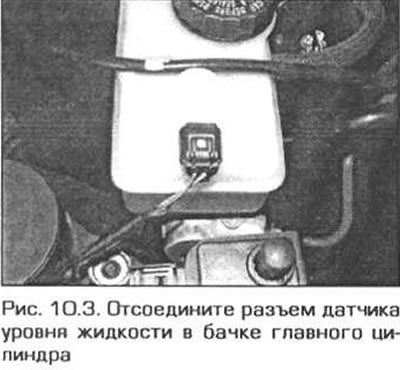
4. Disconnect the hose from the tank wall and plug the ends of the hose(s) to minimize leaks.
5. Unscrew the tank mounting screw (Fig. 10.5).
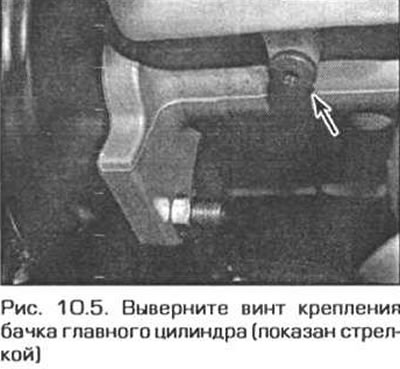
6. Carefully remove the reservoir from the top of the master cylinder. Remove the reservoir seals and plug the cylinder holes to prevent dirt from getting in.
7. Wipe clean the brake pipe connection area on the side of the master cylinder. Place rags under the pipe connections to absorb any leaking fluid. Note the correct position of the connections. Then unscrew the connection nuts and carefully disconnect the pipes. Plug the ends of the pipes and master cylinder ports to minimize leaks and prevent dirt from getting into the system. Rinse off any leaking fluid immediately with cold water.
8. Unscrew the two nuts and washers securing the master cylinder to the booster, remove and discard the master cylinder from the engine compartment. Remove the sealing ring from the back of the cylinder. Discard the ring as you will need a new one for installation.
Repair
9. If the master cylinder is faulty, it must be replaced. There are no repair kits for the master cylinder. The rear seal of the master cylinder and the seals of the reservoir must be replaced regardless of their condition.
Installation
10. Remove all dirt from the mating surfaces of the master cylinder and vacuum booster. Install a new O-ring into the groove on the back of the master cylinder body.
11. Install the master cylinder onto the booster so that the booster pushrod enters the master cylinder at the center. Install the new master cylinder mounting nuts and tighten them to the specified torque.
12. Wipe the brake pipe connections clean. Then connect them to the master cylinder and tighten securely.
13. Insert the reservoir into the holes of the master cylinder and securely tighten the screw of its fastening. Connect the hose and electrical wiring to the reservoir.
14. Fill the reservoir with new brake fluid and bleed the entire hydraulic system (see paragraph 2).
This article is available at russian, bulgarian, belarusian, ukrainian, serbian, croatian, romanian, polish, slovak, hungarian
Article verified: Ilyinsky Matvey
Share information:
Previous articles
БМВ E46: Brake system
Next articles
Similar articles on other types of BMW cars:
Removal and installation the clutch master cylinder BMW 5 Series E12 (1972-1981)
Removal and installation the clutch master cylinder BMW 5 Series E28 (1981-1988)
Removal and installation of the brake master cylinder and its… BMW 7 Series E38 (1994-2001)
Cylinder Head Cover — Removal and Installation BMW 7 Series E32 (1986-1994)
Removal and installation the clutch master cylinder BMW X3 E83 (2003-2010)
Removal and installation the lock cylinder BMW X5 E53 (1999-2006)
Removal and installation the clutch master cylinder BMW 5 Series E12 (1972-1981)
Removal and installation the clutch master cylinder BMW 5 Series E28 (1981-1988)
Removal and installation of the brake master cylinder and its… BMW 7 Series E38 (1994-2001)
Cylinder Head Cover — Removal and Installation BMW 7 Series E32 (1986-1994)
Removal and installation the clutch master cylinder BMW X3 E83 (2003-2010)
Removal and installation the lock cylinder BMW X5 E53 (1999-2006)
Link in different formats to this page
Visitor comments
No comments yet
- General information
- Manual
- Maintenance
- Power unit
- Engine repair
- Cooling system
- Power system (gasoline)
- Injection system (gasoline)
- Fuel system (diesel)
- Exhaust system
- Ignition system
- Charge and launch systems
- Transmission
- Car gearbox
- Clutch and drive shafts
- Chassis
- Brake system
- Suspension front and rear
- Steering
- Body
- Body care and repair
- Exterior
- Interior
- Electrical equipment
- Troubleshooting
- Lighting and signaling
- Equipment and devices
- Heater and air conditioner
- Electrical circuits
- General information
- Manual
- Repair on the road
- Weekly checks
- Maintenance
- Troubleshooting
- Power unit
- 4 cylinder engines
- 6 cylinder engines
- Engine overhaul
- Cooling and heating
- Fuel and exhaust system
- Starting and charging system
- Ignition system
- Transmission
- Clutch
- Mechanical gearbox
- Automatic gearbox
- Cardan and drive shafts
- Chassis
- Brake system
- Wheel suspension
- Steering
- Body
- Exterior
- Interior
- Electrical equipment
- Equipment and devices
- Electrical circuits
- General information
- Maintenance
- Power unit
- Engine repair
- Cooling system
- Ignition system
- Supply system
- Fuel injection system
- Exhaust system
- Transmission
- Clutch
- Car gearbox
- Front and rear axle
- Chassis
- Steering
- Brake system
- Body
- Exterior
- Interior
- Electrical equipment
- Heating system
- Equipment and devices
- Power devices
- Electrical circuits
- Power unit
- M10/M20 engine
- M40 engine
- Ignition system
- Lubrication system
- Cooling system
- Supply system
- Fuel injection
- Exhaust system
- Transmission
- Clutch
- Manual gearbox
- Front axle
- Rear axle
- Chassis
- Steering
- Brake system
- Body
- Exterior
- Interior
- Electrical equipment
- Heating system
- Equipment and devices
- Electrical circuits
- General information
- Specifications
- Operation and maintenance
- 4-cylinder engine
- Engine repair
- Cooling and lubrication system
- Supply system
- Ignition system
- 6-cylinder engine
- Engine repair
- Cooling and lubrication system
- Supply system
- Fuel injection system
- Ignition system
- Transmission
- Clutch
- 4-speed manual gearbox
- 5-speed manual gearbox
- Automatic gearbox
- Cardan and rear axle
- Chassis
- Steering
- Front suspension
- Rear suspension
- Brake system
- Electrical equipment
- Equipment and devices
- Electrical circuits