



- Home
- BMW 5 Series
- E34
- General information
- Manual
- Battery
Battery (BMW 5 Series E34)
The battery does not require maintenance (DIN 43 539/2), i.e. the initial charge of electrolyte should usually be enough for the entire service life.
If the electrolyte level drops below the norm, for example, due to prolonged stay in areas with hot climates, only distilled water should be added (and not acid).
Electrolyte level: the normal level corresponds to the mark on the battery case. In this case, the electrolyte in each section should be 5 mm higher than the plate level.
The top surface of the battery must always be dry and clean.
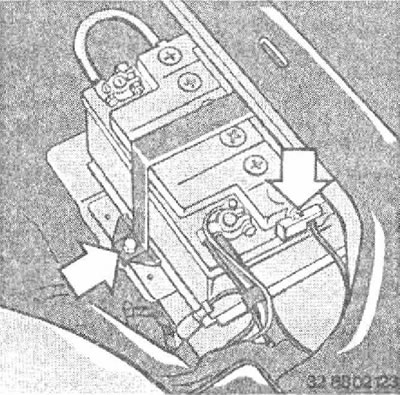
Important instructions:
1. Do not allow electrolyte or lead particles to come into contact with your eyes, skin or clothing. If this happens, rinse immediately with plenty of water, preferably with soda or soap. If necessary, consult a doctor.
2. Never short-circuit the battery terminals - an electrical spark with very high energy can cause injury.
3. Do not allow open flames or sparks near the battery - an explosion may occur.
4. Never disconnect the battery while the engine is running - a voltage surge in the on-board network will damage the car's electronics.
Removing the battery: First disconnect the wire from the negative terminal, then from the positive one. Battery under the rear seat: Loosen the holder screw and remove it.
When installing, connect the wire to the positive terminal first, then to the negative terminal. Make sure the battery is securely fastened.
5. Charging the battery without removing it from the vehicle is only permitted when the engine is not running.
Both wires should be disconnected from the battery terminals.
If the battery has a connection point in the engine compartment, then connect the charger to charge it (positive conclusion) — to this point and (negative conclusion) — to the vehicle's "mass" (see also item 4 in the section "Starting the engine from an external source").
6. Before performing any work on the electrical system, disconnect the negative cable from the battery.
7. If the car will not be used for more than 6 weeks, the battery must be removed, charged and stored in a cool, but frost-free room. No later than 3 months later, it must be recharged, otherwise it will not be possible to start the car from it. Each discharge - and especially a long one - reduces the service life of the battery.
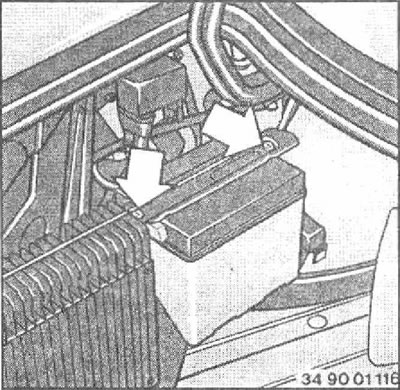
Follow the battery maintenance guidelines on the previous page.
To access this battery, remove the trim.
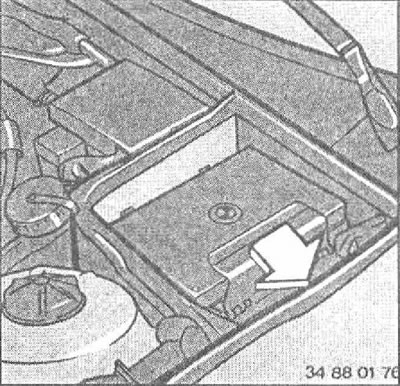
If any current consumer fails, it must be switched off and the corresponding fuse must be checked.
The fuse box with spare fuses, relays and plastic tweezers is located on the left side of the engine compartment.
Press the latch and open the lid.
Using plastic tweezers, remove the fuse of the failed electrical appliance from its socket. If the fuse is blown (what can be judged by the melted wire), then replace it with a new one, with the same color marking and rated for the same current.
Close the fuse box cover and replace the retainer.
If the fuse blows again, contact a BMW service center to have the problem fixed.
Other fuses are located under the rear seat on the left.
On the fuse box cover you will find a list of protected circuits and fuse ratings.
[The original text can be read on the website: «BMWMAN.ru»]
If the electrolyte level drops below the norm, for example, due to prolonged stay in areas with hot climates, only distilled water should be added (and not acid).
Electrolyte level: the normal level corresponds to the mark on the battery case. In this case, the electrolyte in each section should be 5 mm higher than the plate level.
The top surface of the battery must always be dry and clean.
Important instructions:
1. Do not allow electrolyte or lead particles to come into contact with your eyes, skin or clothing. If this happens, rinse immediately with plenty of water, preferably with soda or soap. If necessary, consult a doctor.
2. Never short-circuit the battery terminals - an electrical spark with very high energy can cause injury.
3. Do not allow open flames or sparks near the battery - an explosion may occur.
4. Never disconnect the battery while the engine is running - a voltage surge in the on-board network will damage the car's electronics.
Removing the battery: First disconnect the wire from the negative terminal, then from the positive one. Battery under the rear seat: Loosen the holder screw and remove it.
When installing, connect the wire to the positive terminal first, then to the negative terminal. Make sure the battery is securely fastened.
5. Charging the battery without removing it from the vehicle is only permitted when the engine is not running.
Both wires should be disconnected from the battery terminals.
If the battery has a connection point in the engine compartment, then connect the charger to charge it (positive conclusion) — to this point and (negative conclusion) — to the vehicle's "mass" (see also item 4 in the section "Starting the engine from an external source").
6. Before performing any work on the electrical system, disconnect the negative cable from the battery.
7. If the car will not be used for more than 6 weeks, the battery must be removed, charged and stored in a cool, but frost-free room. No later than 3 months later, it must be recharged, otherwise it will not be possible to start the car from it. Each discharge - and especially a long one - reduces the service life of the battery.
Battery* in the trunk
Follow the battery maintenance guidelines on the previous page.
Attention:
- To charge this battery, connect the charger to its terminals only.
- This battery cannot be used as an external source for starting the engine.
To access this battery, remove the trim.
Fuse box
If any current consumer fails, it must be switched off and the corresponding fuse must be checked.
The fuse box with spare fuses, relays and plastic tweezers is located on the left side of the engine compartment.
Replacing the fuse
Press the latch and open the lid.
Using plastic tweezers, remove the fuse of the failed electrical appliance from its socket. If the fuse is blown (what can be judged by the melted wire), then replace it with a new one, with the same color marking and rated for the same current.
Warning: Never replace blown fuses with "bugs"!
Close the fuse box cover and replace the retainer.
If the fuse blows again, contact a BMW service center to have the problem fixed.
Other fuses are located under the rear seat on the left.
On the fuse box cover you will find a list of protected circuits and fuse ratings.
[The original text can be read on the website: «BMWMAN.ru»]
This article is available at russian, bulgarian, belarusian, ukrainian, serbian, croatian, romanian, polish, slovak, hungarian
Article verified: Polikarpov Saveliy
Share information:
Previous articles
БМВ E34: Manual
Next articles
Similar articles on other types of BMW cars:
Battery, Generator and Starter Specifications BMW 3 Series E21 (1975-1983)
Starting the engine from an external battery BMW 3 Series E46 (1998-2006, petrol)
Starting the engine from an auxiliary battery BMW 7 Series E32 (1986-1994)
Checking and caring for your battery BMW 7 Series E38 (1994-2001)
Safety requirements for handling a car battery BMW X3 E83 (2003-2010)
Battery — care and charging BMW X5 E53 (1999-2006)
Battery, Generator and Starter Specifications BMW 3 Series E21 (1975-1983)
Starting the engine from an external battery BMW 3 Series E46 (1998-2006, petrol)
Starting the engine from an auxiliary battery BMW 7 Series E32 (1986-1994)
Checking and caring for your battery BMW 7 Series E38 (1994-2001)
Safety requirements for handling a car battery BMW X3 E83 (2003-2010)
Battery — care and charging BMW X5 E53 (1999-2006)
Link in different formats to this page
Visitor comments
No comments yet
- General information
- Governing bodies
- Manual
- Maintenance
- Power unit
- Engine repair
- Lubrication system
- Cooling system
- Ignition system
- Supply system
- Injection system (gasoline)
- Injection system (diesel)
- Exhaust system
- Transmission
- Clutch
- Car gearbox
- Front axle
- Rear axle
- Chassis
- Steering
- Brake system
- Wheels and tires
- Body
- Interior
- Exterior
- Heating system
- Electrical equipment
- Equipment and devices
- Power devices
- Windscreen wipers
- Electrical circuits
- General information
- Manual
- Maintenance
- Power unit
- Engine repair
- Ignition system
- Engine lubrication system
- Cooling system
- Fuel system (gasoline)
- Fuel system (diesel)
- Exhaust system
- Transmission
- Clutch
- Car gearbox
- Chassis
- Front and rear suspension
- Steering
- Brake system
- Body
- Exterior
- Interior
- Electrical equipment
- Heating system
- Equipment and devices
- Power devices
- Electrical circuits
- General information
- Manual
- Maintenance
- Power unit
- Engine in a car
- Engine overhaul
- Cooling system
- Supply system
- Ignition system
- Control system
- Transmission
- Clutch
- Manual gearbox
- Automatic gearbox
- Transmission line
- Chassis
- Steering
- Front suspension
- Rear suspension
- Brake system
- Body
- Body elements
- Car care and painting
- Electrical equipment
- Heater and air conditioner
- Equipment and devices
- Starter and generator
- Electrical circuits
- General information
- Operation and maintenance
- Specifications
- Power unit
- Engine repair
- Cooling and lubrication system
- Supply system
- Ecotronic power supply system
- Fuel injection system
- Ignition system
- Transmission
- Clutch
- Gearbox BMW 242/4
- Gearbox Getrag 262/8
- Gearbox Getrag 265/6
- Automatic gearbox
- Cardan gear
- Rear axle
- Chassis
- Steering
- Front suspension
- Rear suspension
- Brake system
- Electrical equipment
- Equipment and devices
- Electrical circuits